Fuel Cell Inspection AI

Catch cracks, burrs, coating defects, pinholes, and misaligned layers on every bipolar plate and MEA before the stack.
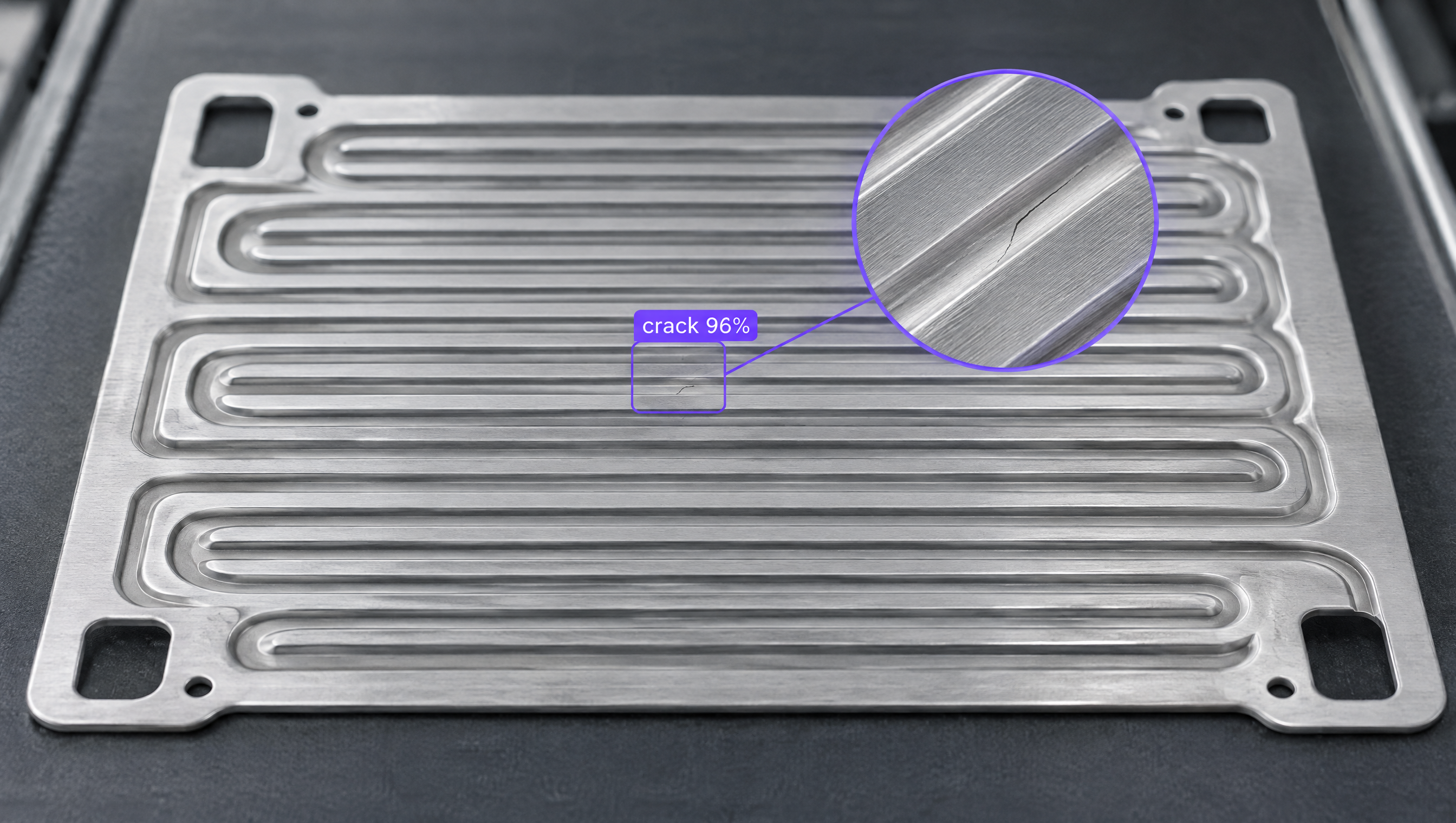
Automated visual inspection of a metal plate detecting a crack, shown with a bounding box and a magnified circular inset of the defect.

Fuel Cell Inspection AI for the Toughest Plate, MEA, and Stack Lines

  • Deploy Anywhere, Run Everywhere

    Run fuel cell inspection at stamping presses, coating and welding cells, roll-to-roll MEA lines, and stacking stations, on the edge, on-prem, air-gapped, in your VPC, or via API.

  • One Platform, Full Adoption

    Tools every fuel cell production team can adopt, from forming and coating process engineers to quality and stack assembly leads, no separate ML team required.

  • Secure, Compliant, and Audit-Ready

    Data stays safe with SOC 2 Type II compliance, encrypted data, and an uptime SLA, with an image and result saved for each plate and MEA serial.

  • Bipolar Plate Cracks & Necking
  • Stamping Burrs & Wrinkles
  • Coating Defects & Scratches
  • Half-Plate Weld Seams
  • MEA Pinholes & Catalyst Voids
  • Subgasket & GDL Alignment
“The vision AI solutions we developed with Roboflow have been a core component of connecting our teams and unlocking their ability to collaborate.”

Lou Stocco

Director of Manufacturing Advanced Analytics, USG

Talk to a Vision AI engineer who's shipped in manufacturing.

Bring us your toughest fuel cell inspection problem and we'll map a working solution.

Ask us about:

  • Solution architecture for plate forming, MEA, and stacking lines
  • A live demo on your own plate and MEA images
  • Deployment options: edge, on-prem, air-gapped, or VPC
  • ROI modeling against scrap, stack rework, and field failures

Over 80,000 organizations build with Roboflow.

  • Rivian
  • Pella
  • Chobani
  • USG Corporation
  • BNSF Railway
  • American Woodmark
Start where you are

Vision AI is transforming businesses

Customers across the board are solving complex challenges and driving meaningful impact.

  • Automotive customer

    $10 million

    Saved by automatically detecting defects on the production line

  • Logistics & freight company

    90%

    Less time spent manually tracking shipping inventory

  • Building materials supplier

    60%

    Lower customer return rate with improved product quality

Inspect Every Plate and MEA, from Forming to Stacking

Add a consistent inspection layer to fuel cell production with Roboflow Vision AI. Built for lines where a single stack holds hundreds of bipolar plates and MEAs connected in series, where one cracked plate or punctured membrane can drag down the whole stack, and where defects are small, rare, and easy to miss by eye at production rates.

Bipolar plate inspection:

MEA inspection:

  • Scan catalyst-coated membrane on the roll for pinholes, bubbles, scratches, and coating voids with web and film inspection.
  • Inspect gas diffusion layers and subgaskets for tears, wrinkles, and foreign material.
  • Verify that the membrane, GDLs, and subgasket sit in place before sealing, and check plate and MEA alignment at the stacking station.
  • Flag rare and never-seen defects with anomaly detection models trained on good parts only.

Connect to your line:

  • Run models on an edge device at the press, coater, or stacker.
  • Send pass or fail results to a PLC or over MQTT to reject a plate or MEA before it reaches the stack.
  • Store each image, result, and serial as a traceable record for root cause analysis and customer audits.

Bring intelligence to every cell today. Catch plate and MEA defects before they reach the stack, and keep a record of every call.

‍

Frequently asked questions

What is fuel cell inspection AI?

Fuel cell inspection AI uses computer vision models to check images of fuel cell components, such as bipolar plates, catalyst-coated membranes, gas diffusion layers, and assembled MEAs, and flag defects before the parts are stacked. It gives every part the same consistent check at line speed.

Which bipolar plate defects can it detect?

Visible forming and surface defects: cracks, necking, wrinkles, burrs, scratches, particles, and coating defects on metal plates, plus weld seam and sealing bead issues. For flow-field channel dimensions, pair it with dimensional inspection.

Can it inspect MEAs on a roll-to-roll line?

Yes. Cameras over the web send images to a model on an edge device, which flags each pinhole, bubble, or coating void with its location so that section can be cut out downstream.

What if we have very few defect images?

Start with anomaly detection, which trains on images of good parts only and highlights anything that looks different. As you collect and label defects, train a detection or segmentation model such as RF-DETR for each defect type.

Roboflow serves as the inspection engine, and your process and quality teams own the defect criteria and pass or fail rules.

‍