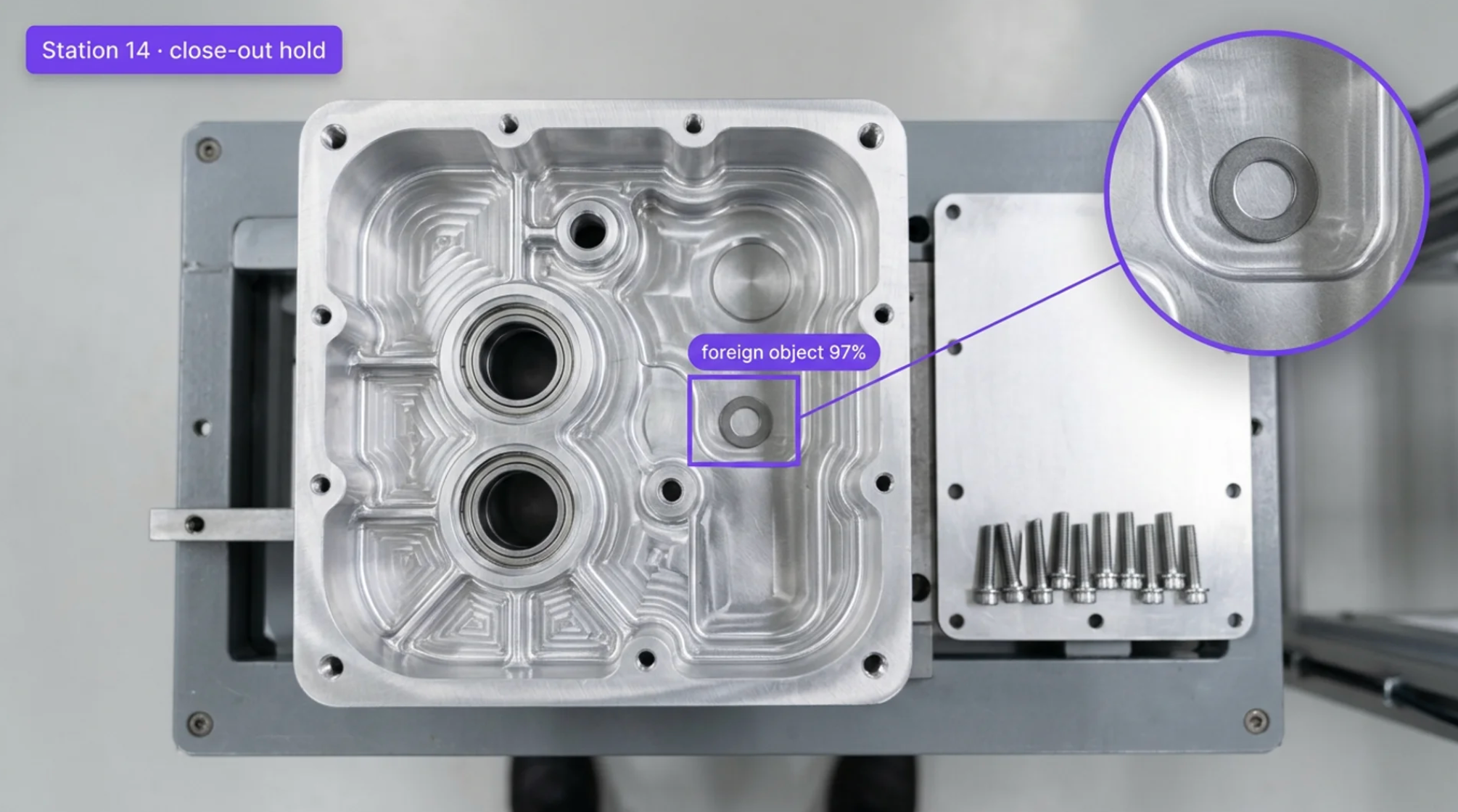
Add a real-time inspection layer to every assembly, cavity, and close-out with vision AI for foreign object detection for manufacturing. Built for the operations where a wire clipping left inside a harness bundle becomes an intermittent short two years into service, a washer that fell into a gearbox housing before the cover went on becomes a warranty teardown, and the mold cavity that still had a flash fragment in it takes the press down for a shift. Roboflow inspects every unit and every station for what should not be there, on the cameras your line already has, with a photo record behind every close-out.
FOD in Assemblies and Close-Outs:
- Detect loose hardware, wire clippings, tape, shims, and tools left inside cavities, housings, harness bundles, and enclosures before the cover, panel, or lid goes on
- Verify every close-out and sealed compartment against a clean-cavity reference, so the last look before the assembly is closed is a recorded inspection, not a glance
- Flag debris, chips, and sealant excess on mating surfaces, gaskets, and seal grooves, the FOD that turns into a leak instead of a rattle
FOD at Presses, Molds, and Machines:
- Check mold and die cavities for flash, fragments, and stuck parts before every cycle, so the press does not close on what the last shot left behind
- Detect chips, swarf, and broken tooling in fixtures, chucks, and work envelopes before the next part is loaded
- Flag dropped fasteners, stray components, and debris on conveyors, pallets, and nests between operations
Kitting, Packing, and Systems Integration:
- Verify kits and trays carry only what the pick list calls for, and flag the extra part, the wrong part, and the packaging fragment that should not be in the tray
- Inspect finished goods and packaging for stray components, desiccant, and shop debris before the box is sealed
- Hold the station or reject the unit through PLC and MES integration, with per-unit imagery and disposition records that support AS9100 and NAS 412 FOD programs, IATF 16949, and FDA 21 CFR 820
Bring intelligence to every close-out today.
More About Foreign Object Detection for Manufacturing
What is foreign object detection for manufacturing with Vision AI?
Foreign object detection for manufacturing with vision AI uses computer vision models on station, fixture, and line cameras to find what should not be there before it gets built in, closed up, or shipped: loose hardware, wire clippings, tape, shims, tools, chips and swarf, flash and fragments in mold and die cavities, debris on mating surfaces, and stray parts in kits, trays, and packaging. Models trained on your actual assemblies, cavities, and stations inspect every unit and every cycle against a clean reference, hold or reject through PLC and MES integration, and keep per-unit imagery that supports AS9100 and NAS 412 FOD prevention programs, IATF 16949, FDA 21 CFR 820, and customer audits. For food and beverage contamination, see foreign material detection in food.
Can Vision AI find a foreign object it has never seen before?
That is the defining problem in manufacturing FOD: the object is by definition not part of the product, it can be anything from a wire clipping to a glove fragment, and no one can label every possible thing that might end up in a cavity. The approach combines two methods. Detection models trained on your common FOD classes (the hardware, clippings, tape, and chips your line actually produces) catch the known offenders with high confidence. Anomaly detection trained on clean reference images of each cavity, fixture, and close-out flags anything that departs from the clean state, whatever it is, and routes it for review with the image. Camera placement and lighting are sized to the smallest object that matters at each station during solution design, and the honest tradeoff is that a cavity the camera cannot see into is a cavity that needs a different camera, not a better model.
Does this support our AS9100 and NAS 412 FOD prevention program?
Yes. AS9100 (the aerospace quality management standard, which requires foreign object prevention, detection, and removal controls), NAS 412 (the industry standard for FOD prevention programs, covering awareness, tool control, close-out inspection, and documentation), IATF 16949 for automotive, and FDA 21 CFR 820 for medical devices each expect that FOD-critical points are inspected and that the inspection is recorded. Vision-based FOD detection turns the close-out inspection from a signature on a traveler into a recorded, image-backed check on every unit, with the station, unit serial, timestamp, finding, and disposition attached. Roboflow is the inspection engine; your quality and FOD program owners define the critical points, the clean-cavity references, and the disposition rules that sit on top.
Can it integrate with our PLCs, MES, and quality systems?
Yes. Roboflow Inference (opens in a new tab) exposes a standard API and supports common industrial protocols, so FOD events flow into your existing systems: station and press PLCs from Allen-Bradley and Siemens holding the cycle or rejecting the unit, MES and ERP platforms like SAP and Oracle for travelers and serial-level records, quality systems like ETQ, MasterControl, and Sparta TrackWise for nonconformance and CAPA, and SCADA and HMI platforms like Ignition and AVEVA, through REST, MQTT, OPC UA, and direct database writes. PLC-level integration stops the press or blocks the close-out the moment a foreign object is found, and every event carries station, unit serial, operation, timestamp, imagery, and disposition, with a full audit trail behind every unit shipped.