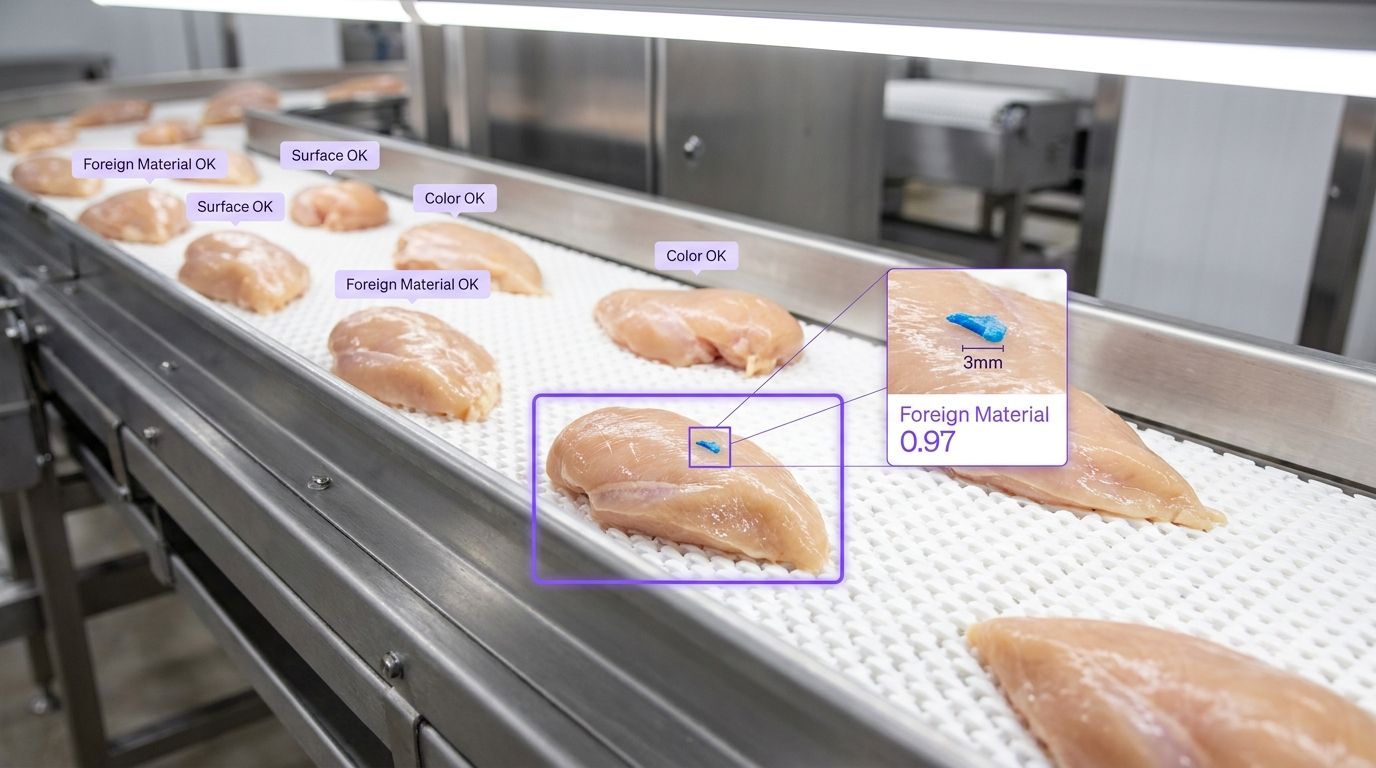
Add a real-time inspection layer to every product on the line with Vision AI for foreign material detection in food. Built for the operations where one missed plastic fragment from a broken equipment guard, glass shard from a containment failure, hair from a process drift, or piece of wood from a pallet can mean a Class I recall, a FDA Health Hazard Evaluation Board injury investigation, a FSMA enforcement action, or a consumer hospitalization that ends in litigation. Whether you're inspecting raw ingredients at intake, in-process product before packaging, finished cases before they ship, or running visual verification on borderline metal detector and X-ray rejects, Roboflow extends your QC coverage to every product on the line, in the washdown environments and temperature zones food manufacturing demands.
Low-Density Foreign Material (What Metal Detectors and X-Ray Miss):
- Catch plastic fragments, rubber gaskets, conveyor belt pieces, and equipment guard breakage that metal detection and X-ray cannot reliably see at production line speeds
- Detect hair, insect parts, and foreign vegetative material (stems, leaves, husks not part of the recipe) at SKU-level appearance
- Flag organic contamination and small foreign biological matter that density-based detection systems are blind to
High-Density Foreign Material (Co-Pilot for Metal Detectors and X-Ray):
- Add deep-learning visual verification on borderline metal detector and X-ray rejects to reduce false-positive scrap from over-sensitive thresholds
- Catch glass shards, stone or rock fragments, bone fragments in meat and poultry, and pit or shell fragments in nut products with visual deep learning that complements X-ray density-based detection
- Verify metal contamination visually after metal detector rejection to confirm true positives and document the contamination event for FSMA reporting
FSMA Compliance, Hazard Thresholds, and Recall Defense:
- Enforce FDA Health Hazard Evaluation Board guidance on hard or sharp foreign material in the 7 mm to 25 mm range that is considered hazardous in food
- Maintain validated inspection records that support FSMA preventive controls under 21 CFR Part 117, HACCP critical control points, USDA FSIS Directive 7160.3 (for meat and poultry), GFSI audits, and recall investigation traceability
- Trigger line-level reject and lot-hold actions through PLC and MES integration when foreign material criteria fail, with full audit trail for FSMA enforcement defense
Bring intelligence to every product today. Stop foreign material contamination from becoming Class I recalls, FDA Health Hazard Evaluation Board investigations, or hospitalized consumers.
Frequently asked questions
What is foreign material detection in food with Vision AI?
Foreign material detection in food with Vision AI uses computer vision models to inspect food products at every stage of manufacturing for foreign material contamination, including plastic fragments, rubber gaskets, conveyor belt pieces, glass shards, stone or rock fragments, bone fragments in meat and poultry, pit or shell fragments in nut products, wood splinters, hair, insect parts, foreign vegetative material (stems, leaves, husks not part of the recipe), and organic foreign biological matter. The system extends QC coverage to every product on the line, catching the low-density foreign material categories that metal detectors and X-ray systems are blind to and co-piloting those existing detection systems with deep-learning visual verification on borderline rejects.
Can Vision AI catch plastic, hair, and organic foreign material that metal detectors and X-ray systems miss?
Yes. Low-density foreign material is the highest-recall-risk contamination category in food manufacturing because existing detection systems have known blind spots and the consumer injury exposure is highest for hard or sharp foreign material that survives to finished product. Metal detectors catch ferrous, non-ferrous, and stainless metals but miss low-density plastic, rubber gaskets, conveyor belt pieces, equipment guard breakage, hair, insect parts, foreign vegetative material, and organic contamination. X-ray systems catch high-density contaminants (metal, stone, bone, glass when density-distinct from the product matrix) but miss low-density plastic, soft rubber, wood, hair, and organic matter, and are challenged by complex product geometry and density-matched glass shards that share density characteristics with the product.
Roboflow models add a deep-learning visual inspection layer trained on your actual product appearance, lot variation, and packaging variation, catching the categories existing detectors miss and co-piloting metal detector and X-ray systems by adding visual verification on borderline rejects (reducing false-positive scrap from over-sensitive thresholds).
Does foreign material detection in food support FDA Health Hazard Evaluation Board guidance, FSMA, HACCP, and USDA FSIS?
Yes. Roboflow models can be trained against your specific FDA FSMA preventive controls under 21 CFR Part 117 (Preventive Controls for Human Food), FDA Health Hazard Evaluation Board guidance on hard or sharp foreign material in the 7 mm to 25 mm range that is considered hazardous in food (especially for high-risk consumer populations including infants, the elderly, and surgical patients), HACCP critical control points (the universal hazard analysis framework required across food manufacturing), USDA FSIS Directive 7160.3 (Foreign Material Contamination in Meat and Poultry Products), USDA FSIS Notice 21-12, SQF (Safe Quality Food, GFSI-recognized), BRCGS (Brand Reputation Compliance Global Standards, GFSI-recognized), FSSC 22000 (FSSC food safety scheme, GFSI-recognized), ISO 22000 (Food Safety Management Systems), Codex Alimentarius international guidelines, and customer-specific co-packer foreign material control programs.
The system applies the same pass/fail logic your trained QA technicians and food safety leads use, against your written food safety plan and HACCP plan, and produces validated inspection records that support GFSI audits, FSMA enforcement defense, FDA Health Hazard Evaluation Board investigation defense, USDA FSIS oversight, recall investigations, retailer audits, and traceability requirements. Your food safety and QA teams own the foreign material control program; Roboflow provides the inspection engine that enforces it at line speed across every product.
Can it integrate with our metal detectors, X-ray systems, line PLCs, MES, and food safety management software?
Yes. Roboflow Inference (opens in a new tab) exposes a standard API and supports common food manufacturing automation protocols, so Vision AI foreign material detection events flow into your existing metal detectors, X-ray systems, optical sorters, line PLCs, MES, food safety management software, ERP, and traceability platforms. Customers integrate with metal detectors from Mettler-Toledo Safeline, Anritsu, Loma, and CEIA, X-ray systems from Eagle PI, Mettler X-ray, Loma X5, Ishida IX-G2, Sesotec, and Antares Vision, optical sorting equipment from TOMRA, Key Technology, and Bühler, line-level PLCs from Allen-Bradley, Siemens, and Mitsubishi, MES platforms (SAP, Oracle, Ignition, Wonderware, AVEVA), and food safety management software (Safefood 360°, FoodLogiQ, TraceGains, Trustwell) through REST, MQTT, OPC UA, and direct database writes, with PLC-level integration at HACCP critical control points.