Metal Surface Defect Detection AI
Catch scratches, dents, pits, corrosion, rolling defects, and coating anomalies on every metal part and coil before defects ship.
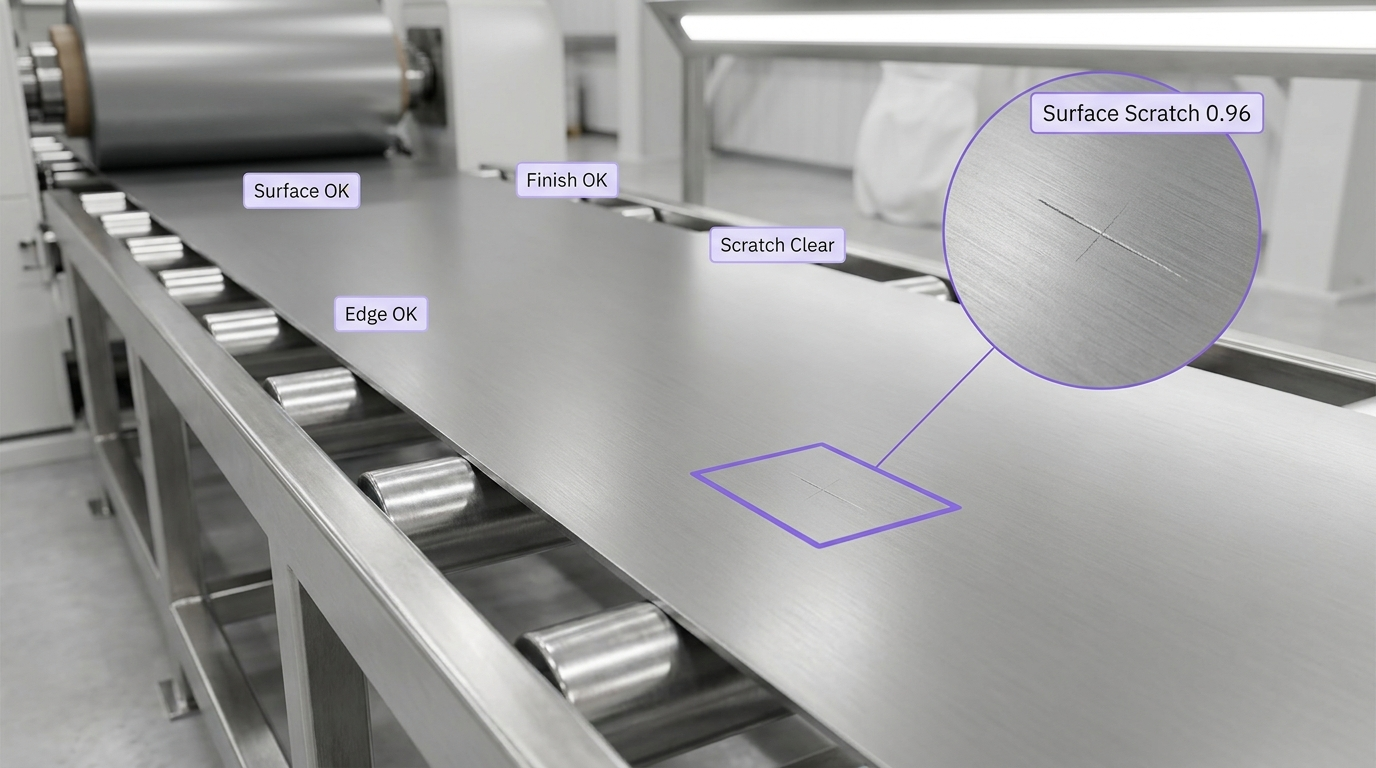
Metal Surface Defect Detection AI Across Sheet, Coil, Cast, Forged, and Machined Parts
Deploy Anywhere, Run Everywhere
Run metal surface defect detection on coil and strip lines, cast and forged part inspection cells, machined part QC stations, weld and coating verification, robot-mounted body-in-white inspection, and final QC checkpoints, on the edge, on-prem, in your VPC, or via API.
One Platform, Full Adoption
Tools every metal manufacturing team can adopt, from process engineers, QA inspectors, and metallurgists to plant managers, manufacturing engineering, and operations leadership.
Built for Metal Manufacturing Standards and Audit-Ready Records
Data stays safe with SOC 2 Type II, encrypted data, on-prem or air-gapped deployment, and an uptime SLA on every line. Audit-ready records support ASTM A1030, ASTM B610, ISO 4287, ISO 8501, IATF 16949, AS9100, and ISO 9001.
- Scratch, Abrasion & Tool Mark Detection
- Dent, Ding & Deformation Detection
- Corrosion, Rust & Stain Detection
- Pit, Inclusion & Roll Mark Detection
- Seam, Lap & Forging Defect Detection
- Coating, Plating & Anodizing Defects
“Roboflow has been instrumental in accelerating our deployment of innovative AI solutions.”
Travis Turnbull
Vice President & CIO, Pella Corporation
Talk to a Vision AI engineer who's shipped metal surface defect detection.
A single missed scratch on an automotive body panel, undetected corrosion on an aerospace forging, or rolling defect on coil destined for a customer can mean rework downstream, a warranty claim, an automotive recall on a deployed program, or a customer chargeback that erodes margin and Tier 1 supplier reputation. Bring us your toughest metal surface defect detection problem and we'll map a working solution.
Ask us about:
- Solution architecture for ASTM A1030, ASTM B610, ISO 4287, ISO 8501, IATF 16949, AS9100, ISO 9001, and customer-specific PPAP and APQP environments
- Live demo on your coil line footage, cast part imagery, machined part QC video, or finished metal samples
- Deployment options: edge, on-prem, air-gapped, robot-mounted, or VPC, with integration into mill PLCs, coil line monitoring, robot inspection cells, and MES
- ROI modeling against rework, scrap, warranty claims, customer chargebacks, recall risk, and field-failure exposure
Over 16,000 organizations build with Roboflow.
- Rivian
- Pella
- Chobani
- USG Corporation
- BNSF Railway
- American Woodmark
Catch Every Scratch, Pit, Rolling Defect, and Coating Anomaly, with Vision AI
Add a real-time inspection layer to every metal part and coil on the line with Vision AI for metal surface defect detection. Built for the operations where one missed scratch on an automotive body panel, undetected corrosion on an aerospace forging, mis-flagged rolling defect on coil destined for a customer, or coating anomaly on a finished part can mean rework downstream, a warranty claim, an automotive recall on a deployed program, a customer chargeback that erodes margin and Tier 1 supplier reputation, or a field-failure that ends in litigation. Whether you're inspecting hot-rolled and cold-rolled coil on the mill, cast or forged parts at the foundry, machined components in precision shops, welded assemblies, painted or plated finished parts, or robot-mounted inspection on automotive body-in-white, Roboflow extends QC coverage to every part on the line.
Coil, Sheet, and Strip Surface Defects:
- Catch scratches, abrasions, and tool marks across the full width of hot-rolled and cold-rolled coil at line speed
- Detect pits, inclusions, slivers, and rolling defects (roll marks, sticker marks, edge cracks) that grade-out coil from premium customers
- Flag stains, discoloration, and oxidation patterns that affect downstream coating adhesion and customer acceptance
Cast, Forged, and Machined Part Defects:
- Verify cast and forged surface integrity for seams, laps, cold shuts, surface porosity, and inclusion defects per ASTM acceptance criteria
- Catch machining tool marks, burrs, scratches, and dimensional surface anomalies on precision-machined components
- Detect weld surface defects (porosity, undercut, spatter, missed fusion) on welded assemblies and structural fabrications
Coating, Plating, and Final Surface QC:
- Inspect painted, powder-coated, anodized, and plated surfaces for coating defects (orange peel, fisheye, runs, sags, holidays, color drift) on every finished part
- Verify surface preparation and cleanliness per ISO 8501 before coating application across automotive, aerospace, and heavy equipment programs
- Maintain validated inspection records that support ASTM, ISO, IATF 16949, AS9100, customer-specific PPAP submissions, and field-failure traceability
Bring intelligence to every metal part today. Stop surface defects from becoming warranty claims, recalls, customer chargebacks, or field failures.
More About Metal Surface Defect Detection
What is metal surface defect detection with Vision AI?
Metal surface defect detection with Vision AI uses computer vision models to inspect metal parts and coils at every stage of manufacturing, catching scratches and tool marks, dents and deformation, pits and inclusions, rolling defects (roll marks, sticker marks, slivers, edge cracks), seams and laps in cast and forged parts, corrosion and stains, weld surface defects (porosity, undercut, spatter), and coating anomalies (orange peel, fisheye, runs, sags, holidays, color drift) across thousands of part configurations and surface finishes.
Can Vision AI catch the subtle metal surface defects that rule-based vision struggles with?
Yes. Subtle metal surface defects, lot-to-lot finish variation, and grade-specific defect morphology are exactly where rule-based and template-based machine vision systems feel the most pressure. Rule-based vision excels at deterministic measurement tasks with high-contrast features, fixed lighting, and consistent surface presentation, but struggles with metal surface defects because metal surfaces are reflective and specular (creating glare that breaks templating), defect morphology varies lot to lot (a roll mark on one batch looks different from another batch from the same mill), surface finish varies by alloy and processing (hot-rolled, cold-rolled, pickled, galvanized, and anodized all reflect light differently), and SKU complexity spans hundreds of grades, finishes, and customer-specific surface specifications.
Roboflow models add a deep-learning inspection layer trained on your actual product appearance, lot variation, and grade-specific characteristics, catching the defect categories rule-based vision struggles with and co-piloting existing surface inspection systems from ISRA Vision, Parsytec, AMETEK Surface Vision, and IMS Systems by adding visual verification on borderline rejects.
Does metal surface defect detection support ASTM A1030, ASTM B610, IATF 16949, and AS9100?
Yes. Roboflow models can be trained against your specific ASTM A1030 (Standard Test Method for Visual Examination of Steel Strip, Plate, and Sheet), ASTM B610 (Standard Specification for Aluminum Surface Defects), ASTM E165 (liquid penetrant testing), ASTM E709 (magnetic particle testing), ISO 4287 (Surface Texture), ISO 8501 (Surface Preparation Before Coating Application), ISO 1101 (Geometrical Product Specifications), IATF 16949 for automotive quality management, AS9100 and AS9110 for aerospace quality management, ISO 9001, NACE corrosion standards, and customer-specific PPAP and APQP acceptance criteria. Your metallurgy and quality teams own the acceptance criteria; Roboflow provides the inspection engine that enforces them at line speed across every part and coil.
Can it integrate with our mill PLCs, robot inspection cells, MES, eQMS, and ERP?
Yes. Roboflow Inference exposes a standard API and supports common metal manufacturing automation protocols. Customers integrate with mill-level PLCs from Allen-Bradley, Siemens, ABB, and GE, robot inspection cells from FANUC, ABB, KUKA, and Yaskawa, surface inspection systems from ISRA Vision (now Atlas Copco), Parsytec, AMETEK Surface Vision, and IMS Systems, mill MES platforms (PSI Metals, Quintiq, Aspen Technology, AVEVA), eQMS (MasterControl, Veeva Vault QMS, Sparta TrackWise, ETQ Reliance), and ERP (SAP, Oracle) through REST, MQTT, OPC UA, and direct database writes, with PLC-level integration to coil line speed controllers, robot pick decisions, and downstream sorting where pass/fail decisions need to drive line behavior.