Anomaly Detection AI

Flag scratches, dents, contamination, and missing parts on every item, trained only on images of good parts.
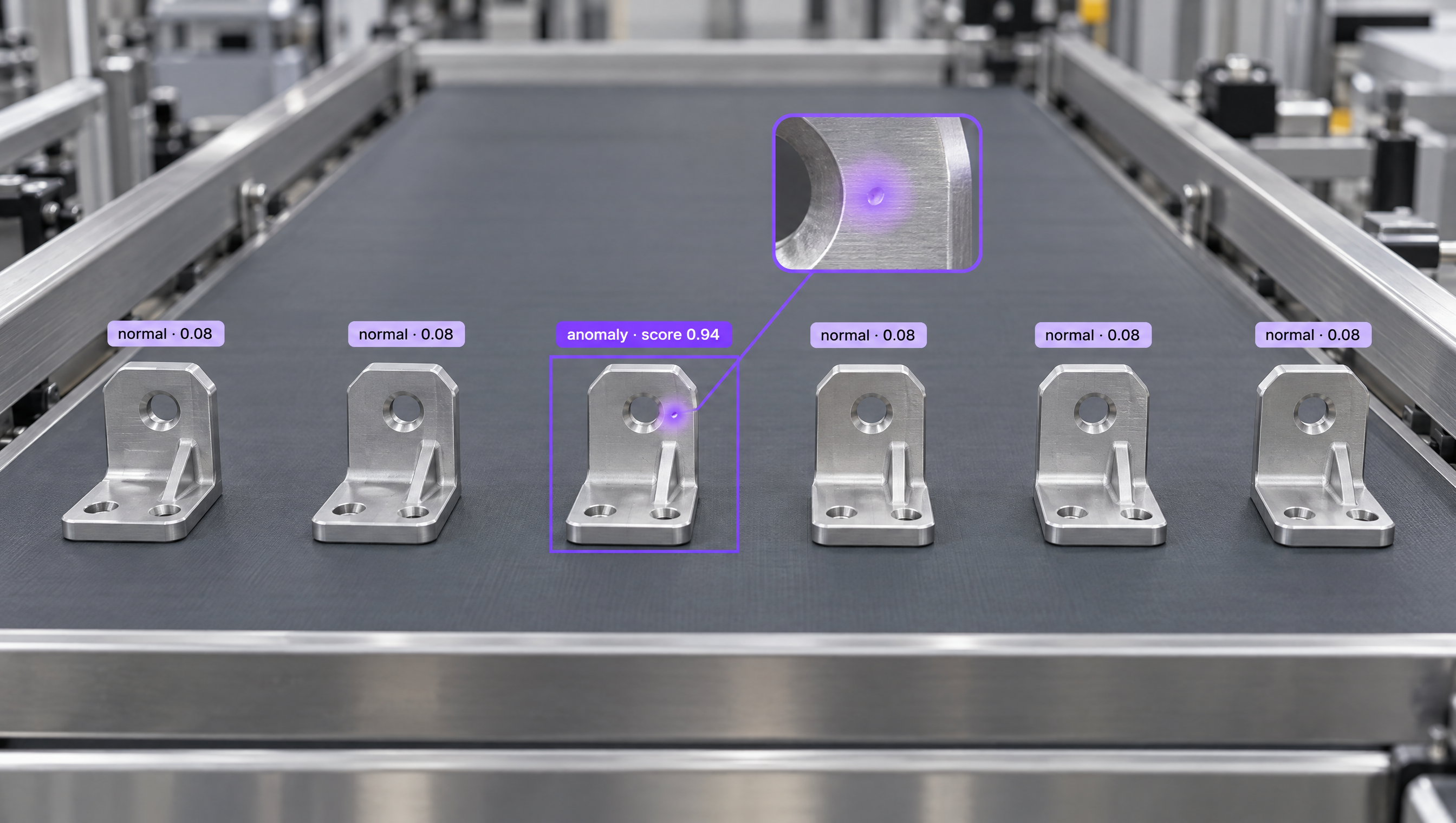
Anomaly Detection AI for the Toughest Production Lines

  • Deploy Anywhere, Run Everywhere

    Run anomaly detection at every inspection station and reject gate, on the edge, on-prem, air-gapped, in your VPC, or via API.

  • One Platform, Full Adoption

    Quality engineers collect images of good parts, train a model in minutes, and set the threshold themselves. No defect library and no separate ML team required.

  • Secure, Compliant, and Audit-Ready

    Data stays safe with SOC 2 Type II compliance, encrypted data, and an uptime SLA, with an anomaly score and heatmap kept for every flagged part.

  • Never-Seen Defect Types
  • Foreign Object Debris
  • Missing Components
  • Scratches, Dents & Cracks
  • Contamination & Inclusions
  • Color & Finish Shift
“The vision AI solutions we developed with Roboflow have been a core component of connecting our teams and unlocking their ability to collaborate.”

Lou Stocco

Director of Manufacturing Advanced Analytics, USG

Talk to a Vision AI engineer who's shipped anomaly detection in manufacturing.

Bring us your toughest inspection problem and we'll map a working solution.

Ask us about:

  • Solution architecture for your stations, reject gates, and quality system
  • A live demo trained on images of your own good parts
  • Deployment options: edge, on-prem, air-gapped, or VPC
  • ROI modeling against escapes, scrap, returns, and inspection labor

Over 80,000 organizations build with Roboflow.

  • Rivian
  • Pella
  • Chobani
  • USG Corporation
  • BNSF Railway
  • American Woodmark
Start where you are

Vision AI is transforming businesses

Customers across the board are solving complex challenges and driving meaningful impact.

  • Automotive customer

    $10 million

    Saved by automatically detecting defects on the production line

  • Logistics & freight company

    90%

    Less time spent manually tracking shipping inventory

  • Building materials supplier

    60%

    Lower customer return rate with improved product quality

Inspect Every Part Against Good, from the First Sample to the Reject Gate

Add a safety net to every inspection station with Roboflow anomaly detection. Built for production lines where defects are rare, new failure modes keep appearing, and nobody has hundreds of labeled examples of every crack, stain, or stray bolt.

Train on good parts only:

  • Train an anomaly detection model from images of normal parts, labeled only as normal, with no boxes or masks to draw.
  • Choose PatchCore, which trains in minutes, or FoundAD, built on a DINOv3 foundation model, for subtler defects.
  • Add a few known bad parts to set the threshold and report precision and recall before you go live.

See where and why a part was flagged:

  • Get an anomaly score and a pass or fail for every image, against a threshold you control.
  • Show a heatmap of where the part differs from normal, so operators can confirm a reject in seconds.
  • Crop to the part first with object detection, so backgrounds and fixtures stay out of the score, as shown in our guide to visual anomaly detection.

Run it on the line:

  • Deploy on Roboflow Serverless, on-prem, or on NVIDIA Jetson devices at the station.
  • Chain it in a Workflow with a defect detector, so known defects get named and everything else gets flagged.
  • Send every result to PLCs, MES, and reject mechanisms the moment a part is flagged.

Build your defect library as you go:

  • Review flagged parts and label the defects that matter to your customers.
  • Use those labels to train an RF-DETR detector for the defects that keep coming back.
  • Fill gaps for your rarest defects with synthetic defect images.

Bring a second set of eyes to every part today. Stop the defect nobody planned for from becoming an escape.

‍

Frequently asked questions

What is anomaly detection with Vision AI?

Anomaly detection with Vision AI learns what a good part looks like from images of normal parts, then scores every new image by how much it differs. Parts above the threshold are flagged with a heatmap showing where they differ, so you catch defects even when nobody has seen or labeled that type before.

What is the difference between PatchCore and FoundAD?

PatchCore compares each new image to a memory bank of patches from normal images and trains in minutes, which makes it a fast first model. FoundAD builds on a DINOv3 foundation model and takes longer to train, and catches more subtle defects. Train both on the same images in Roboflow and keep the one that fits your line.

Can it run on our line and connect to our systems?

Yes. Roboflow runs on-prem and fully air-gapped, on edge devices at the station, and sends scores and pass or fail results over OPC UA, MQTT, or REST to PLCs, MES, and reject mechanisms.

Roboflow serves as the inspection engine, and your quality team owns the threshold and the reject decisions.

‍