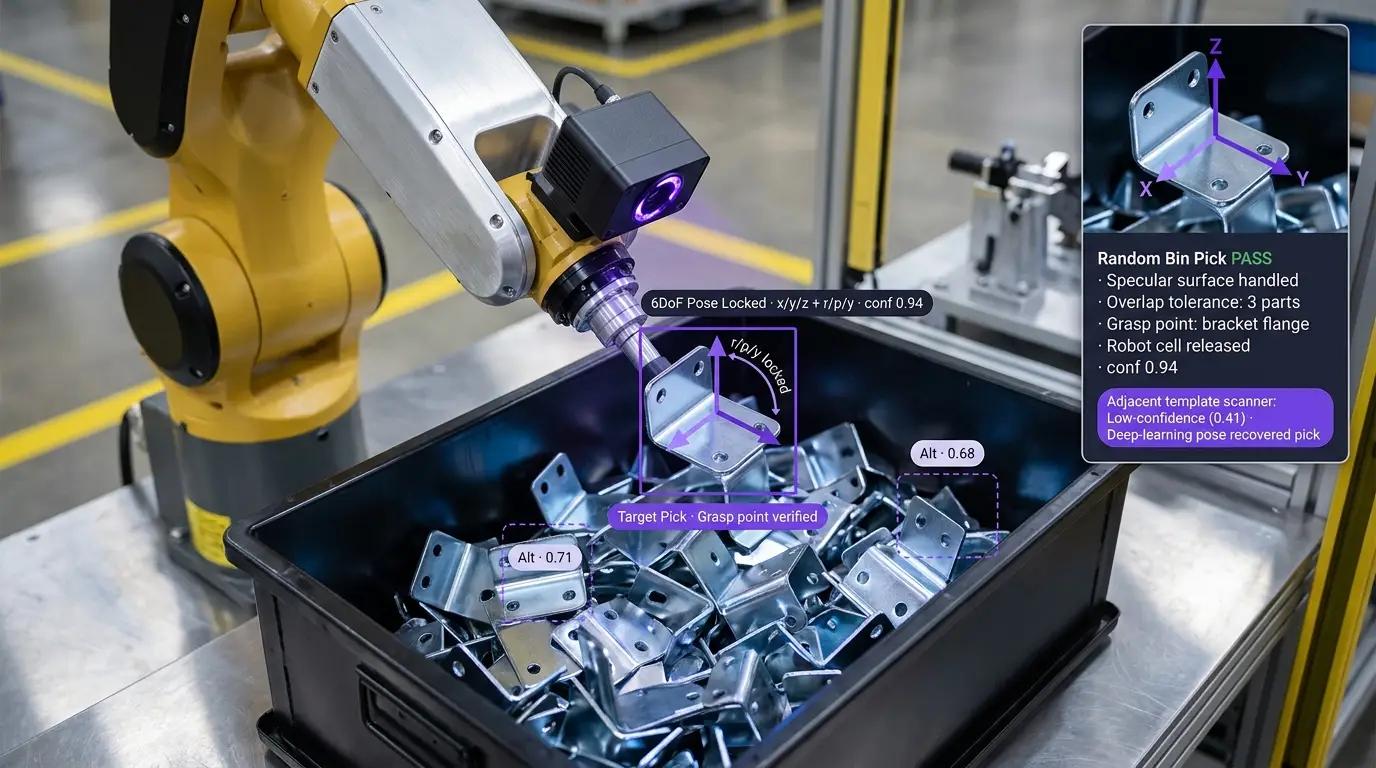
Add a real-time guidance layer to every robot on the line with Vision AI for robotic guidance and alignment. Roboflow extends robotic guidance coverage to every station, on the cameras and 3D sensors your robots already have.
6DoF Pose Estimation, Random Bin Picking, and Assembly Alignment:
- Estimate 6-degree-of-freedom pose (x, y, z, roll, pitch, yaw) on parts from cluttered bins, on shiny stamped brackets, on cast morphology surfaces, and on parts that vary lot to lot with subtle geometric differences that pattern-based localization templates cannot handle
- Handle random bin picking with overlapping parts, mixed-SKU bins, and reflective or specular surfaces (shiny fasteners, stamped steel, machined aluminum, black plastic, glossy medical device housings) where template matching feels the most pressure
- Verify assembly alignment on mating cycles (insulator-to-stator, connector-to-header, panel-to-fixture, weld-fixture-to-part, screw-to-thread), with pose-tolerance thresholds and success classification on every attempt
Robot-Mounted, Fixed-Mount, and Multi-Camera Deployment:
- Deploy on eye-in-hand (robot-mounted) 2D and 3D cameras for approach-and-verify sequences, eye-to-hand (fixed-mount) top-down and side-view cameras for bin and fixture localization, and structured-light, stereo, and ToF 3D sensors for full pose estimation
- Support multi-camera unified guidance: a single Roboflow inference across an eye-in-hand and an eye-to-hand camera on the same cell, with hand-eye calibration and coordinate-frame transformation handled at the API layer
- Camera-agnostic and sensor-agnostic: no proprietary vision hardware required, deploys on cameras and sensors from Basler, IDS, FLIR, LMI, Zivid, Photoneo, Mech-Mind, SICK, IFM, and standard USB or GigE cameras, or co-pilots existing dedicated robot vision systems from incumbent vendors
Robot Controller Integration, Safety, and Audit-Ready Records:
- Integrate with robot controllers from FANUC, ABB, KUKA, Yaskawa Motoman, Universal Robots, Stäubli, Kawasaki, Comau, Epson, Denso, Nachi, Mitsubishi, and Techman through native TCP/IP, EtherNet/IP, PROFINET, EtherCAT, and standard robot-vendor protocols, plus PLC control (Rockwell, Siemens, Beckhoff, Allen-Bradley, Omron) and MES (Rockwell PharmaSuite, Siemens Opcenter, GE Proficy, Ignition, Wonderware, AVEVA)
- Support ISO 10218 (industrial robot safety), ISO/TS 15066 (collaborative robot safety), ANSI/RIA R15.06 (US robot safety), IATF 16949 (automotive traceability), AS9100 (aerospace quality management), FDA 21 CFR Part 11 (electronic records) and Part 820 (medical device manufacturing), and PMMI/OMAC PackML (packaging state model), with validation records that support customer PPAP submissions and OEM traceability
- Log every guidance call with confidence, image crop, pose estimate, robot response, timestamp, and station ID for audit trail, warranty investigation, integrator handoff records, and IATF 16949, AS9100, and FDA Part 820 device history records
Bring intelligence to every robot cell today. Stop mis-picks, mis-alignments, and integrator revisits from becoming stalled lines, warranty escapes, audit findings, or blown manufacturing engineering budgets.
More About Robotic Guidance and Alignment
What is robotic guidance and alignment with Vision AI?
Robotic guidance and alignment with Vision AI uses computer vision models (opens in a new tab) to guide industrial and collaborative robots to the right part, the right fixture, and the right alignment on every cell. Coverage spans 6-degree-of-freedom (6DoF) pose estimation (x, y, z, roll, pitch, yaw), random bin picking on cluttered and overlapping parts, assembly alignment verification on mating cycles, palletizing and depalletizing, machine tending and CNC fixture alignment, weld seam tracking, dispense-path following, and hand-off cells.
Can Vision AI handle random bin picking on shiny, reflective, and overlapping parts that pattern-based localization struggles with?
Yes. Roboflow models are trained on your actual bin imagery, real part-mix, real fixture lighting, and real specular and reflective surfaces, and produce 6DoF pose estimates on parts that vary lot to lot, with confidence scores that let the robot controller decide between attempt, retry, or hand-off to a human.
Does robotic guidance and alignment support ISO 10218, ISO/TS 15066, IATF 16949, and AS9100?
Yes. Roboflow models can be trained to support robot cells operating under ISO 10218 (industrial robot safety requirements, Parts 1 and 2), ISO/TS 15066 (collaborative robot safety with power and force limiting), ANSI/RIA R15.06 (US robot safety), IATF 16949 (automotive quality management and traceability), AS9100 (aerospace quality management systems), AS9110 (aerospace maintenance organizations), FDA 21 CFR Part 11 (electronic records and signatures), FDA Part 820 (medical device manufacturing quality system regulation, including device history records and design history files), EU MDR, PMMI/OMAC PackML (packaging machine state model), and customer-specific PPAP submissions and OEM traceability requirements.
The system logs every guidance call with confidence, image crop, pose estimate, robot response, and station ID against the pass/fail logic your automation, controls, and quality teams already use, and produces validated guidance records that support customer PPAP submissions, IATF 16949 and AS9100 registrar audits, FDA Part 820 device history records, and integrator handoff documentation.
Can it integrate with our robot controllers, PLC, MES, and existing 3D vision hardware?
Yes. Roboflow Inference (opens in a new tab) exposes a standard API supporting common robot automation protocols. Customers integrate with robot controllers (FANUC R-30iB and iRVision-compatible workflows, ABB IRC5 and OmniCore with RobotStudio, KUKA KRC and KUKA.VisionTech-compatible workflows, Yaskawa Motoman DX and YRC1000, Universal Robots URCap, Stäubli CS9, Kawasaki E controllers, Comau C5G, Epson RC+, Denso RC8, Nachi FD, Mitsubishi RV, and Techman TMflow) through native TCP/IP sockets, EtherNet/IP, PROFINET, EtherCAT, and standard robot-vendor protocols, PLC control (Rockwell, Siemens, Beckhoff, Allen-Bradley, Omron), MES platforms (Rockwell PharmaSuite, Werum PAS-X, Siemens Opcenter, GE Proficy, Ignition, Wonderware, AVEVA), eQMS (MasterControl, Veeva Vault QMS, Sparta TrackWise, ETQ Reliance), ERP (SAP, Oracle, NetSuite, Infor), and existing 3D vision systems from incumbent vendors (co-pilot mode on borderline localization) through REST, MQTT, OPC UA, and direct database writes.