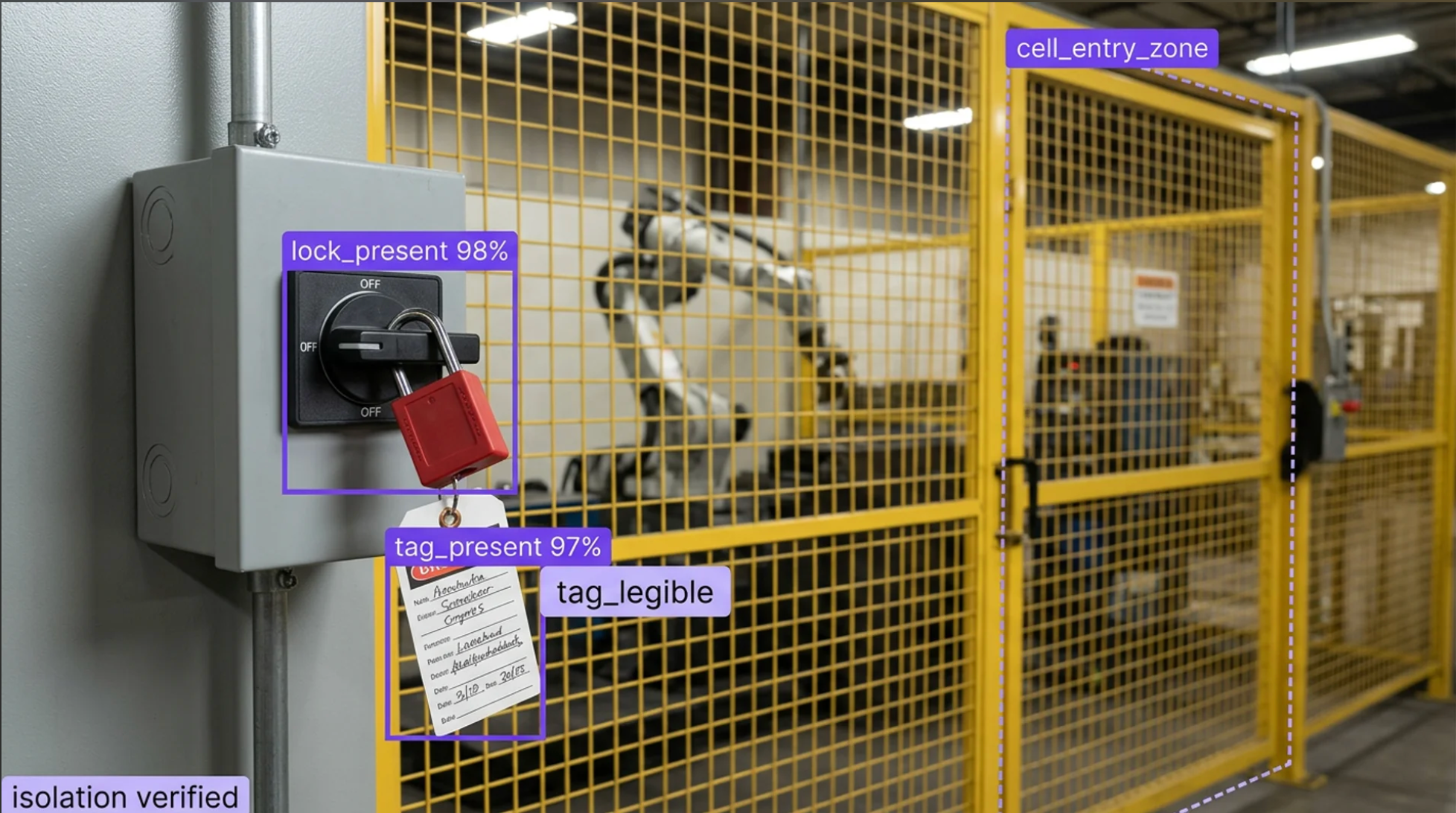
Bring real-time verification to every energy-isolation step on the floor with Roboflow vision AI for lockout tagout.
Verify the lock and tag on the isolation point:
- Detect a padlock and tag on a disconnect switch, breaker handle, valve wheel, or plug lock with a model trained on your own site footage, including the lock colors, hasps, and tag stock your program actually uses.
- Read the tag for legibility and required fields such as name, date, and equipment ID, and flag a tag that is blank, faded, or turned away from the camera.
- Count locks on a group lockbox and compare the count to the number of workers checked in on the job, so a missing personal lock is caught before anyone enters.
Tie lockout state to who is entering the machine:
- Define the machine guard, robot cell, or mixer entry as a zone on the same camera and raise an event when a person enters while the isolation point shows no lock.
- Sequence the record: lockout applied, entry, exit, lockout removed, so a lock pulled while a worker is still inside or a worker who enters before the lock is on becomes a logged deviation with a clip.
- Run the same model across the mixers, conveyors, palletizers, and packaging lines your worker presence detection and PPE detection already watch.
Document, integrate, and sit alongside rated safety devices:
- Publish lockout state to the PLC or historian over OPC UA or MQTT so the state is logged next to the machine's own run and stop signals, and push events to the EHS platform and the work order in the CMMS.
- Keep every verification as a time-stamped image or clip, which gives EHS the evidence for 29 CFR 1910.147(c)(6) periodic inspections and for incident review.
- Operate as a supplementary verification and documentation layer alongside rated interlocks, trapped-key systems, and safety relays, without replacing your ISO 13849 or IEC 62061 rated safety functions.
Bring verification to every lockout today.
Frequently asked questions
What is lockout tagout verification with Vision AI?
Lockout tagout verification with Vision AI uses existing plant cameras and a trained computer vision model (opens in a new tab) to confirm that the energy-isolation steps in a lockout procedure were carried out: a lock and tag are on the disconnect, breaker, or valve, the number of locks on a group lockbox matches the number of workers on the job, the tag is legible and filled in, and no one enters the machine guard or cell while the lockout state is absent. Each check is stored as a time-stamped image or clip and can be written to the PLC, EHS platform, or CMMS. It works as a supplementary verification and documentation layer alongside your written procedures and rated safety devices, with records that support OSHA 29 CFR 1910.147, 1910.333, ANSI/ASSP Z244.1, and ISO 45001 programs, and it fits alongside the EHS monitoring and safety zone monitoring many plants already run on the same cameras.
Can Vision AI reliably tell whether a lock is on a disconnect and read the tag?
Yes. A detection model trained on footage from your own disconnects, MCC panels, and valve stations learns what a padlock on a hasp, a lock on a breaker handle, and a tag on a valve wheel look like at that angle and lighting, and it learns the lock colors and tag stock your program issues. Tag fields are read with OCR from the same frame, and a tag that is too small, faded, or turned away is reported as unreadable rather than assumed correct.
Does lockout tagout verification support OSHA 29 CFR 1910.147 and ANSI/ASSP Z244.1?
Lockout tagout verification supports the documentation and periodic inspection expectations of OSHA 29 CFR 1910.147 (the control of hazardous energy standard, including the annual periodic inspection requirement in paragraph (c)(6)), OSHA 1910.333 (the electrical safety-related work practices standard covering lockout and tagging of circuits), ANSI/ASSP Z244.1 (the consensus standard for lockout, tagout, and alternative methods), and ISO 45001 (the occupational health and safety management system standard), by giving EHS a continuous, time-stamped record of locks applied, lock counts, tag condition, and entries. ISO 13849 and IEC 62061 (the functional safety standards that define performance levels and safety integrity levels for safety-related control systems) apply to rated interlocks, safety relays, and trapped-key systems. Vision AI on Roboflow is not a safety-rated device. It is a verification and documentation layer, not as a replacement for a rated safety function or for the authorized employee's own verification step. Roboflow serves as the detection engine, and your EHS, maintenance, and functional safety teams own the energy control procedures, the acceptance criteria, and the decision on how the control system responds.
Can it integrate with our PLC, EHS platform, and CMMS?
Yes. Roboflow writes lockout state, lock count, and entry events to a PLC variable over OPC UA or MQTT, so Allen-Bradley, Siemens, and Schneider controllers can log the state next to run and stop signals or hold a restart until a supervisor clears the flag. Events and clips can be sent over REST (opens in a new tab) or written to a database for SCADA and historian platforms such as Ignition and AVEVA, for EHS platforms such as Intelex, Cority, and VelocityEHS, and for CMMS systems such as SAP PM and Maximo, where each verification attaches to the maintenance work order that required the lockout. Where the same cameras cover confined space entry or line clearance, those events flow through the same integrations.