Confined Space Entry Monitoring AI
Know who went in, who is still inside, and whether the attendant ever left the opening.
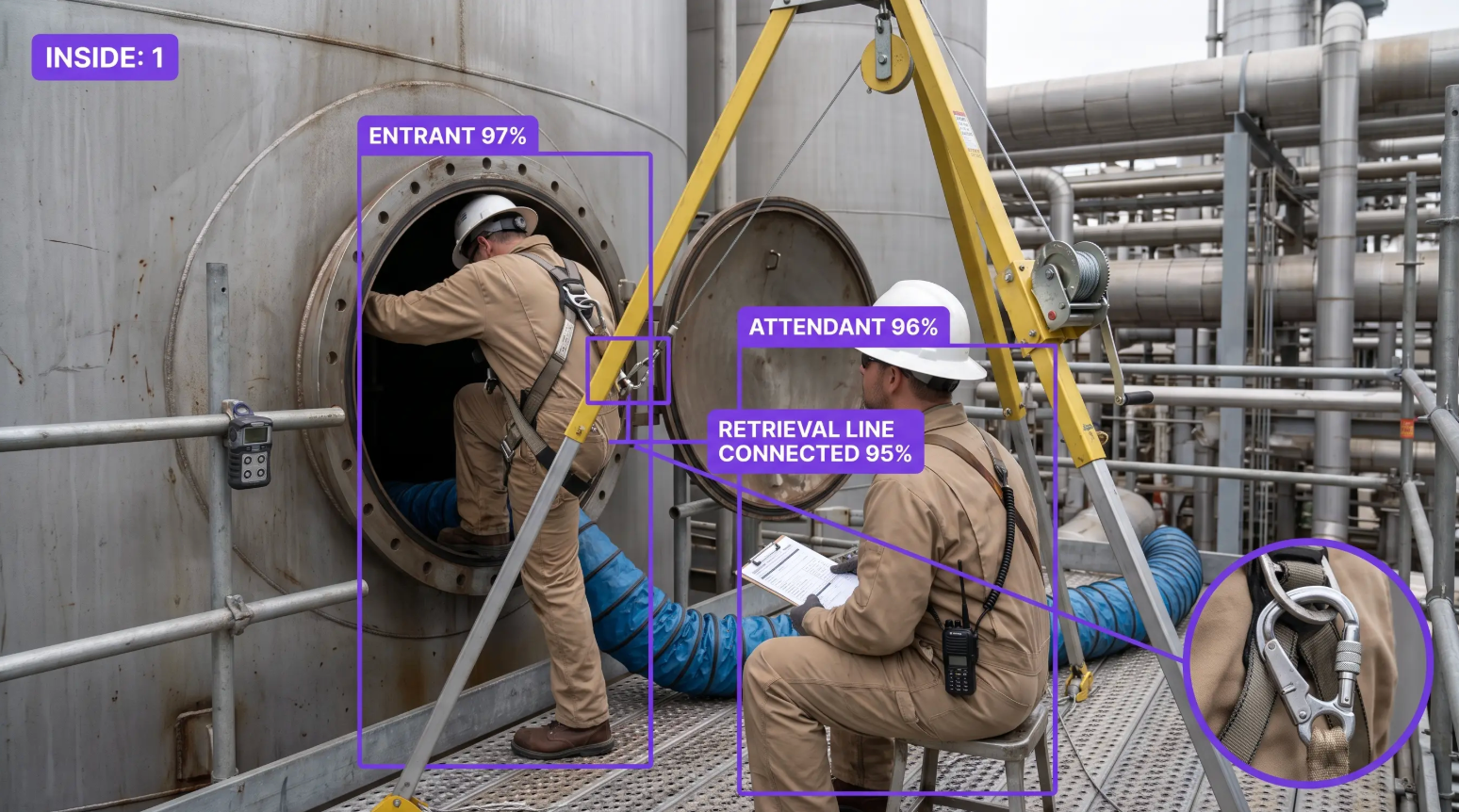
Confined Space Entry Monitoring AI Across Tanks, Vessels, Vaults, and Pits
Deploy Anywhere, Run Everywhere
Run confined space entry monitoring on portable mast and trailer cameras, fixed plant cameras, the edge, on-prem, in your VPC, or via API, wherever your tanks, vaults, digesters, and turnarounds need it.
One Platform, Full Adoption
Tools every safety organization can adopt, from EHS leads and permit writers to entry supervisors, turnaround planners, and contractor safety managers, no separate ML team required to ship and own detection models.
Secure, Compliant, and Audit-Ready
Data stays safe with SOC 2 Type II compliance, encrypted data, and an uptime SLA, with documentation that supports OSHA permit-required confined space rules (29 CFR 1910.146 and 1926 Subpart AA), NFPA 350, and ISO 45001 programs.
- Entrant & Attendant Presence
- Entry-Exit Headcount Reconciliation
- Permit, Barricade & Signage Checks
- Harness, Tripod & Retrieval Line
- Ventilation Blower & Gas Monitor
- Unauthorized Entry & Worker-Down
Talk to a vision AI engineer who's shipped confined space entry monitoring on live sites.
A single attendant who steps away from the opening, an entrant who never signed out, or a retrieval line left unhooked can mean a rescue that starts minutes late, an OSHA citation, or the second casualty that follows when a coworker climbs in after the first. Bring us your toughest confined space entry monitoring problem and we'll map a working solution.
Ask us about:
- Solution architecture for OSHA 29 CFR 1910.146, OSHA 1926 Subpart AA construction entries, NFPA 350, and ISO 45001 programs
- Live demo on your own entry footage, manway layouts, or turnaround camera positions
- Deployment options: portable mast and trailer cameras, fixed plant cameras, edge, on-prem, air-gapped, or VPC, with integration into permit-to-work systems and site alerting
- ROI modeling against rescue response time, permit audit hours, contractor compliance, and citation exposure
Over 16,000 organizations build with Roboflow.
- Rivian
- Pella
- Chobani
- USG Corporation
- BNSF Railway
- American Woodmark
Vision AI is transforming businesses
Customers across the board are solving complex challenges and driving meaningful impact.
- Automotive customer
$10 million
Saved by automatically detecting defects on the production line
- Logistics & freight company
90%
Less time spent manually tracking shipping inventory
- Building materials supplier
60%
Lower customer return rate with improved product quality