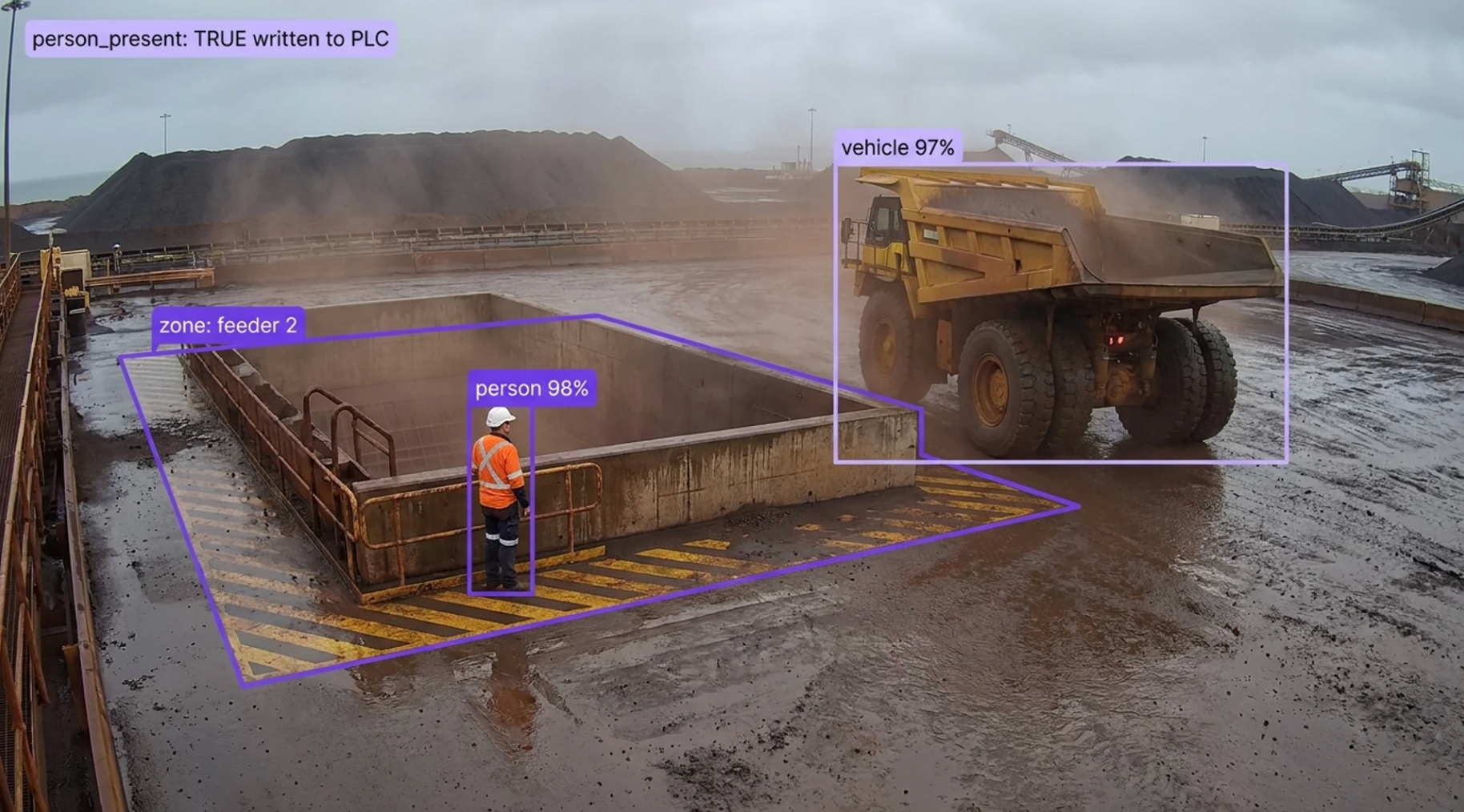
Bring real-time intelligence to every hazardous zone on site with Roboflow vision AI for worker presence detection.
Detect people, not trucks, in the zones that matter:
- Detect a person inside a defined zone on apron feeder, wet-dump, crusher, transfer point, robot cell, press brake, and dock cameras with a model trained on your own site footage, including rain, dust, night lighting, high-visibility vests, and partial views behind equipment.
- Discriminate person from haul truck, loader, forklift, and other vehicles so the zone logic reacts to a worker and not to every vehicle that enters.
- Tune the model and thresholds for recall over precision, because a false stop on a truck costs minutes and a missed person costs a life.
Debounce, zone logic, and PLC write-back:
- Apply time-based debounce so a worker who steps out of frame for a few seconds is not counted as having left the zone, and a worker who walks through is not counted as an intrusion until they dwell.
- Define zones per camera with entry, dwell, and clear rules, and configure people-zone timing per site without retraining the model.
- Write person/no-person to a PLC variable over OPC UA, Modbus, or MQTT so the feeder, crusher, robot, or press brake can interlock, slow, or hold until the zone is clear, and log every state change with a clip.
Scale across sites and sit alongside rated safety devices:
- Deploy one model across 70 streams today and 700 tomorrow with a deployment manager for edge devices at ports, pits, and plants where connectivity drops.
- Run alongside LiDAR safety scanners, light curtains, and safety mats as a supplementary detection layer that covers the angles and distances those devices do not, without replacing your ISO 13849 or IEC 62061 rated safety functions.
- Give EHS the record: every intrusion, every debounce decision, and every PLC write, with video, for incident review and MSHA or OSHA documentation.
Bring intelligence to every hazardous zone today.
Frequently asked questions
What is worker presence detection with Vision AI?
Worker presence detection with Vision AI uses existing site cameras and a trained computer vision model to determine whether a person is inside a defined hazardous zone such as an apron feeder, wet-dump area, crusher, conveyor transfer point, robot cell, press brake, or loading dock, and to report person/no-person to the control system that gates the equipment. The model is trained on your own site footage so it handles dust, rain, night lighting, and partial views, it tells a person apart from trucks and mobile equipment, and it applies time-based debounce so brief occlusions do not flip the state. It runs as a supplementary detection layer alongside light curtains, LiDAR scanners, and rated safety functions, with logging that supports OSHA 29 CFR 1910, MSHA 30 CFR, ISO 45001, and ANSI B11 programs.
Can Vision AI reliably tell a person from a truck in a dusty, poorly lit wet-dump area?
Person versus vehicle discrimination in a wet-dump or apron feeder area is one of the highest-stakes detection tasks in mining. A detection model trained on footage from your own cameras learns what a worker looks like at that angle and distance, in a vest, in rain, at night, and partially behind a truck, and it learns what a truck, loader, or forklift looks like so those do not trip the zone. We tune for recall: the threshold is set so a person is caught even at the cost of more false stops on ambiguous frames, and debounce logic then filters single-frame flickers before anything reaches the PLC.
Does worker presence detection support OSHA 29 CFR 1910 and ISO 13849?
Worker presence detection supports the documentation and monitoring expectations of OSHA 29 CFR 1910 (the general industry standards, including machine guarding under Subpart O and lockout/tagout under 1910.147), MSHA 30 CFR (the mine safety regulations covering surface and underground operations), and ISO 45001 (the occupational health and safety management system standard), by giving EHS a continuous record of zone intrusions and equipment responses. ISO 13849 and IEC 62061 (the functional safety standards that define performance levels and safety integrity levels for safety-related control systems) apply to certified safety-rated devices such as light curtains and safety scanners. Vision AI on Roboflow is not a certified safety-rated device, and we position it as a supplementary layer that extends coverage and feeds the control system, not as a replacement for a rated safety function. Roboflow serves as the detection engine, and your EHS, controls, and functional safety teams own the risk assessment, the zone definitions, and the decision on how the PLC responds.
Can it integrate with our PLC, safety system, and EHS platform?
Yes. Roboflow writes person/no-person and zone state to a PLC variable over OPC UA, Modbus TCP, or MQTT, so Allen-Bradley, Siemens, and Schneider controllers can use the signal in interlock, slow-down, or hold logic alongside inputs from SICK or Pilz safety scanners and light curtains. Events, clips, and state changes can be sent over REST or written to a database for SCADA and EHS platforms such as Ignition, AVEVA, Intelex, and Cority, and for incident review.