Safety Zone and Restricted Area Monitoring AI

Know who is in every zone, what is moving through it, and which combinations are not allowed, from the cameras you already have.
Shipping container with OCR output

Safety Zone Monitoring AI Across Warehouses, Plants, Construction Sites, Yards, and Mines

Deploy Anywhere, Run Everywhere

Run safety zone and restricted area monitoring on the cameras your site already has and an edge device on-site, on-prem, air-gapped, in your VPC, or via API, wherever your plants, warehouses, sites, and yards need it.

One Platform, Full Adoption

Tools every site team can adopt, from supervisors and safety coordinators to EHS managers, controls engineers, and operations leadership, no separate ML team required to ship and own zone models.

Secure, Compliant, and Audit-Ready

Data stays safe with SOC 2 Type II compliance, encrypted data, and an uptime SLA, with edge face blurring, retention controls, and zone-level reporting that respect worker privacy and support OSHA and internal incident review.
Restricted Area Intrusion Detection
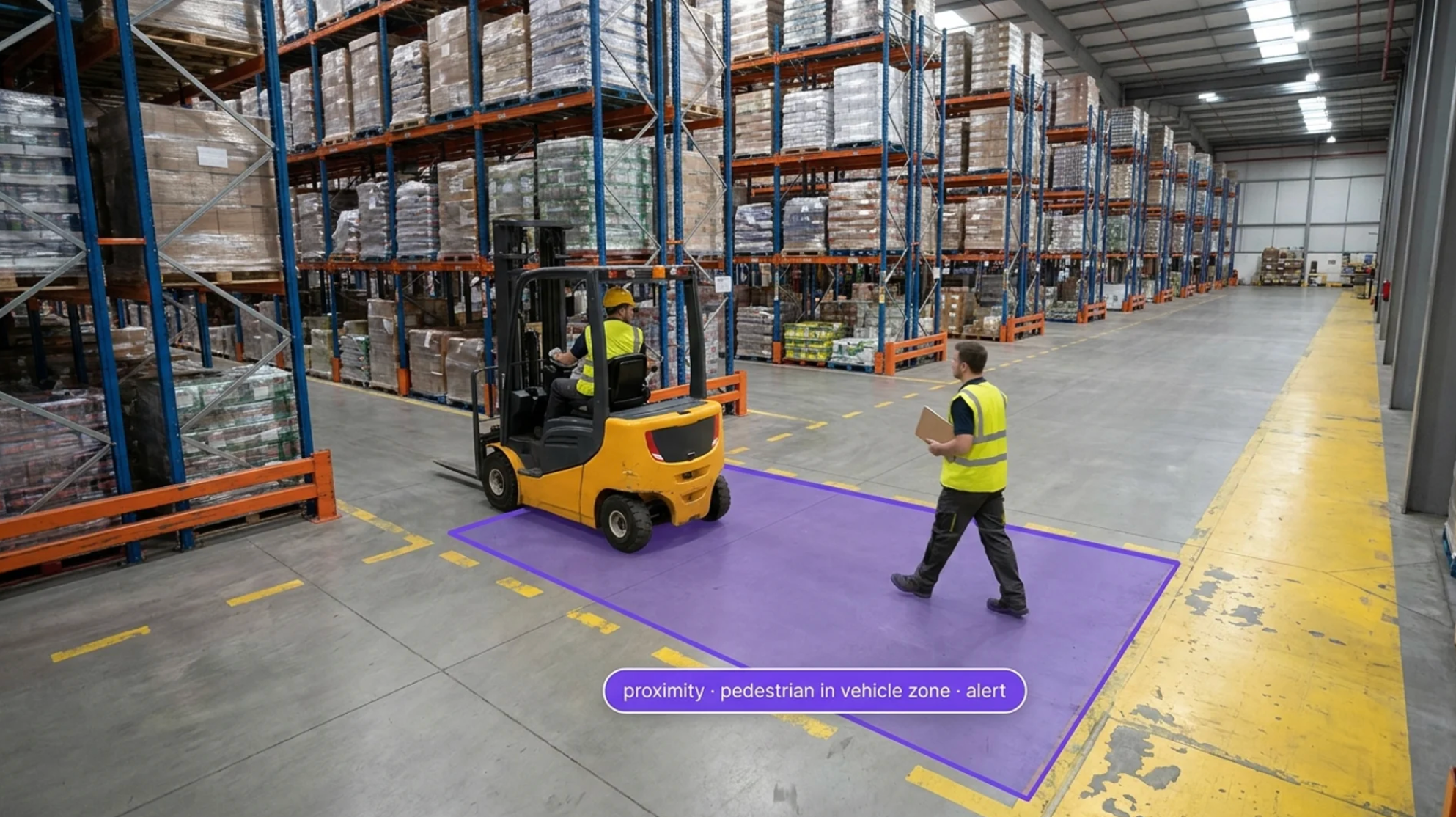
Pedestrian-Vehicle Proximity Alerts
Robot Cell & Machine Guarding Zones
Crane Swing & Drop Zone Monitoring
Confined Space & Permit Area Attendance
Near-Miss Recording & Zone Trends
Restricted Area Intrusion Detection
Pedestrian-Vehicle Proximity Alerts
Robot Cell & Machine Guarding Zones
Crane Swing & Drop Zone Monitoring
Confined Space & Permit Area Attendance
Near-Miss Recording & Zone Trends
Restricted Area Intrusion Detection
Pedestrian-Vehicle Proximity Alerts
Robot Cell & Machine Guarding Zones
Crane Swing & Drop Zone Monitoring
Confined Space & Permit Area Attendance
Near-Miss Recording & Zone Trends
Restricted Area Intrusion Detection
Pedestrian-Vehicle Proximity Alerts
Robot Cell & Machine Guarding Zones
Crane Swing & Drop Zone Monitoring
Confined Space & Permit Area Attendance
Near-Miss Recording & Zone Trends

Talk to a Vision AI engineer who's shipped zone monitoring on a live site.

Bring us your toughest safety zone monitoring problem and we'll map a working solution.
  • Solution architecture for warehouses, plants, construction sites, yards and ports, mines, and utilities, alongside existing guarding, light curtains, scanners, and access control
  • Live demo on your site camera footage, with the zone, lane, cell, or area where near misses happen most
  • Deployment options: existing cameras and an edge device on-site, on-prem, air-gapped, or VPC, with integration into PLCs, safety controllers, fleet systems, access control, and EHS platforms
  • ROI modeling against recordable injuries and near misses, citations and stop-work events, equipment downtime from interlocks, and insurance and workers' compensation costs
  • We will connect you with an AI subject matter expert on our team based on your answers.
    What challenges would you like to solve with vision AI?
    Where will you run vision AI?
    Are you replacing a current solution with AI or will this be a new solution?
    How many detections do you anticipate per month?
    Describe the business problem you would like to solve.
    Oops! Something went wrong while submitting the form.

    Over 16,000 organizations build with Roboflow.

    “Roboflow has been instrumental in accelerating our learning and deployment of innovative AI solutions”
    Travis Turnbull Vice President & CIO, Pella Corporation
    See customer stories
    Trusted by top manufacturers

    Vision AI is transforming manufacturing

    Customers are deploying solutions across the entire business and driving meaningful impact
    $0 million
    Saved by automatically detecting defects
    0%
    Less time spent manually tracking inventory
    0%
    Reduction in customer return rate

    Monitor Every Zone, Catch Every Intrusion, and Record Every Near Miss, with Vision AI

    Add a real-time zone layer to every camera on the site with vision AI for safety zone and restricted area monitoring.

    Restricted Area and Intrusion Detection:

    • Detect people entering restricted areas, robot cells, hazardous energy zones, electrical rooms, and exclusion zones drawn on any camera, with alerts, alarms, and equipment interlocks in real time
    • Detect tailgating and unauthorized entry at controlled doors, gates, and turnstiles, and verify that only authorized headcount is inside a zone
    • Track zone occupancy and dwell, so a person who has been in a hazardous area longer than the permit allows is flagged before the shift ends

    Vehicle, Equipment, and Proximity Zones:

    • Detect people in forklift, AGV, and truck lanes, in the swing radius of cranes and excavators, and behind reversing vehicles, and alert the operator and the pedestrian at the moment of proximity
    • Enforce pedestrian-vehicle separation, one-way lanes, and crossing points, so a near miss is recorded with the clip and the pattern is fixed rather than forgotten
    • Detect people under suspended loads, inside drop zones, and within machine guarding boundaries when equipment is running

    Permits, Confined Spaces, and Systems Integration:

    • Monitor confined space entries and hot work areas for attendant presence, entrant count, and permit windows, so a missing attendant is an alert rather than a citation
    • Trend intrusions and near misses by zone, shift, and contractor, so the lane everyone cuts through and the cell whose guarding gets bypassed on nights show up as patterns
    • Push events, clips, and zone states into safety, access control, and equipment systems through PLC and API integration, with a video record behind every alert and every near miss

    Bring intelligence to every zone today.

    More About Safety Zone and Restricted Area Monitoring

    What is safety zone monitoring with Vision AI?

    Safety zone and restricted area monitoring with vision AI uses the cameras a site already has and deep-learning models to detect people, vehicles, and equipment, place them against zones defined on each camera view, and enforce the rules that apply to each zone: no entry, authorized headcount only, no pedestrians while a vehicle is present, attendant required, maximum dwell, and equipment interlocked when a person is inside. Events trigger alerts to the person and the supervisor, alarms and stack lights at the zone, and interlocks through the PLC, and every event is recorded with the clip, so near misses are counted and patterned rather than lost. It complements physical guarding, light curtains, and access control by covering the areas and situations those systems do not, and it is the zone-and-proximity counterpart to PPE detection, which checks what a person is wearing rather than where they are.

    How is this different from light curtains, laser scanners, and access control?

    Those systems are excellent at the point they protect and blind everywhere else. A light curtain guards one plane at one machine opening; a laser scanner covers a fixed area at floor level; access control knows who badged through a door and nothing about who followed them. Vision zones are drawn anywhere a camera sees, cover large and irregular areas like a crane swing radius or a truck apron, distinguish a person from a pallet, and understand combinations, a person in a lane is fine and a person in a lane with a forklift approaching is not. They also work on the sites that have no fixed guarding at all, construction, yards, ports, and outdoor plants. For machine safety functions with a required performance level, the safety-rated device stays in place; vision adds the layer that catches the bypass, the reach-over, and the person who walked in from the side.

    How does this handle worker privacy?

    Zone monitoring is about position and situation, not identity, and deployments are built that way. Models detect people as people, not as individuals; faces can be blurred at the edge before any frame is stored; clips are retained by your policy and used for safety review; and reporting is by zone, shift, and contractor rather than by named worker unless your program chooses otherwise. Most sites introduce the system with the workforce and the safety committee, and the framing that holds up is that the system warns the person in the zone in the moment, and the near-miss data goes to fixing the lane, the cell, or the procedure. Roboflow supplies the controls; your site sets the policy.

    Can it integrate with our safety systems, PLCs, and access control?

    Yes. Roboflow Inference runs on an edge device at the site and exposes a standard API and common industrial protocols, so zone events, states, and clips flow into your existing systems: PLCs and safety controllers from Allen-Bradley, Siemens, and Pilz for interlocks and slow-downs, forklift and AGV fleet systems for proximity alerts, access control and visitor systems, EHS and incident management platforms, stack lights, horns, and wearable alerts, and messaging into Slack, Microsoft Teams, radio, and SMS, through REST, MQTT, OPC UA, discrete I/O, and webhooks. PLC-level integration stops or slows the equipment when a person enters the zone, and every event carries camera, zone, rule, timestamp, object classes, and the clip, with a full record behind every alert and every near miss for OSHA and internal review.

    Stay Connected

    Get the Latest in Computer Vision First

    Thank you for subscribing!
    Oops! Something went wrong!.
    Unsubscribe at any time. Review our Privacy Policy.

    Additional resources

    Vision AI is transforming every industry. Let’s transform yours.