Kiln Monitoring AI

Find shell hot spots, watch the flame and burning zone, and track clinker, rings, and cooler conditions on every kiln.
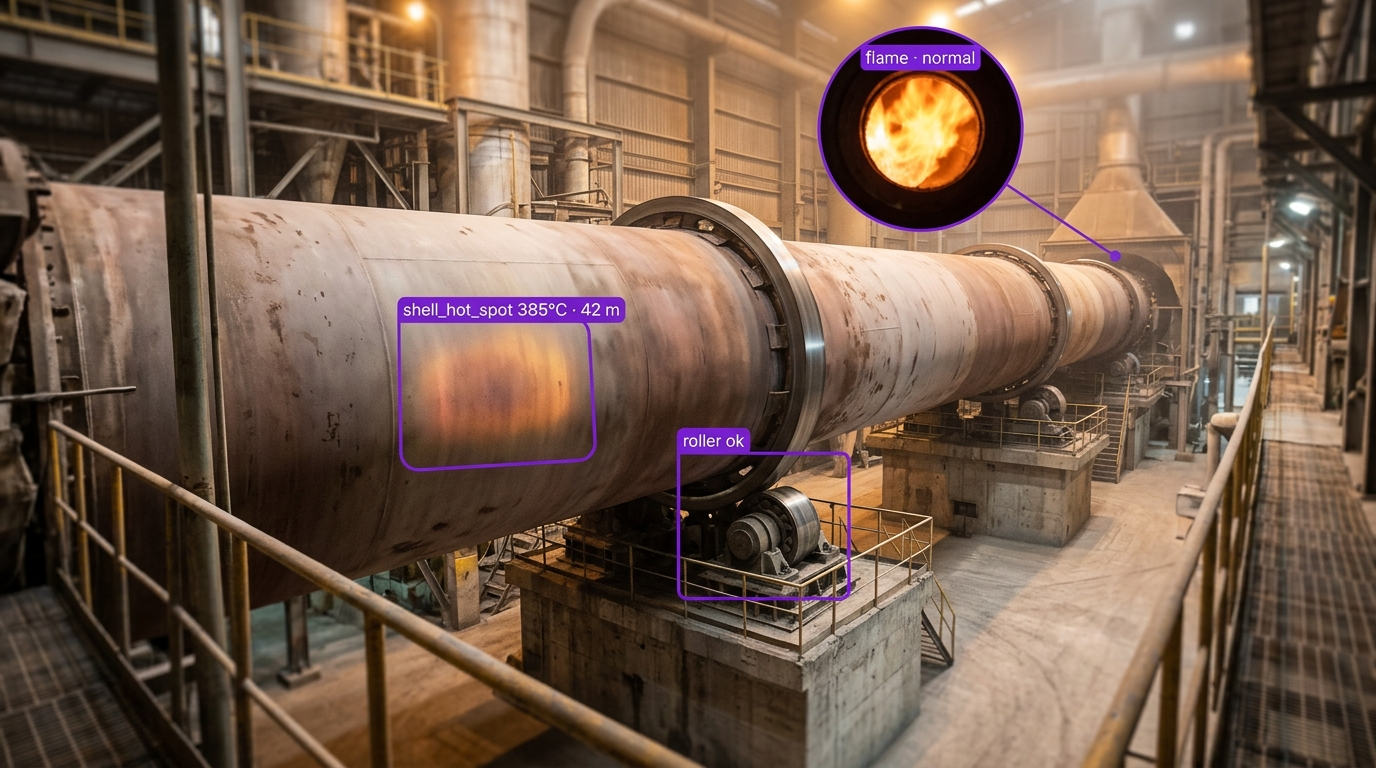
An industrial rotating kiln with AI monitoring displaying a 385°C shell hot spot, 'roller ok', and a 'normal' flame.

Kiln Monitoring AI for the Toughest Cement, Lime, and Minerals Plants

  • Deploy Anywhere, Run Everywhere

    Run kiln monitoring on visual and thermal cameras at the shell, burner, inlet, and cooler, on the edge, on-prem, in your VPC, or via API.

  • One Platform, Full Adoption

    Tools every kiln team can adopt, from control room operators and kiln burners to process, refractory, and maintenance engineers, no separate ML team required.

  • Secure, Compliant, and Audit-Ready

    Data stays safe with SOC 2 Type II compliance, encrypted data, and an uptime SLA, with a timestamped record of every hot spot, alarm, and upset.

  • Shell Hot Spots & Red Spots
  • Burning Zone Flame Shape
  • Coating Loss & Ring Formation
  • Inlet & Riser Build-Up
  • Clinker Size & Cooler Red River
  • Tire, Roller & Girth Gear Condition
“The vision AI solutions we developed with Roboflow have been a core component of connecting our teams and unlocking their ability to collaborate.”

Lou Stocco

Director of Manufacturing Advanced Analytics, USG

Talk to a Vision AI engineer who's shipped in building materials.

Bring us your toughest kiln monitoring problem and we'll map a working solution.

Ask us about:

  • Solution architecture that fits your kilns, coolers, cameras, and control system
  • A live demo on your own kiln and cooler footage
  • Deployment options: edge, on-prem, air-gapped, or VPC, on visual and thermal cameras
  • ROI modeling against unplanned stops, refractory costs, fuel use, and off-spec clinker

Over 80,000 organizations build with Roboflow.

  • Rivian
  • Pella
  • Chobani
  • USG Corporation
  • BNSF Railway
  • American Woodmark
Start where you are

Vision AI is transforming businesses

Customers across the board are solving complex challenges and driving meaningful impact.

  • Automotive customer

    $10 million

    Saved by automatically detecting defects on the production line

  • Logistics & freight company

    90%

    Less time spent manually tracking shipping inventory

  • Building materials supplier

    60%

    Lower customer return rate with improved product quality

Watch Every Kiln, from the Inlet to the Cooler

Add a real-time monitoring layer to every kiln with Roboflow vision AI for kiln monitoring. Built for rotary kilns in cement, lime, and iron ore pellet plants, and for tunnel and shuttle kilns in ceramics and refractories, where a lost patch of coating shows up as a red spot on the shell, a ring can choke the kiln for hours, and the burner watches the flame through one screen in a busy control room.

Shell and refractory:

  • Map shell temperature along the full kiln with thermal cameras and flag hot spots that point to lost coating or thin refractory.
  • Trend each section of the shell over the campaign so relines are planned before a red spot forces a stop.
  • Watch tires, support rollers, and the girth gear for heat and wear, alongside hot bearing detection.

Burning zone and process:

  • Classify flame shape, length, and position from the burning zone camera, and flag flame impingement on the coating.
  • Detect ring formation, coating build-up, and falling coating inside the kiln.
  • Spot build-up at the kiln inlet and riser before it restricts gas flow.

Cooler, clinker, and people:

  • Measure clinker size at the kiln outlet and cooler, alongside size and gradation analysis.
  • Detect red river, snowmen, and an uneven bed on the grate cooler.
  • Detect people near the kiln hood, cooler, and shell during upsets, and check their PPE.

Bring intelligence to every kiln today. Stop hot spots, rings, and cooler upsets from becoming unplanned stops, relines, and off-spec clinker.

‍

Frequently asked questions

What is kiln monitoring with Vision AI?

Kiln monitoring with Vision AI uses visual and thermal cameras along the shell and at the burner, inlet, and cooler, and a trained computer vision model (opens in a new tab) to map shell temperature, watch the flame and burning zone, detect rings and build-up, and track clinker and cooler conditions. It pairs with conveyor belt monitoring on the raw meal and clinker belts and ceramic defect detection for products out of tunnel kilns.

Which kilns does it work on?

Rotary kilns for cement clinker, lime, and iron ore pellets, along with tunnel, shuttle, and roller kilns for ceramics, brick, refractories, and sanitaryware. Any kiln with a camera view of the shell, the flame, the inlet, or the outlet is a fit.

Can it use the cameras already on our kiln?

Yes. Roboflow runs on video from the burning zone, inlet, cooler, and thermal cameras you already have, over RTSP streams, and adds detection on top: each hot spot is tagged with its position along the kiln, flame and cooler conditions are classified, and an alert goes out when something changes.

Can it integrate with our kiln control system, PLCs, and historian?

Yes. Roboflow sends hot spots, temperatures, and alerts over OPC UA, MQTT, or REST (opens in a new tab), or writes them to a database, so they feed the kiln control system, a PLC for alarms, and plant historians.

Roboflow serves as the monitoring engine, and your process, refractory, and safety teams own the limits, alarms, and response.

‍

Stay connected

Get the Latest in Computer Vision First

Unsubscribe at any time. Review our Privacy Policy.