Hot Bearing Detection AI
Find overheating idlers, pulley bearings, and wheel bearings, and give maintenance time to change it before it seizes, starts a belt fire, or causes a derailment.
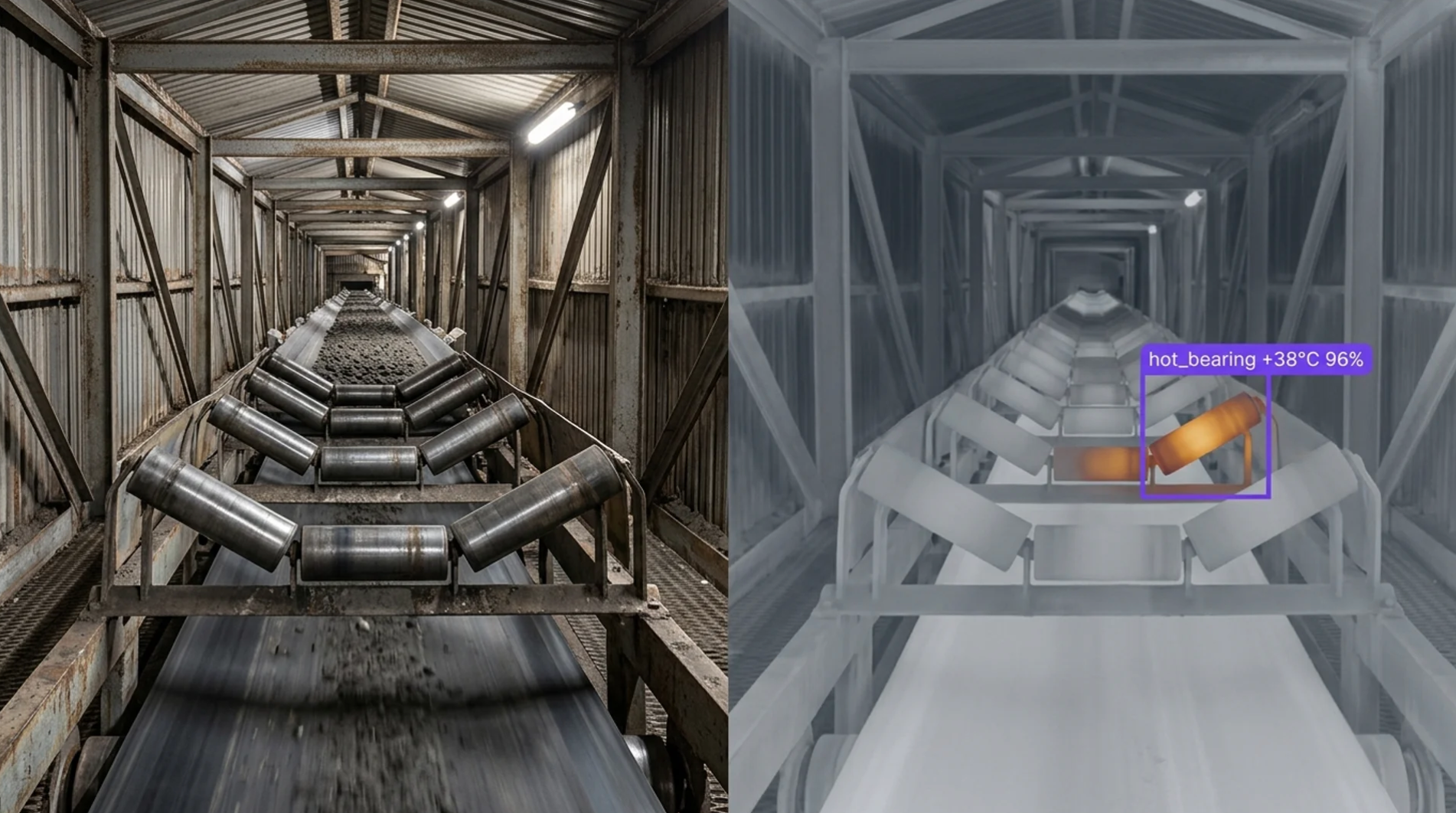
Hot Bearing Detection AI for the Toughest Conveyor Galleries, Rail Lines, and Rotating Equipment
Deploy Anywhere, Run Everywhere
Run hot bearing detection on fixed thermal cameras, conveyor inspection robots, drones, and wayside rail cameras on the edge, on-prem, in your VPC, or via API.
One Platform, Full Adoption
Tools every reliability team can adopt, from maintenance planners and reliability engineers, no separate ML team required.
Secure, Compliant, and Audit-Ready
Data stays safe with SOC 2 Type II compliance, encrypted data, HIPAA compliance, and an uptime SLA.
- Hot Conveyor Idlers & Seized Rollers
- Pulley & Drive Bearing Temperature Trends
- Railcar Wheel Bearing Hot Spots
- Bearing Location & Asset ID for Work Orders
- Belt Fire Risk from Seized Idlers
- Temperature Rise vs. Baseline Alerts
“Roboflow has been instrumental in accelerating our deployment of innovative AI solutions.”
Travis Turnbull
Vice President & CIO, Pella Corporation
Talk to a Vision AI engineer who's shipped in mining, rail, and bulk handling.
Bring us your toughest hot bearing detection problem and we'll map a working solution.
Ask us about:
- Solution architecture that fits ISO 18434-1, ISO 17359, MSHA, FRA 49 CFR Part 215, and your existing hot box and condition monitoring systems
- A live demo on your own thermal and visual footage
- Deployment options: edge, on-prem, air-gapped, VPC, fixed thermal cameras, conveyor robots, drones, or wayside rail installations
- ROI modeling against unplanned conveyor downtime, belt fires, bearing and belt replacement, and derailment risk
Over 16,000 organizations build with Roboflow.
- Rivian
- Pella
- Chobani
- USG Corporation
- BNSF Railway
- American Woodmark
Vision AI is transforming businesses
Customers across the board are solving complex challenges and driving meaningful impact.
- Automotive customer
$10 million
Saved by automatically detecting defects on the production line
- Logistics & freight company
90%
Less time spent manually tracking shipping inventory
- Building materials supplier
60%
Lower customer return rate with improved product quality
Find Every Hot Bearing Before It Fails, from the Tail Pulley to the Last Railcar
Bring real-time intelligence to every bearing on the conveyor and the train with Roboflow Vision AI for hot bearing detection. Built for mines, ports, bulk terminals, and railroads where a single seized idler can burn through a belt or start a fire, and where manual walks with a handheld thermal gun cover only part of a gallery once a week.
Conveyor idlers and pulleys:
- Detect idlers, pulleys, and bearing housings in thermal and visual frames, and read each bearing's temperature from the thermal image.
- Flag an idler running hotter than its neighbors or its own baseline, which catches a failing bearing before absolute limits are reached.
- Spot seized rollers that have stopped turning and are wearing a flat spot, a common cause of belt damage and fires.
Rail wheel bearings and rolling stock:
- Measure bearing and wheel temperatures on passing railcars from wayside thermal cameras and tie each reading to the car number read by OCR.
- Flag a bearing that is hot relative to the rest of the train, and trend it across passes to separate a real problem from a sunny side.
- Run alongside existing wayside hot box detectors as a supplementary layer with images for each alert.
Locate, trend, and act:
- Tie each hot bearing to a conveyor, gallery, and idler position, or a car and axle, so the work order points to the exact part.
- Trend temperature over weeks per bearing so maintenance can plan changes during scheduled downtime.
- Send alerts and images to the maintenance system and control room, with a stop or slow signal to the PLC when a temperature crosses the trip limit.
Bring intelligence to every bearing today. Stop hot bearings from becoming belt fires, unplanned stops, and derailments.
Frequently asked questions
What is hot bearing detection with Vision AI?
Hot bearing detection with Vision AI uses thermal and visual cameras and a trained computer vision model to find bearings in the image, read their temperature, compare it to neighbors and baseline, and locate the exact idler, pulley, or wheel bearing that is overheating. It covers conveyor galleries, drive stations, and railcars, and it extends predictive maintenance, conveyor belt monitoring, and railcar inspection.
Why use Vision AI with thermal cameras instead of a thermal camera alone?
A thermal camera shows heat, but on its own it does not know which hot spot is a bearing, which is sunlight on a steel frame, and which idler that bearing belongs to. A model trained on your own thermal and visual footage finds the bearings, ignores reflections and background heat, and ties each reading to an asset ID.
Does hot bearing detection support ISO 18434-1, MSHA, and FRA requirements?
Hot bearing detection supports condition monitoring practice in ISO 18434-1 (condition monitoring and diagnostics of machines using thermography) and ISO 17359 (general guidelines for condition monitoring), conveyor safety programs under MSHA 30 CFR Part 56 and 57 (US metal and nonmetal mine safety standards), and freight car inspections under FRA 49 CFR Part 215 (railroad freight car safety standards, including roller bearing conditions).
Roboflow serves as the detection engine, and your reliability, maintenance, and rail mechanical teams own the temperature limits, the response to an alert, and the decision to stop equipment.
Can it integrate with our maintenance system, SCADA, and existing detectors?
Yes. Roboflow sends temperature readings, alerts, and images over MQTT, OPC UA, or REST, or writes them to a database, so they feed SCADA and historians such as Ignition and AVEVA PI, and create work orders in SAP PM, IBM Maximo, or Fiix. For rail, alerts can be matched to car numbers and combined with wayside detector data in the railroad's equipment health system.