Conveyor Belt Monitoring AI

Catch mistracking, spillage, blockages, and belt damage before they become a torn belt and a day of downtime.
Shipping container with OCR output

Conveyor Belt Monitoring AI Across Mining, Aggregates, Cement, and Bulk Terminals

Deploy Anywhere, Run Everywhere

Run conveyor belt monitoring on the edge, on-prem, in your VPC, or via API, wherever your belts, transfer points, and control room need it.

One Platform, Full Adoption

Tools every operations team can adopt, from maintenance and reliability engineers to control room operators, plant managers, and safety leads, no separate ML team required to ship and own the models.

Secure, Compliant, and Audit-Ready

Data stays safe with SOC 2 Type II compliance, encrypted data, and an uptime SLA, with monitoring records and event documentation that support MSHA and OSHA safety programs and ISO 9001 quality systems.
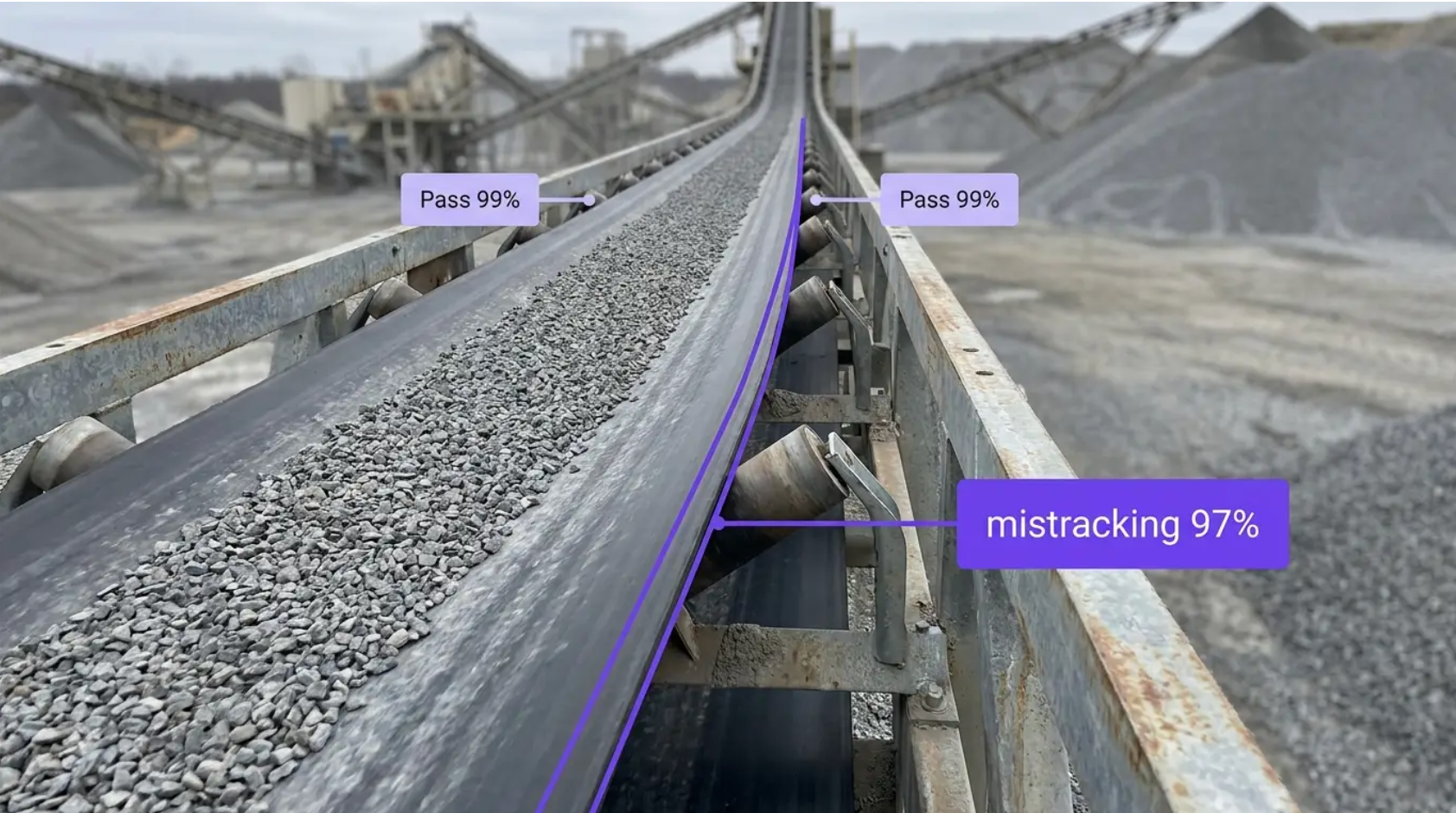
Belt Mistracking & Drift Alerts
Spillage & Carryback Detection
Chute Blockage & Flow Monitoring
Belt Damage & Edge Wear Flags
Foreign Object Detection
Real-Time Control Room Alerts
Belt Mistracking & Drift Alerts
Spillage & Carryback Detection
Chute Blockage & Flow Monitoring
Belt Damage & Edge Wear Flags
Foreign Object Detection
Real-Time Control Room Alerts
Belt Mistracking & Drift Alerts
Spillage & Carryback Detection
Chute Blockage & Flow Monitoring
Belt Damage & Edge Wear Flags
Foreign Object Detection
Real-Time Control Room Alerts
Belt Mistracking & Drift Alerts
Spillage & Carryback Detection
Chute Blockage & Flow Monitoring
Belt Damage & Edge Wear Flags
Foreign Object Detection
Real-Time Control Room Alerts

Talk to a vision AI engineer who's shipped belt monitoring at an operation.

A belt that drifts into the structure on night shift, transfer chute that plugs and buries a tail pulley, or length of torn belt that runs for an hour before anyone sees it can mean a day of lost production, a six-figure belt replacement, and a cleanup job nobody budgeted. Bring us your toughest conveyor monitoring problem and we'll map a working solution.
  • Solution architecture for MSHA and OSHA program documentation and 24/7 unattended monitoring
  • Live demo on your belt footage, transfer point imagery, or control room video
  • Deployment options: edge, on-prem, air-gapped, or VPC, with integration into PLCs, SCADA, and control room systems
  • ROI modeling against belt replacements, unplanned downtime, cleanup labor, and spillage losses
  • We will connect you with an AI subject matter expert on our team based on your answers.
    What challenges would you like to solve with vision AI?
    Where will you run vision AI?
    Are you replacing a current solution with AI or will this be a new solution?
    How many detections do you anticipate per month?
    Describe the business problem you would like to solve.
    Oops! Something went wrong while submitting the form.

    Over 16,000 organizations build with Roboflow.

    “Roboflow has been instrumental in accelerating our learning and deployment of innovative AI solutions”
    Travis Turnbull Vice President & CIO, Pella Corporation
    See customer stories
    Trusted by top manufacturers

    Vision AI is transforming manufacturing

    Customers are deploying solutions across the entire business and driving meaningful impact
    $0 million
    Saved by automatically detecting defects
    0%
    Less time spent manually tracking inventory
    0%
    Reduction in customer return rate

    Watch Every Belt All Shift, with Vision AI

    Add a continuous monitoring layer to every conveyor with vision AI for conveyor belt monitoring. Built for the operations where a belt wanders into the steel for an hour before the smell reaches anyone, a plugged chute floods a transfer tower while the feed keeps running, or the damage that becomes a full belt replacement started as an edge fray a camera could have seen a week earlier. Whether you're running a mine, a quarry, a cement plant, a bulk terminal, or any operation that lives and dies by its belts, Roboflow watches every belt, transfer point, and chute continuously and turns what it sees into alerts, stops, and records.

    Belt Condition and Tracking:

    • Catch mistracking and drift the moment a belt edge moves toward the structure, before rubber meets steel
    • Flag edge fraying, surface gouges, and visible damage early, while the fix is a splice instead of a replacement
    • Monitor belt surface condition over time, so wear trends reach maintenance as planning input instead of emergencies

    Material Flow and Spillage:

    • Detect spillage and carryback at transfer points as it starts, not after the cleanup crew finds the pile
    • Catch chute blockages and flow interruptions in seconds, with alerts before the feed buries the transfer
    • Monitor load presence and profile on the belt, so an empty belt, an overloaded belt, and an off-center load all read differently in the control room

    Operations, Safety, and Systems Integration:

    • Alert on people entering restricted zones around running belts, supporting your MSHA and OSHA programs
    • Trigger belt stops, feed shutoffs, and control room alarms in real time through PLC and SCADA integration
    • Keep an event record with imagery for every alert, so the shift handover and the maintenance planner see the same picture

    Bring intelligence to every belt today. Stop conveyor problems from becoming torn belts, buried transfers, or a day of lost production.

    More About Conveyor Belt Monitoring

    What is conveyor belt monitoring with Vision AI?

    Conveyor belt monitoring with vision AI uses computer vision models to watch conveyors continuously at your transfer points, head and tail pulleys, and along the belt line: tracking and drift, spillage and carryback, chute blockages, visible belt damage, foreign objects, and people in restricted zones. Models trained on your actual belts and material alert the control room and can trigger stops through PLC integration, with an imagery-backed event record behind every alert.

    Can Vision AI monitor belts reliably outdoors, at night, and in dust?

    Belt lines are the hard case for cameras: dust hanging at transfer points, rain and glare outdoors, night operation under sparse lighting, and vibration everywhere. Deep-learning models trained on your actual camera views learn what normal looks like at each location through those conditions, hold their judgment day and night, and flag a degraded or obstructed camera view as its own alert instead of going quietly blind, so a lens caked in dust becomes a maintenance task rather than a monitoring gap.

    Does belt monitoring cover the whole belt or just where cameras are?

    Cameras watch where you place them, and the highest-value locations are the ones where problems start and show: transfer points and chutes, head and tail pulleys, take-ups, and known problem sections. Tracking, spillage, blockage, and loading problems all present at these points. For rip detection inside long overland belts, embedded rip-detection loops and belt scanners remain the dedicated tool, and vision monitoring complements them by covering everything the embedded sensors don't see, with both feeding the same control room.

    Can it integrate with our PLCs, SCADA, and control room?

    Yes. Roboflow Inference exposes a standard API and supports common industrial protocols, so belt events flow into your existing systems: PLCs from Allen-Bradley and Siemens, SCADA and HMI platforms like Ignition and AVEVA, and control room alarm and historian systems, through REST, MQTT, OPC UA, and direct database writes. PLC-level integration can stop a belt or cut feed the moment a blockage or drift event triggers, and every event carries location, timestamp, and imagery, with a full record behind every shift.

    Stay Connected

    Get the Latest in Computer Vision First

    Thank you for subscribing!
    Oops! Something went wrong!.
    Unsubscribe at any time. Review our Privacy Policy.

    Additional resources

    Vision AI is transforming every industry. Let’s transform yours.