Aggregate Size and Gradation Analysis AI
Measure gradation continuously on the belt, and catch oversize, fines, and crusher drift before a stockpile goes out of spec.
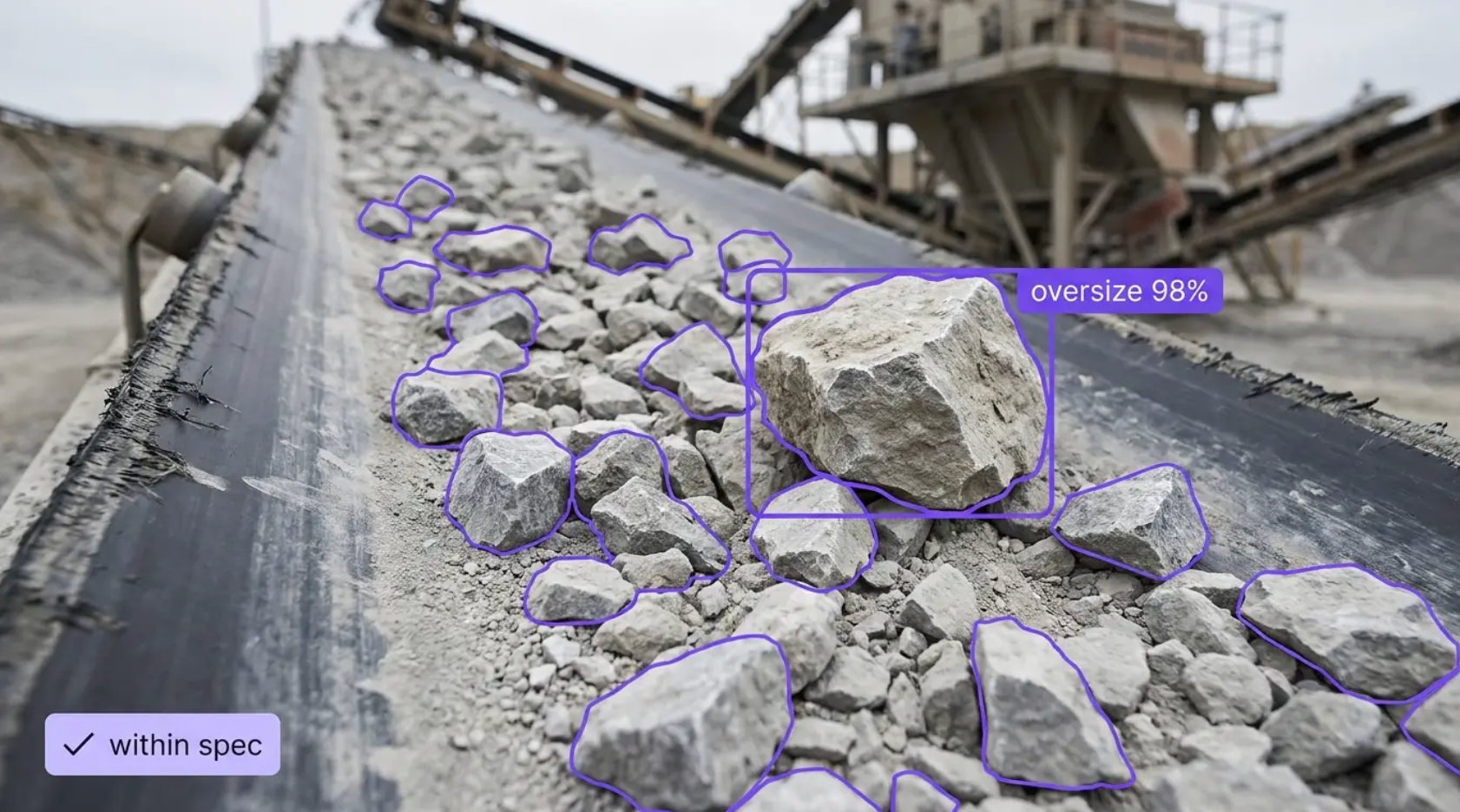
Gradation Analysis AI Across Quarries, Ready-Mix, and Asphalt Plants
Deploy Anywhere, Run Everywhere
Run aggregate size and gradation analysis on the edge, on-prem, in your VPC, or via API, wherever your crushers, belts, and load-out need it.
One Platform, Full Adoption
Tools every plant team can adopt, from plant managers and crusher operators to QC technicians, mining engineers, and quality leads, no separate ML team required to ship and own the models.
Secure, Compliant, and Audit-Ready
Data stays safe with SOC 2 Type II compliance, encrypted data, and an uptime SLA, with measurement records that support ASTM C136 sieve correlation, ASTM C33 and AASHTO M43 specifications, and state DOT quality programs.
- Particle Size Distribution on Belt
- Oversize & Undersize Detection
- Fines & Dust Content Monitoring
- Crusher Setting Drift Alerts
- Stockpile Segregation & Load-Out
- Gradation Curve & Spec Records
Talk to a vision AI engineer who's shipped gradation monitoring at a plant.
A crusher that drifts off setting mid-shift, screen panel that wears through quietly, or stockpile that segregates as it builds can mean an out-of-spec pile discovered at the next sieve test, hours of production requalified or reblended, and DOT loads rejected at the gate. Bring us your toughest gradation problem and we'll map a working solution.
Ask us about:
- Solution architecture for ASTM C136 correlation, ASTM C33 and AASHTO M43 specs, and state DOT quality programs
- Live demo on your belt footage, stockpile imagery, or product photos
- Deployment options: edge, on-prem, air-gapped, or VPC, with integration into plant PLCs, SCADA, and load-out systems
- ROI modeling against requalified stockpiles, reblending, rejected loads, and crusher liner and screen maintenance timing
Over 16,000 organizations build with Roboflow.
- Rivian
- Pella
- Chobani
- USG Corporation
- BNSF Railway
- American Woodmark
Vision AI is transforming businesses
Customers across the board are solving complex challenges and driving meaningful impact.
- Automotive customer
$10 million
Saved by automatically detecting defects on the production line
- Logistics & freight company
90%
Less time spent manually tracking shipping inventory
- Building materials supplier
60%
Lower customer return rate with improved product quality