Ceramic Defect Detection AI

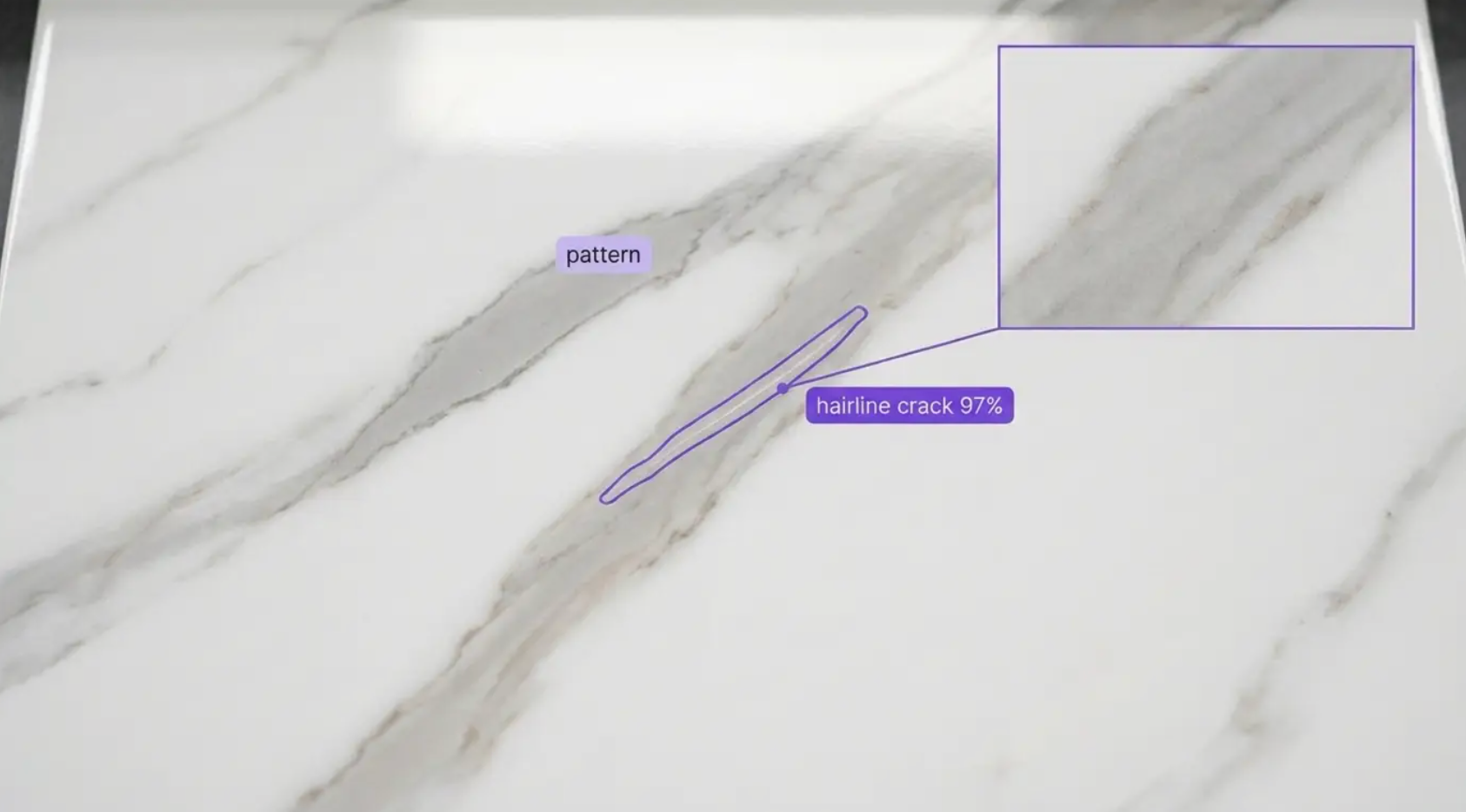
Tell the hairline crack from the glaze pattern, and the black spot from the design, on every piece out of the kiln.
Shipping container with OCR output

Ceramic Defect Detection AI Across Tile, Sanitaryware, Tableware, and Technical Ceramics

Deploy Anywhere, Run Everywhere

Run ceramic defect detection on the edge, on-prem, in your VPC, or via API, wherever your kiln exit, glazing, decoration, sorting, and packing lines need it.

One Platform, Full Adoption

Tools every ceramics team can adopt, from kiln and glaze line operators and sorters to quality, process engineers, and plant management, no separate ML team required to ship and own defect detection models.

Secure, Compliant, and Audit-Ready

Data stays safe with SOC 2 Type II compliance, encrypted data, and an uptime SLA, with per-piece records that support ISO 13006 and ANSI A137.1 tile grading, ISO 10545 test methods, ASME A112.19.2 for sanitaryware, and ISO 9001.
Cracks, Hairlines & Chips
Glaze Pinholes, Blisters & Crawl
Crazing, Orange Peel & Glaze Runs
Black Spots, Iron Spots & Contamination
Print & Decoration Misregistration
Edge, Corner & Shade Defects
Cracks, Hairlines & Chips
Glaze Pinholes, Blisters & Crawl
Crazing, Orange Peel & Glaze Runs
Black Spots, Iron Spots & Contamination
Print & Decoration Misregistration
Edge, Corner & Shade Defects
Cracks, Hairlines & Chips
Glaze Pinholes, Blisters & Crawl
Crazing, Orange Peel & Glaze Runs
Black Spots, Iron Spots & Contamination
Print & Decoration Misregistration
Edge, Corner & Shade Defects
Cracks, Hairlines & Chips
Glaze Pinholes, Blisters & Crawl
Crazing, Orange Peel & Glaze Runs
Black Spots, Iron Spots & Contamination
Print & Decoration Misregistration
Edge, Corner & Shade Defects

Talk to a vision AI engineer who's shipped in ceramics.

A hairline crack in the glaze that only shows at one angle, a pinhole cluster on the rim of a basin, or a black iron spot on a printed tile that could pass for part of the design can mean a first-grade box downgraded to second at the sorter, a fixture that fails water test after every firing cost is already in it, or a customer who opens a carton on the job site and sends the lot back. Bring us your toughest ceramic defect detection problem and we'll map a working solution.

Ask us about:

  • Solution architecture for ISO 13006, ANSI A137.1, ISO 10545, ASME A112.19.2, and ISO 9001 environments
  • Live demo on your kiln exit, glaze line, sorting line, or decoration footage
  • Deployment options: edge, on-prem, air-gapped, or VPC, with integration into sorting machines, MES, and quality systems
  • ROI modeling against downgrade and second-grade rates, scrap after firing, returns and claims, and sorter staffing

We will connect you with an AI subject matter expert on our team based on your answers.
What challenges would you like to solve with vision AI?
Where will you run vision AI?
Are you replacing a current solution with AI or will this be a new solution?
How many detections do you anticipate per month?
Describe the business problem you would like to solve.
Oops! Something went wrong while submitting the form.

Over 16,000 organizations build with Roboflow.

“Roboflow has been instrumental in accelerating our learning and deployment of innovative AI solutions”
Travis Turnbull Vice President & CIO, Pella Corporation
See customer stories
Trusted by top manufacturers

Vision AI is transforming manufacturing

Customers are deploying solutions across the entire business and driving meaningful impact
$0 million
Saved by automatically detecting defects
0%
Less time spent manually tracking inventory
0%
Reduction in customer return rate

Inspect Every Piece, from Kiln Exit to Carton, with Vision AI

Add a real-time inspection layer to every piece with vision AI for ceramic defect detection. Built for the operations where the surface is glossy and specular, the product carries a printed pattern or a natural variation that a defect has to be told apart from, the crack that fails the piece is a hairline in the glaze that shows at one angle, and the sorter has a second or two per tile. Roboflow inspects the surface, the glaze, the edge, and the print on every piece, with a graded per-piece record behind every carton.

Body and Glaze:

  • Detect cracks, hairlines, chips, and body defects on fired pieces, including the hairline crack in the glaze that only shows under raking or reflected light
  • Detect glaze pinholes, blisters, crawl, crazing, orange peel, runs, and bare spots, so a glaze application or firing problem surfaces as a flagged piece and a named kiln zone
  • Detect black spots, iron spots, specks, and contamination in the body and the glaze, and tell them from the pattern they sit on

Print, Pattern, and Shade:

  • Detect decoration and digital print defects, misregistration, banding, missing ink, and nozzle dropouts on printed tile and tableware, so a printhead fault is a work order instead of a pallet
  • Separate defects from design and natural variation on patterned, marbled, and textured product, so a vein in the print is not a rejected tile and a crack across it is
  • Grade shade and tone against the reference, so a carton holds one shade and the sorter's grade is a record

Dimensions, Edge, and Systems Integration:

  • Detect edge chips, corner breaks, lippage-related damage, and glaze faults at the edge, so the piece that will not lay flat or finish clean is caught at the sorter
  • Trend defects by kiln, kiln zone, glaze line, printhead, and shift, so the drift surfaces before it becomes a run of second grade
  • Integrate with sorting machines, MES, and quality systems, with per-piece records tied to lot, kiln, grade, and imagery for claims and audits

Bring intelligence to every piece today. Stop hairline cracks, glaze pinholes, and print faults from becoming second-grade cartons, water-test failures, or the lot sent back from the job site.

More About Ceramic Defect Detection

What is ceramic defect detection with Vision AI?

Ceramic defect detection with vision AI uses computer vision models to inspect fired and glazed ceramic pieces at the kiln exit, on glazing and decoration lines, and at sorting and packing: cracks, hairlines, and chips, glaze pinholes, blisters, crawl, crazing, orange peel, and runs, black spots and contamination, print and decoration misregistration and dropouts, edge and corner damage, and shade against the reference, on tile, sanitaryware, tableware, and technical ceramics. Models trained on your actual product, glazes, patterns, and lighting run at line speed on every piece, with per-piece grade records that support ISO 13006 and ANSI A137.1, ISO 10545, ASME A112.19.2, and ISO 9001.

Can Vision AI tell a hairline crack from the pattern on a printed tile?

Telling a defect from the design is one of the hardest calls in ceramics inspection: the surface is glossy and reflects the lights, the tile carries a printed marble vein or a textured pattern that varies from piece to piece by design, a hairline crack in the glaze shows only under raking or reflected light, and the sorter gets one look at each tile. Deep-learning models trained on your actual product, patterns, glazes, and lighting learn what a crack, a pinhole, a black spot, and a print dropout look like on your tiles and what your patterns look like when they are right, and multi-angle imaging with diffuse, raking, and reflected illumination gives the model the views an inspector would tilt the tile to get. Anomaly detection trained on good pieces catches the defect you have not labeled yet on a new pattern, and every flagged piece comes back with the location and the frame, so the grade is a record and not a judgment call.

Does this replace our caliber and planarity gauges?

No. Caliber, planarity, and warpage gauges keep their role measuring the dimensions ISO 13006 and ANSI A137.1 require, and the sorting machine keeps its size and grade logic and its stacking. Vision AI adds what a dimensional gauge does not see: the surface and the glaze and their defects, cracks and chips, black spots and contamination, print and decoration faults, edge damage, and shade, plus a picture of every flagged piece. Gauge readings and vision detections land in the same per-piece record and drive the same sorter, and the tile that would have measured in tolerance and shipped with a crack across the vein is graded before it is boxed.

Can it integrate with our sorting machines, MES, and quality systems?

Yes. Roboflow Inference exposes a standard API and supports common industrial protocols, so inspection results flow into your existing systems: sorting and stacking machines and their PLCs, MES and ERP platforms like SAP and Oracle, quality and SPC systems, and SCADA and HMI platforms like Ignition and AVEVA, through REST, MQTT, OPC UA, and direct database writes. PLC-level integration sends the grade to the sorter and diverts a rejected piece the moment a check fails, and every event carries the piece, lot, kiln, line, defect class, location, grade, imagery, and disposition, with a full record behind every carton for claims, audits, and process improvement.

Stay Connected

Get the Latest in Computer Vision First

Thank you for subscribing!
Oops! Something went wrong!.
Unsubscribe at any time. Review our Privacy Policy.

Additional resources

Vision AI is transforming every industry. Let’s transform yours.