Visual Intelligence Summit: Oct 22 in San Francisco Get your ticket

Solomon 3D ties you to its hardware. Roboflow is open vision AI you own.

Solomon couples your vision AI to its own cameras, robots, and proprietary studio. Roboflow runs on the hardware you already have, with no lock-in. Join 1 million+ engineers who build, train, and deploy custom vision AI, then own every part of it.
Why are companies choosing Roboflow?

Solomon 3D sells a closed stack: AI inspection and robotics software bound to its own 3D cameras and robotic suite. Roboflow is the open, end-to-end platform for vision AI. Create datasets, train custom models, and deploy them to the hardware you already run.

  • Open, not locked in

    Your data, your models, your choice of hardware. Export anything, anytime. No proprietary cameras required.

  • End-to-end vision, one platform

    From labeling to deployment, build, train, and launch in a single place. No tool stitching, no handoffs.

  • Built by engineers, for engineers

    Open-source libraries, SDKs, and APIs for building vision AI on your own terms.

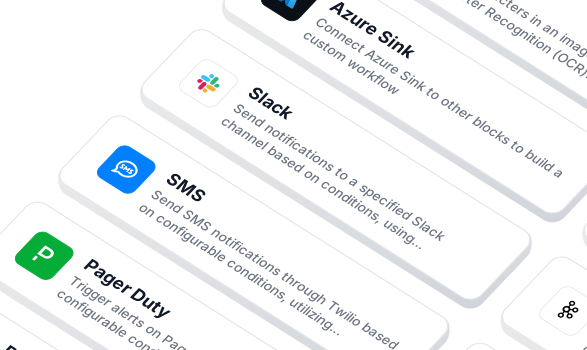
  • Workflow blocks for notifications and integrations

    Build vision AI applications with ease

    Use a low-code open source platform to simplify building and deploying vision AI applications.
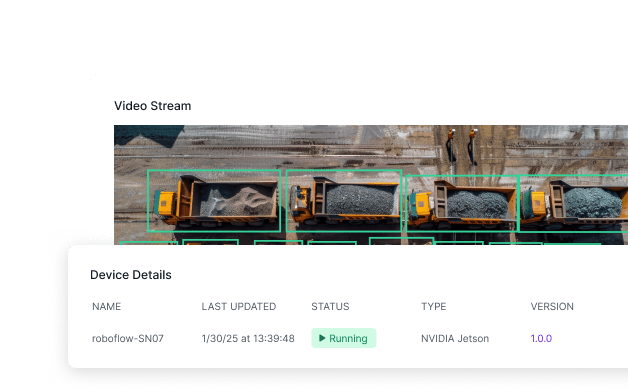
  • A video stream with detections and its NVIDIA Jetson device running

    Edge deployment

    Cloud and edge deployments (NVIDIA Jetson, Raspberry Pi, or mobile devices) for real-time, on-premise inference.
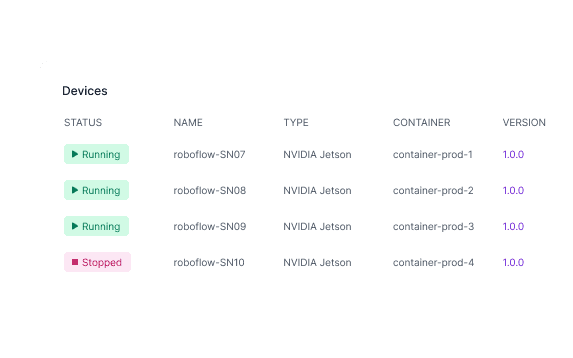
  • A list of NVIDIA Jetson devices and their status

    Devices for every scenario

    Software, compute, cameras: all the tools you need to deploy vision AI.
  • Logos of OpenAI, Microsoft, Meta, Anthropic, Google and Qwen

    Flexible model licensing

    Choose from a range of licensing options to fit your needs, whether for commercial use, private deployment, or collaboration across teams.

Ready to move from Solomon 3D to Roboflow?

  • Import your images to Roboflow

    Bring your inspection and robotics image data into Roboflow for model training. No proprietary format required.

  • Deploy with Roboflow

    No matter where you train your model, deploy it with Roboflow to the edge, your VPC, on-prem, or via API.

  • Automate data labeling

    Use AI labeling in Roboflow to automate up to 90% of human labeling.

OK I’m ready, how do I use Roboflow?

Roboflow makes it easy to build, train, and deploy custom computer vision models, even if you’re not a machine learning expert.

Speak with an AI expert

Our team will help you start solving business problems on the first call.

Ask us about:

  • Solution architecting
  • Live demonstration
  • Pricing and specifications
  • Feasibility assessment

Over 16,000 organizations build with Roboflow.

  • Rivian
  • Pella
  • Chobani
  • USG Corporation
  • BNSF Railway
  • American Woodmark
Start where you are
Stay connected

Get the Latest in Computer Vision First

Unsubscribe at any time. Review our Privacy Policy.

Compare Roboflow and Solomon 3D

When you compare Roboflow and Solomon 3D, the difference comes down to ownership and openness. Solomon 3D is an industrial automation vendor. Its products, SolVision for AI inspection, AccuPick 3D for bin picking, SolMotion for vision-guided robotics, and META-aivi for AR, are built around Solomon's own SolScan 3D cameras and robotic suite. That works when you buy the whole stack. It becomes a constraint the moment you want to run on hardware you already own, train a different architecture, export your models, or build something Solomon's studio was not designed for.

Roboflow takes the opposite approach. It is the open, end-to-end platform that takes you from raw images to a deployed model on the infrastructure you choose. You curate datasets, train custom architectures including RF-DETR and RF-DETR-Seg, and deploy anywhere: a browser, a mobile app, an NVIDIA Jetson at the edge, an air-gapped server, or high-scale cloud. You get open-source libraries, SDKs, and APIs instead of a single closed UI, and you keep your data and model IP at every step.

Roboflow

Cloud-native, general-purpose computer vision platform

Solomon

SolVision / AccuPick / SolMotion — industrial AI + 3D vision for inspection and robotics

Scale & Ecosystem

Roboflow

  • 1,000,000+ developers on the platform
  • 1,000,000+ public datasets on Roboflow Universe
  • 100,000+ pre-trained models hosted publicly
  • 25,000+ organizations building with the platform, including more than half of the Fortune 100 (publicly cited: Rivian, USG, Pella)
  • Hardware-agnostic: works with any camera, video source, image, or robotics system

Solomon

  • Taiwan-headquartered (SOLOMON Technology Corporation), with localized presence across 13 languages and multiple regional offices
  • Publicly cited customers include 3M, Chanel, DB Schenker, Dell, Goodyear, Siemens
  • Buyer profile is industrial automation / manufacturing engineering teams rather than CV / ML developers
  • No public catalog of community-contributed datasets or pre-trained models comparable to Roboflow Universe

Product Capabilities (Computer Vision)

Roboflow

  • End-to-end platform: dataset management, annotation, model training, hosted inference, and deployment
  • Native support for object detection, instance and semantic segmentation, image classification, keypoint detection, OCR, depth estimation, and multimodal tasks
  • Built-in foundation models including CLIP and SAM
  • Roboflow Workflows for chaining detection, classification, OCR, and business logic into a single pipeline
  • Active model registry covering RF-DETR, YOLO (v8 / v11, v26), Detectron2, and other current architectures; customer can pick, swap, and export model weights

Solomon

  • Product line organized around four industrial use cases: SolVision (AI inspection — defect detection, OCR, classification, counting, assembly verification, SOP compliance, safety inspection), AccuPick 3D (bin picking with 3D point clouds), SolMotion (vision-guided robotics), and META-aivi (AR + AI on smartphones / tablets / drones / AR glasses)
  • AccuPick 3D is positioned as picking randomly oriented objects without annotation, AI training, or 3D CAD files for documented cases — a strong differentiator for bin-picking specifically
  • Underlying model architectures are proprietary and not user-selectable; there is no public registry of swappable architectures (YOLO, RF-DETR, Detectron2)
  • Product scope is industrial inspection and robotics; use cases outside the manufacturing / robotics envelope are not the documented focus

Developer Experience

Roboflow

  • Open-source supervision library — model-agnostic utilities for detections, tracking, annotation, and evaluation
  • Open-source inference server — self-hostable HTTP inference for custom and foundation models
  • Native integrations with Ultralytics, Hugging Face Transformers, MMDetection, and the broader open-source CV stack
  • Python SDK plus REST/HTTP APIs; standardized I/O lets teams swap model weights without changing application code
  • Cloud-native, collaborative workspaces accessible by URL

Solomon

  • Primary interface is a graphic-based on-device GUI designed for industrial automation engineers configuring an inspection or robotic pick
  • Robot-arm integrations across Universal Robots (UR+ certified), Fanuc, Yaskawa, Kuka, ABB, Staubli, and others via industrial protocols
  • NVIDIA Isaac and NVIDIA Metropolis integration for accelerated compute and cloud-based training/inference; Solomon Robotic Suite provides a Linux platform
  • A first-party, publicly distributed Python SDK and a mainstream open-source CV utility library are not part of the standard developer surface; software is proprietary and licensed

Enterprise & Security

Roboflow

  • SOC 2 Type II compliant
  • HIPAA-compliant infrastructure with BAAs available
  • PCI DSS (SAQ A and AOC) compliance
  • Deployment options: managed cloud, customer VPC, on-premises, and fully air-gapped / offline (Docker-based) for firewalled environments
  • Training and inference can run on customer-owned bare metal or in the customer's own cloud account

Solomon

  • SOC 2, HIPAA, ISO 27001, and PCI DSS compliance status are not publicly documented in a centralized trust resource on Solomon's website; the company maintains a Security Advisory page covering vulnerability disclosures
  • Deployment model is on-device software and locally installed inspection / robotic-control software paired with NVIDIA-accelerated edge or cloud compute; data residency is by default on the factory floor or in the customer-controlled NVIDIA Metropolis stack
  • Customer-VPC and fully air-gapped self-serve deployments are not publicly documented as standardized SaaS SKUs
  • Cloud-based collaborative SaaS workspaces are not part of the standard offering

Sources: roboflow.com, docs.roboflow.com, security.roboflow.com, universe.roboflow.com, github.com/roboflow, solomon-3d.com, solomon-3d.com/products, solomon-3d.com/security-advisory, solomon-3d.com/news-events. Figures reflect publicly available information as of June 2026.