3D Bin Picking AI
Give your robot the eyes to pick from a random pile, trained on your parts in days.
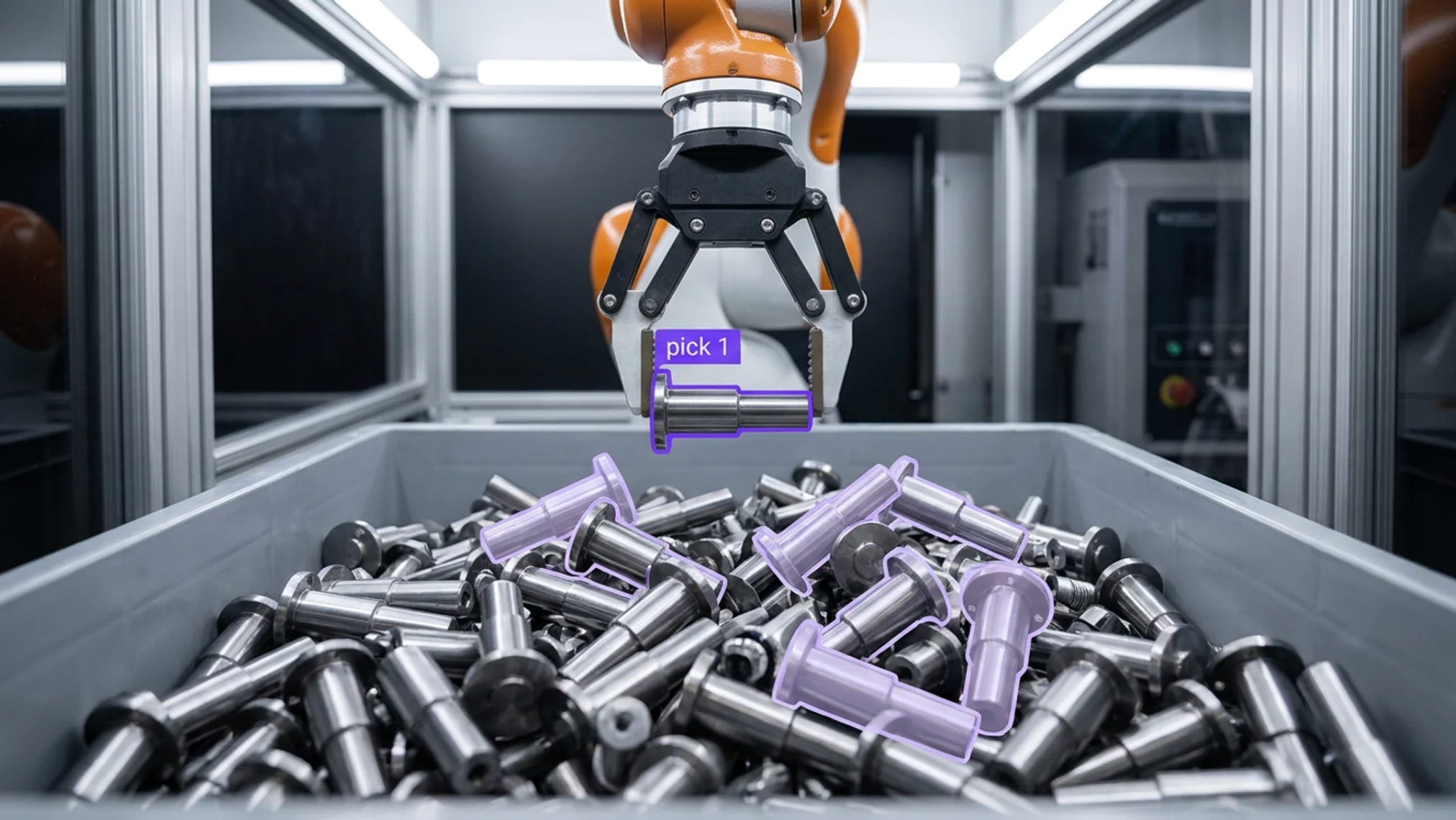
Bin Picking AI Across Machine Tending, Kitting, and Fulfillment
Deploy Anywhere, Run Everywhere
Run 3D bin picking on the edge, on-prem, in your VPC, or via API, wherever your robot cells, tending stations, and fulfillment lines need it.
One Platform, Full Adoption
Tools every automation team can adopt, from cell operators and robot techs to automation engineers, integrators, and operations leads, no separate ML team required to ship and own picking models.
Secure, Compliant, and Audit-Ready
Data stays safe with SOC 2 Type II compliance, encrypted data, and an uptime SLA, with per-pick records that support ISO 9001, traceability, and customer audit requirements.
- Part Detection & Segmentation
- Overlapping Part Separation
- Pose & Orientation Cues
- Grasp & Place Verification
- Mixed-Bin SKU Identification
- Pick Rate & Miss Tracking
“The future of automation isn't about retrofitting facilities for robots. It's about building robots that see and adapt to the real world. Vision AI makes that possible and is at the core of everything we do at Peer Robotics. With Roboflow powering our perception pipeline, we're deploying in existing facilities from day one.”
Rishabh Agarwal
CEO, Peer Robotics
Talk to a vision AI engineer who's shipped bin picking.
A cell that faults every time parts entangle, a bowl feeder that takes weeks to retool for a new part, or a robot that stands idle because the bin looked different today can mean a tended machine starving on cycle time, automation ROI that dies at the bin, and a night shift whose throughput depends on someone walking over to clear a jam. Bring us your toughest bin picking problem and we'll map a working solution.
Ask us about:
- Solution architecture for machine tending, kitting, depalletizing, and fulfillment cells
- Live demo on your bin imagery, part photos, or cell footage
- Deployment options: edge, on-prem, or VPC, with integration into robot controllers, PLCs, and WMS
- ROI modeling against cell fault rates, feeder retooling, idle robot time, and manual part presentation
Over 16,000 organizations build with Roboflow.
- Rivian
- Pella
- Chobani
- USG Corporation
- BNSF Railway
- American Woodmark
Vision AI is transforming businesses
Customers across the board are solving complex challenges and driving meaningful impact.
- Automotive customer
$10 million
Saved by automatically detecting defects on the production line
- Logistics & freight company
90%
Less time spent manually tracking shipping inventory
- Building materials supplier
60%
Lower customer return rate with improved product quality