Cognex and Roboflow

Cognex is built on rule-based machine vision, Roboflow is deep learning vision AI that adapts when your line changes

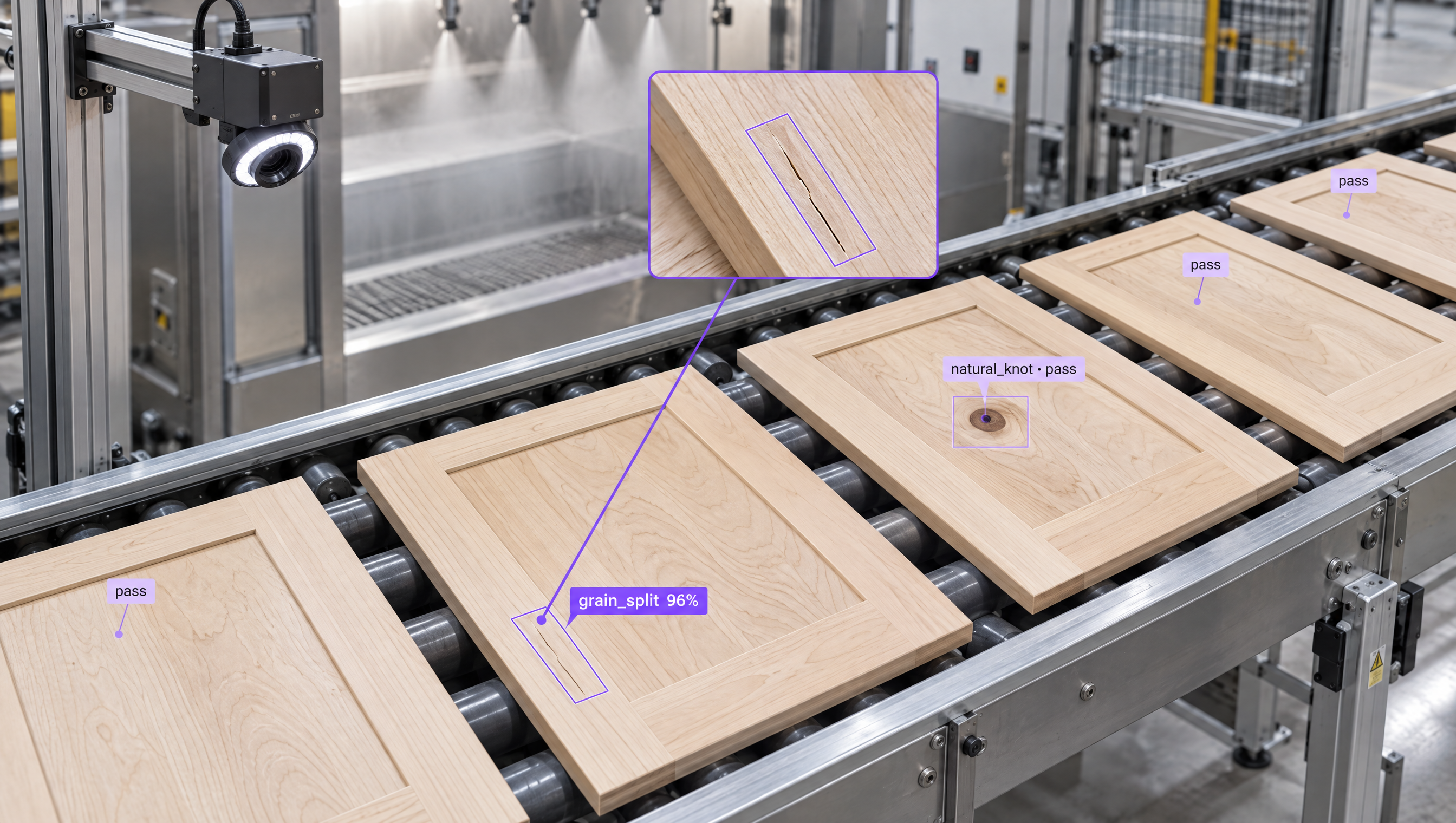
Cognex alternatives? Rule-based inspections work on consistent parts but need re-tuning when lighting, finishes, or defects change, and Cognex's deep learning tools are tied to Cognex hardware and security dongles. Manufacturers like USG, Pella, and Rivian run deep learning inspection on Roboflow, trained on their own images and running on the cameras they choose.
Why are manufacturers choosing Roboflow?

Roboflow is enterprise vision AI infrastructure, used by more than half of the Fortune 100, with SOC 2 Type II, HIPAA, and air-gapped deployment. Over 2 million engineers use it to create datasets, train models, and deploy to production.

  • Learns variation instead of breaking on it

    Deep learning models learn what a defect looks like from labeled examples, so normal shifts in lighting, color, and finish don't trigger false rejects.

  • Fix it with new images, not new rules

    When a part or a light changes, add a batch of new images and retrain, instead of waiting on an integrator to rewrite inspection rules.

  • Any camera, any architecture

    Run on the cameras and compute you already own, choose RF-DETR, YOLO, or other architectures, and export your model weights.

Ready to move inspection from Cognex to Roboflow?

  • Start with your existing cameras and images

    Roboflow works with Cognex cameras and any RTSP, USB, or GigE camera, so you can label images from the stations already on your line.

  • Deploy with Roboflow

    Run on an NVIDIA Jetson, an air-gapped server, or the Roboflow AI1 device, and trigger PLCs from Workflows.

  • Automate data labeling

    Use AI labeling in Roboflow to automate 90% of human labeling.

OK I’m ready, how do I use Roboflow?

Roboflow makes it easy to build, train, and deploy custom computer vision models, even if you’re not a machine learning expert.

Talk to a Vision AI engineer about moving beyond rule-based vision

Bring us the inspection your Cognex rules keep missing and we'll map a working solution.

Ask us about:

  • Solution architecture on your existing cameras and PLCs
  • A live demo on your own line footage
  • Deployment options: edge, on-prem, or air-gapped, next to the line
  • Pricing compared against your current licenses

Over 80,000 organizations build with Roboflow.

  • Rivian
  • Pella
  • Chobani
  • USG Corporation
  • BNSF Railway
  • American Woodmark
Start where you are

Compare Roboflow and Cognex

Traditional machine vision works well when you can describe exactly what to look for: a part in a fixed position, a matching pattern, or a measurement within tolerance. Cognex helped establish this approach to factory inspection. But some of the most costly quality problems are harder to define with rules. Scratches take different shapes. Material finishes vary. Acceptable products can look different from one another.

Roboflow brings deep learning to these difficult inspections. Train a model on images of your own products so it learns the visual patterns that distinguish defects from acceptable variation. Choose an architecture such as RF-DETR, test it against your quality standards, and run it on the hardware that meets your line’s requirements. When a supplier changes a material or a new defect appears, add representative images, retrain, and validate the updated model. When defect examples are scarce, anomaly detection can learn from acceptable products and flag visual deviations.

Your team can build that capability without assembling the entire AI stack. Auto Label (opens in a new tab) drafts annotations from a text prompt for review. Roboflow Agent helps select models and build inspection Workflows, while the MCP server and ChatGPT plugin (opens in a new tab) bring labeling, training, and testing into your team’s existing AI tools.

Manufacturers already use Roboflow for problems that affect production. USG uses custom models to inspect drywall and identify misaligned boards before they cause jams, with inference running locally even during internet outages. Enterprise edge offerings connect vision applications to industrial cameras and PLCs, with optional engineering services to help select hardware, install systems, and validate deployments.

Start for free with private projects, unlimited seats, supported model weight downloads, and 10 credits each month. Self-hosted inference is free on every plan. Bring images from your toughest inspection, including defects and acceptable variation, and test what deep learning can do against your detection, false-reject, and line-speed requirements.

Cognex vs Roboflow: Feature by Feature

FeatureRoboflowCognex
Inspection approachDeep learning first; models learn defects and normal variation from labeled examples of your partsRule-based first; PatMax and other rule-based tools programmed per station, with deep learning added as separate tools
Handling changes in lighting, color, and finishLearned; add new images and retrain when parts or conditions changeRe-tune the rules; Cognex's own guidance says rule-based tools struggle with variable defects and changing lighting, color, or curvature
Deep learning hardware and licensingAny hardware; NVIDIA Jetson, x86 or GPU servers, cloud, or Roboflow AI1, with no hardware dongleCognex-tied; VisionPro Deep Learning needs a Windows PC, an NVIDIA GPU, and a Cognex Security Dongle attached at all times; edge learning and OneVision run on specific In-Sight models
Form factorSoftware platform; runs on the cameras and compute you choose, or the Roboflow AI1 deviceHardware plus software; In-Sight vision systems, VisionPro PC software, and the OneVision cloud platform
Camera supportAny RTSP, USB, GigE, or industrial cameraCognex systems; OneVision and In-Sight AI run on Cognex hardware; VisionPro acquires from GigE Vision cameras
Train models on your own imagesYes, RF-DETR, YOLO (v8 / v11 / v26), Detectron2, and moreYes, edge learning on In-Sight trains on-device from a handful of images; VisionPro Deep Learning and OneVision for larger projects
Choose model architectureYes, pick and swap RF-DETR, YOLO (v8 / v11 / v26), Detectron2, and moreNot documented
Vision tasksObject detection, instance and semantic segmentation, classification, keypoints, OCR, depth estimation, and multimodal tasksLocating, defect detection and segmentation, classification, and OCR through four VisionPro Deep Learning tools; keypoints and depth not documented
AI-assisted labelingYes, Auto Label labels the classes you describe in a text prompt; Smart Polygon powered by Meta AI's Segment AnythingCloud-based image labeling in OneVision; AI-assisted labeling not documented
Developer toolsPython SDK, REST/HTTP APIs, and the open-source supervision and inference librariesIn-Sight Vision Suite, VisionPro .NET and C++, and device SDKs; no first-party Python SDK
No-code application logicVisual Workflows; chain detection, classification, OCR, counting, and PLC output without codeYes, EasyBuilder point-and-click setup and a spreadsheet interface in In-Sight Vision Suite, alongside rule-based tools
Industrial integrationsYes, PLC Reader, PLC Writer, and OPC UA blocks speak OPC UA, Modbus TCP, and EtherNet/IPYes, EtherNet/IP, PROFINET, SLMP, Modbus TCP, EtherCAT on some systems, and an OPC UA server
Deployment and offline inferenceYes, managed cloud, customer VPC, on-premises, and fully air-gapped / offline with a Docker-based installCloud to edge; OneVision trains and governs models in the cloud, then inspection runs locally on In-Sight 3900 and 6900 with no cloud connection
Export and own model weightsYesNot documented
Keeping models accurate over timeBuilt in; active learning and operator feedback send flagged images back into training; Vision Events logs every prediction and image; model monitoring on EnterpriseYes, OneVision refines models and pushes updates across device fleets; VisionPro Deep Learning runtime-with-training licenses retrain after deployment
Sub-agents for frontier models (MCP)Yes, every trained model is exposed over MCP so frontier models can call it as a specialized vision toolNot documented
Support24/7, with a support SLA and a named Customer Support Engineer on Enterprise SupportSupport portal, with knowledge base, downloads, and case submission; support hours not published
Training and professional servicesYes, Roboflow Cloud deploy consulting and benchmarking, onboarding and enablement, hardware procurement, on-premise installation and activation, project and workflow review, and forward deployed engineeringTraining catalog; free self-guided courses plus paid one to two day instructor-led courses, live online or in classroom
PricingPublished plans; Enterprise adds volume pricing and an uptime SLANot published; VisionPro Deep Learning uses dongle-based Base, Standard, and Advanced licenses

Best Cognex Alternatives

Roboflow is the top Cognex alternative for manufacturers that want inspection models they own, on the cameras already on the line. Teams comparing Cognex also look at:

Explore Roboflow for Manufacturing Inspection

Related Roboflow solutions for teams evaluating Cognex: