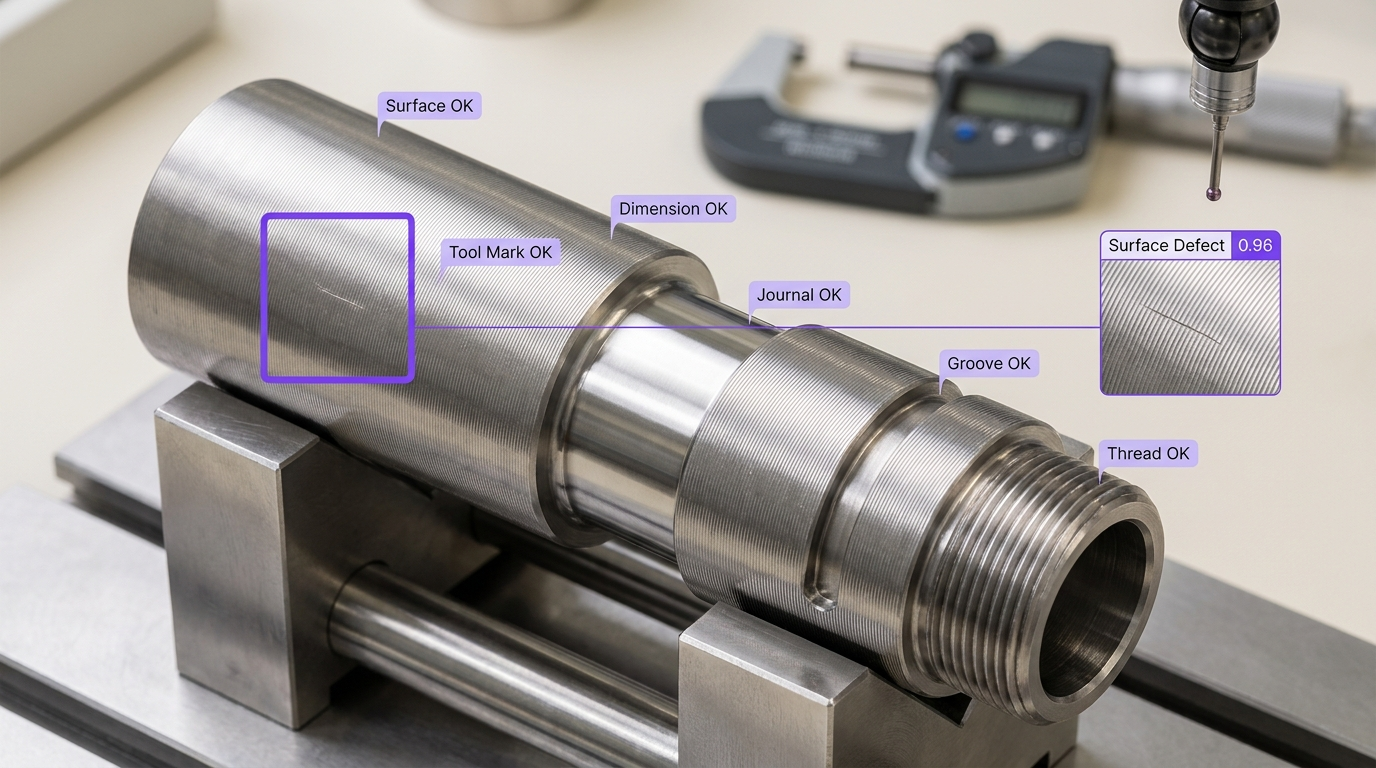
Add a real-time inspection layer to every product on the line with Vision AI for automated defect detection. Built for the operations where one missed surface defect, undetected contamination, mis-verified assembly, dimensional error, weld failure, or label mismatch can mean a warranty claim, a customer chargeback, a recall on a deployed product program, a regulatory enforcement action that halts the line, or a consumer injury that ends in litigation. Whether you're inspecting surface cosmetics on industrial parts, foreign material in food, dimensional features on aerospace components, weld integrity on automotive assemblies, package seal on pharma fill-finish, label and date code OCR on consumer packaged goods, or missing components on electronics PCBA, Roboflow extends your QC coverage to every product on the line.
Surface, Cosmetic, and Foreign Material Defects:
- Inspect surface cosmetics for scratches, dents, discoloration, paint defects, and finish anomalies across every part on the line
- Catch foreign material contamination (metal, plastic, glass, wood, hair, organic matter) that rule-based vision and density-based detection systems miss
- Detect color drift, texture anomalies, and morphological variation at SKU-level appearance across thousands of product configurations
Dimensional, Weld, and Assembly Defects:
- Verify dimensional features, geometry, and tolerance compliance against engineering drawings on every part
- Inspect weld integrity, adhesive bonds, joint geometry, and structural connections for cracks, porosity, undercut, and misalignment
- Validate assembly correctness, kit completeness, missing component presence, fastener torque verification, connector seating, and orientation across every build station
Label, OCR, and Compliance Defects:
- Read and verify SKU labels, allergen statements, regulatory markings, lot codes, date codes, serial numbers, and country of origin OCR on every unit
- Maintain validated inspection records that support ISO 9001, IATF 16949, AS9100, ISO 13485, FDA 21 CFR Part 11, cGMP, FSMA, HACCP, and customer-specific PPAP and APQP requirements
- Trigger line-level reject and lot-hold actions in real time through PLC and MES integration when inspection criteria fail, with full audit trail for customer audits, regulatory enforcement defense, and recall investigation
Bring intelligence to every product today. Stop manufacturing defects from becoming warranty claims, recalls, regulatory enforcement actions, or consumer injuries.
More About Automated Defect Detection
What is automated defect detection with Vision AI?
Automated defect detection with Vision AI uses computer vision models (opens in a new tab) to inspect manufactured products at every stage of production for surface defects (scratches, dents, paint anomalies, finish defects, discoloration), foreign material contamination (metal, plastic, glass, wood, hair, organic matter), dimensional and geometry errors against engineering drawings, weld integrity and adhesive bond failures (cracks, porosity, undercut, misalignment), assembly and kit completeness errors (missing components, wrong-orientation parts, unseated connectors, missed fasteners), and label and OCR mismatches (SKU labels, allergen statements, lot codes, date codes, serial numbers, country of origin markings).
Roboflow Vision AI extends QC coverage to every product on the line, catching the defect categories rule-based machine vision systems struggle with and complementing existing AOI and AVI installations where deep learning adds the most value. Industrial, automotive, electronics, aerospace, medical device, pharma, and food manufacturers use it to cut rework, prevent recalls, reduce warranty claims and customer chargebacks, defend against regulatory enforcement actions, and document compliance under ISO 9001, IATF 16949, AS9100, ISO 13485, EU MDR, FDA 21 CFR Part 11, cGMP, FSMA, HACCP, and customer-specific PPAP and APQP requirements.
Can Vision AI catch defects that rule-based machine vision systems miss?
Yes. Subtle morphological defects, lot-to-lot product variation, and SKU complexity are exactly where rule-based machine vision systems feel the most pressure. Rule-based vision excels at deterministic measurement tasks with high-contrast features, fixed lighting, and consistent product presentation (precise 2D dimensional measurement of machined edges, barcode scanning, presence-or-absence of high-contrast objects), but struggles with morphological variation (cosmetic defects that look slightly different lot to lot), surface texture variation (defects that catch the light at specific angles), color drift under variable lighting, SKU complexity across thousands of product configurations, and low-density foreign material that density-based systems are blind to.
Roboflow models add a deep-learning inspection layer trained on your actual product appearance and lot variation, catching the defect categories rule-based systems struggle with and co-piloting existing AOI, AVI, metal detection, and X-ray systems by adding visual verification on borderline rejects (reducing false-positive scrap from over-sensitive thresholds).
Does automated defect detection support ISO 9001, IATF 16949, AS9100, ISO 13485, FDA 21 CFR Part 11, and cGMP?
Yes. Roboflow models can be trained against your specific ISO 9001 (general quality management system, the universal foundation), IATF 16949 (automotive quality management system, the global automotive standard), AS9100 (aerospace quality management system) and AS9110 (aerospace MRO), ISO 13485 (medical device quality management system), EU MDR (Medical Device Regulation 2017/745), FDA 21 CFR Part 11 (electronic records and signatures), FDA Part 820 (Quality System Regulation for medical devices), cGMP (current Good Manufacturing Practices across pharma, medtech, and food contexts), EU GMP Annex 11 (computerised systems in pharma), FSMA (Food Safety Modernization Act under 21 CFR Part 117), HACCP (the universal food safety hazard analysis framework), and customer-specific PPAP (Production Part Approval Process) and APQP (Advanced Product Quality Planning) acceptance criteria.
The system applies the same pass/fail logic your trained quality engineers use, against your written specifications, engineering drawings, food safety plan, or device master record, and produces validated inspection records that support customer audits, regulatory enforcement defense, FDA and EMA inspections, GFSI audits, automotive Tier 1 PPAP submissions, and recall investigation traceability. Your quality and regulatory teams own the acceptance criteria; Roboflow provides the inspection engine that enforces them at line speed across every product.
Can it integrate with our PLCs, AOI and AVI systems, MES, eQMS, and ERP?
Yes. Roboflow Inference (opens in a new tab) exposes a standard API and supports common industrial automation protocols, so Vision AI automated defect detection events flow into your existing PLCs, AOI and AVI systems, MES, eQMS, ERP, and traceability platforms. Customers integrate with SAP, Oracle, Ignition, Wonderware, AVEVA, line-level PLCs from Allen-Bradley, Siemens, Mitsubishi, and Omron, existing machine vision installations from Keyence, Omron, ISRA Vision, Datalogic, and Sick, AOI and AVI systems for electronics (Koh Young, ViTrox, Saki, Mirtec), metal detection and X-ray systems for food (Mettler-Toledo Safeline, Eagle PI, Loma, Anritsu, Ishida), eQMS platforms (MasterControl, Veeva Vault QMS, Sparta TrackWise, ETQ Reliance), and torque tools (Atlas Copco, Bosch Rexroth) through REST, MQTT, OPC UA, and direct database writes, with PLC-level integration to build stations, inspection cells, and final QC checkpoints where pass/fail decisions need to drive line behavior or downstream sorting.
Models support full IQ/OQ/PQ documentation, FDA 21 CFR Part 11 audit trails for training data, model versions, and inspection results that pass customer audits, regulatory enforcement defense, automotive Tier 1 PPAP submissions, GFSI food safety audits, FDA and EMA inspections, and recall investigation requirements.