Lincode and Roboflow

Catch every defect, not every shadow with Roboflow

Lincode alternatives? Lincode's AI Inspector is a proprietary layer with no documented architecture choice or weights export, and its plans cap seats, AI inspectors, and GPU hours. Roboflow lets you choose the architecture, keep the weights, and run models on the cameras already on your line. Manufacturers like USG, Pella, and Rivian build production vision AI with Roboflow.
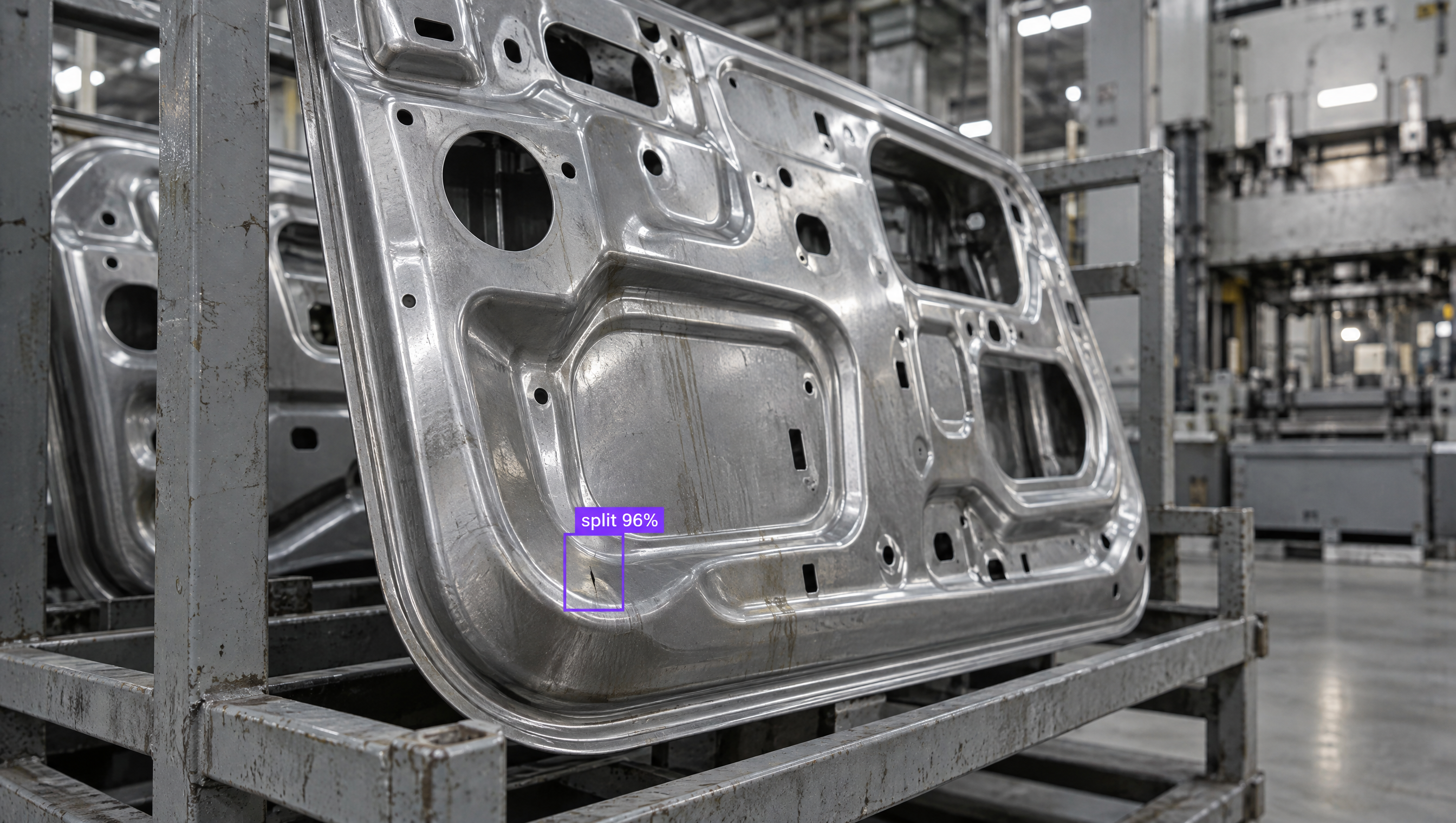
AI identifies a "split" defect (96% confidence) on a metal car door frame in a factory.

Why are companies choosing Roboflow?

Roboflow is enterprise vision AI infrastructure, used by more than half of the Fortune 100, with SOC 2 Type II, HIPAA, and air-gapped deployment. Reliability, flexibility, and platform depth for manufacturing inspection.

  • Reliable on the line

    Models you retrain on your own images, tuned per station to cut misses and false alarms, running fully offline with no cloud dependency.

  • Proof in days, not quarters

    Prove a use case on your own images within days, with Roboflow engineers helping through onboarding and workflow review.

  • A platform you own and grow

    Retrain, export, and scale your models across every line and plant with a modern HMI and published pricing.

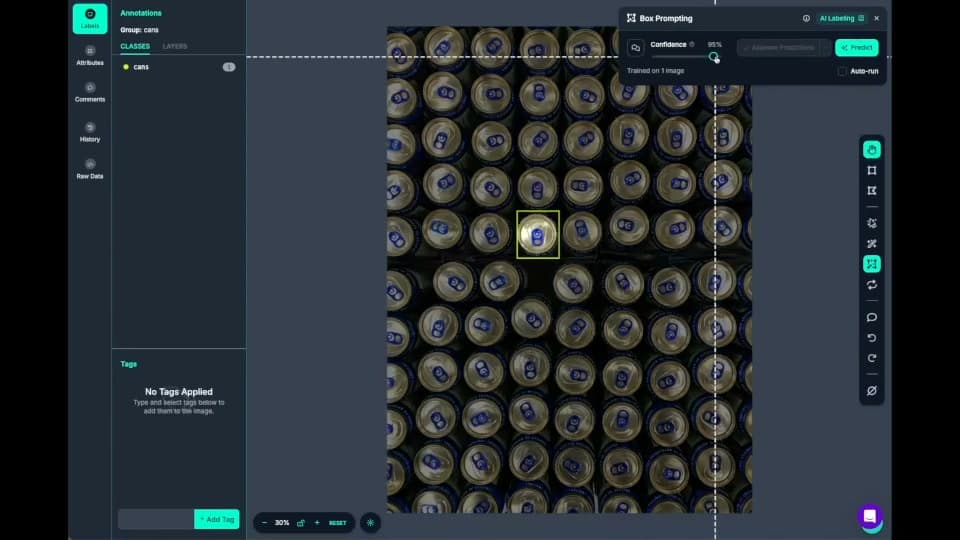
  • Roboflow Annotate labeling cans with AI box prompting

    Fast data labeling

    Label data quickly with a suite of AI-assisted annotation tools to augment human labeling or fully automate your data labeling pipeline.
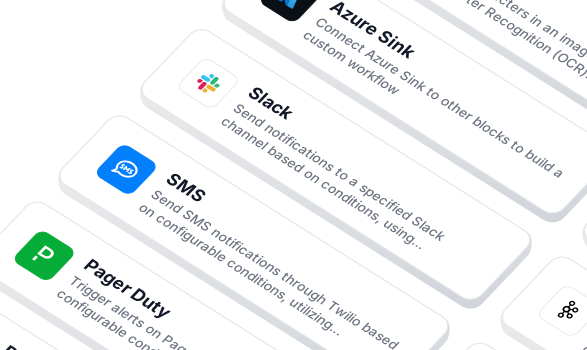
  • Workflow blocks for notifications and integrations

    Build vision AI applications with ease

    Use a low-code open source platform to simplify building and deploying vision AI applications.
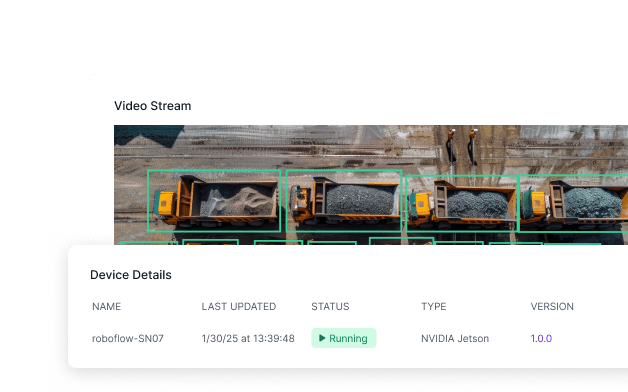
  • A video stream with detections and its NVIDIA Jetson device running

    Edge deployment

    Cloud and edge deployments (NVIDIA Jetson, Raspberry Pi, or mobile devices) for real-time, on-premise inference.
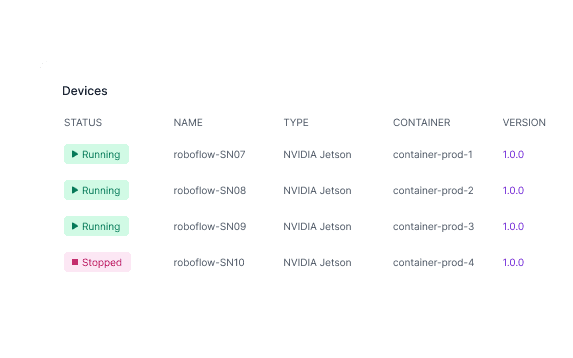
  • A list of NVIDIA Jetson devices and their status

    Devices for every scenario

    Software, compute, cameras: all the tools you need to deploy vision AI.
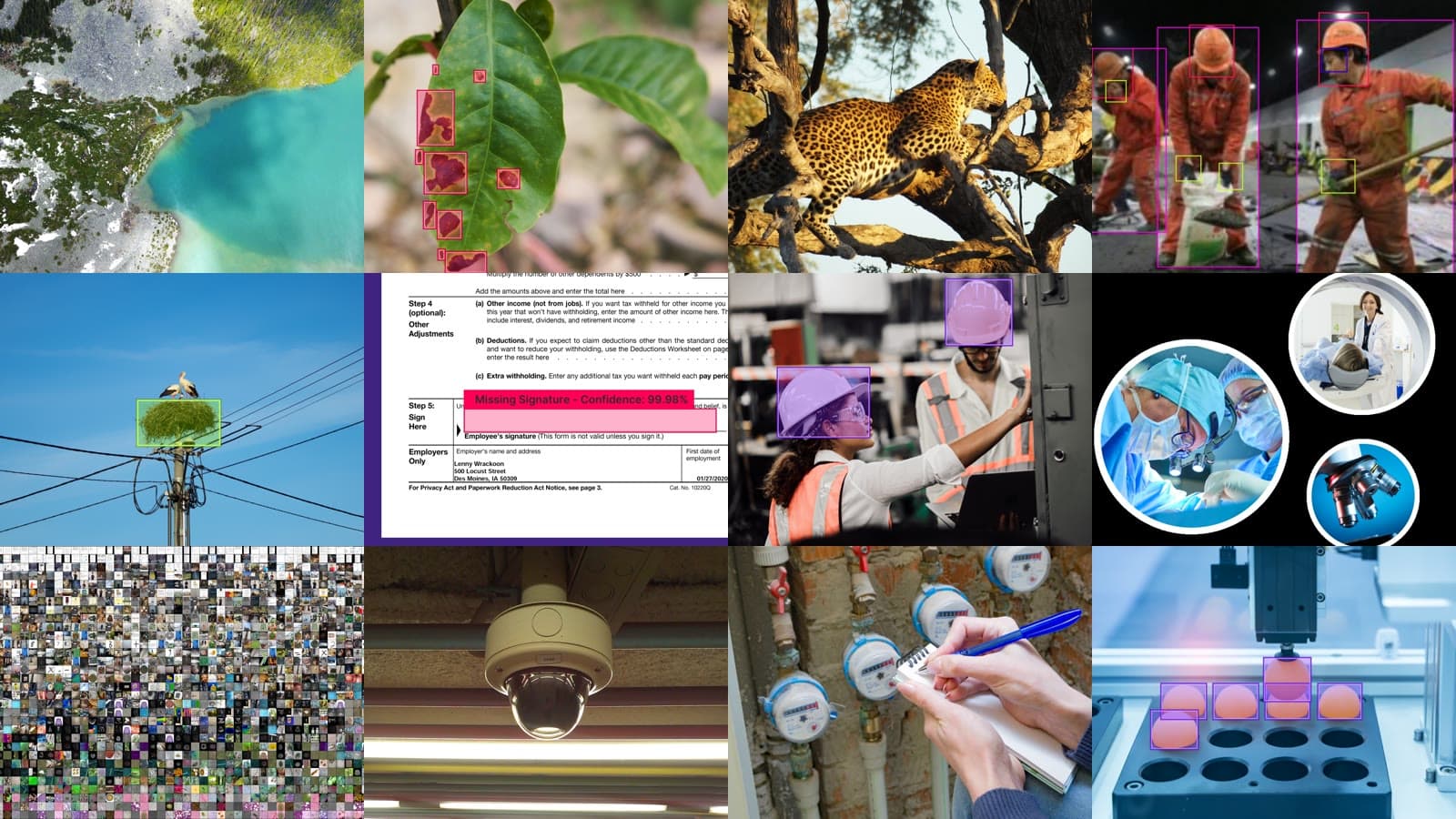
  • Photos from datasets across industries

    Datasets and models for every industry

    Access thousands of datasets and pre-trained models to kickstart your computer vision projects.
  • Logos of OpenAI, Microsoft, Meta, Anthropic, Google and Qwen

    Flexible model licensing

    Choose from a range of licensing options to fit your needs, whether for commercial use, private deployment, or collaboration across teams.

Ready to migrate from Lincode to Roboflow in minutes?

  • Import images to Roboflow

    Bring your existing inspection images and labels from LIVIS into Roboflow for model training.

  • Deploy with Roboflow

    Run on an NVIDIA Jetson, an air-gapped server, or the Roboflow AI1 device, and trigger PLCs from Workflows.

  • Automate data labeling

    Use AI labeling in Roboflow to automate 90% of human labeling.

OK I’m ready, how do I use Roboflow?

Roboflow makes it easy to build, train, and deploy custom computer vision models, even if you’re not a machine learning expert.

Talk to a Vision AI engineer about defect detection

Bring us your toughest defect problem and we'll map a working solution on the first call.

Ask us about:

  • Solution architecture on your existing cameras, PLCs, and MES
  • A live demo on your own defect images
  • Deployment options: edge, on-prem, or air-gapped
  • ROI modeling against false rejects, escapes, and manual inspection time

Over 80,000 organizations build with Roboflow.

  • Rivian
  • Pella
  • Chobani
  • USG Corporation
  • BNSF Railway
  • American Woodmark
Start where you are

Compare Lincode and Roboflow

Lincode’s LIVIS combines AI model training, inspection management, and edge inference for manufacturing. It supports existing cameras and connects to factory systems. Roboflow gives engineering teams control over the model, inspection logic, and deployment, with tools to test how the complete application behaves on their own production images.

That control matters when a missed defect and a false reject have different costs. In Roboflow Workflows (opens in a new tab), define confidence thresholds, combine models, and route uncertain results for review. Check that a valid part was inspected before treating an absence of defect detections as a pass. Workflow Evals helps test those final decisions against reviewed examples before an updated application reaches the line.

To build the model, use Auto Label to draft annotations from a text prompt, review them, and train an architecture such as RF-DETR or YOLO. Roboflow Agent helps assemble the inspection application, while the MCP integration makes dataset management, training, and inference available through ChatGPT (opens in a new tab) and coding assistants. Engineers can inspect the resulting Workflow and revise it as parts, lighting, or inspection criteria change.

Deploy on compatible edge hardware, your own servers, or Roboflow Cloud. Enterprise options include PLC integrations, offline operation, on-site installation, and Workflow review. With Vision Events, teams can retain selected inspection images and predictions, investigate incorrect decisions, and add useful examples to the next training dataset.

Roboflow’s free plan provides private projects and 10 monthly credits for an initial evaluation. Supported model weights are downloadable, and local inference has no metered Roboflow inference charge. Your team can validate the inspection before a larger rollout and keep improving the system it deploys.

Lincode vs Roboflow: Feature by Feature

FeatureRoboflowLincode (LIVIS)
Vision tasksObject detection, instance and semantic segmentation, classification, keypoints, OCR, depth estimation, and multimodal tasksAnomaly detection, classification, object detection, and segmentation, plus OCR reading and label inspection; keypoints and depth estimation not documented
Camera supportAny RTSP, USB, GigE, or industrial cameraBroad; GigE Vision, USB3 Vision, IP, and webcams, plus Cognex, Keyence, and Omron cameras via FTP or shared folder
Train your own modelYes, RF-DETR, YOLO (v8 / v11 / v26), Detectron2, and moreYes; 30 to 50 images per defect on average, with initial training in a few hours; architecture choice not documented
Choose model architectureYes, pick and swap RF-DETR, YOLO (v8 / v11 / v26), Detectron2, and moreNot documented; AI Inspector is a proprietary intelligence layer
Export and own model weightsYesNot documented; clients own their input and output data
AI-assisted labelingYes, Auto Label labels the classes you describe in a text prompt; Smart Polygon powered by Meta AI's Segment Anything; Label Assist pre-annotates with your own trained modelsYes, auto-annotate datasets and AI-assisted labeling on all plans
Keeping models accurate over timeBuilt in; active learning and operator feedback send flagged images back into training; Vision Events logs every prediction and image; model monitoring on EnterpriseContinuous learning; operators can teach new defect types with one click
PLC and factory integrationsPLC Reader, PLC Writer, and OPC UA blocks speak OPC UA, Modbus TCP, and EtherNet/IPYes, Modbus, Profibus, Profinet, TCP, and SLMP; APIs for MES and ERP
Edge hardwareYes, the Roboflow AI1 device packages onboard AI compute, integrated lighting, and an industrial camera, or run on hardware you already ownYes, LIVIS Edge+ controllers run inference on premises in under 40 ms on average, charged separately
Deployment optionsManaged cloud, customer VPC, on-premises, and fully air-gapped / offlineLIVIS Cloud Platform or LIVIS On-Prem Platform, with inference on on-prem Edge+ controllers; air-gapped install not documented
API and SDKYes, Python SDK, REST API, MCP server, public docs; open-source inference server and supervision libraryAPIs for factory systems; no public API reference or SDK documentation
No-code application logicYes, visual Workflows chain detection, OCR, counting, and PLC output without code, with confidence thresholds and business logic tuned per stationYes, the no-code LIVIS Platform trains models and manages workstations, plus an Android app
Open sourceYes, supervision and inference libraries, plus integrations with Hugging Face Transformers and MMDetectionNo, there are no open-source libraries or public GitHub organization listed
Sub-agents for frontier models (MCP)Yes, every trained model is exposed over MCP so frontier models can call it as a specialized vision toolNot documented
Uptime SLAYes, on Enterprise, with a public status pageNot published
ComplianceSOC 2 Type II, HIPAA with BAAs, PCI DSSSOC 2 certified; Type 2 report available to clients
PricingPublished plans; Enterprise adds volume pricing and an uptime SLANot published; Station and Factory plans cap seats, AI inspectors, GPU hours, and storage, Enterprise is custom, and Edge+ controllers are charged separately

Best Lincode Alternatives

Roboflow is the top Lincode alternative for manufacturers that want inspection models they own, on the cameras already on the line. Teams comparing Lincode also look at:

Explore Roboflow for Manufacturing Inspection

Related Roboflow solutions for teams evaluating Lincode: