IBM Maximo Visual Inspection alternatives? Over 2 million engineers create datasets, train models, and deploy to production with Roboflow.
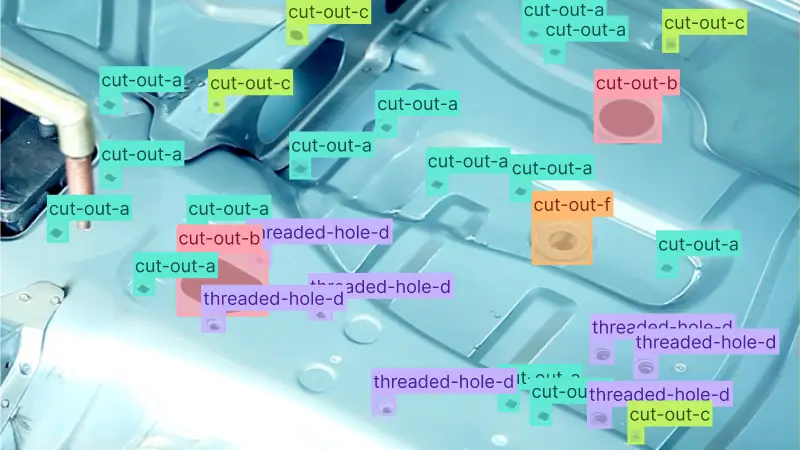


IBM Maximo Visual Inspection (MVI) is the computer vision application inside IBM Maximo Application Suite. The labeling UI is no-code, but everything around it is not. Standing it up means a Red Hat OpenShift cluster, NVIDIA GPUs, a MAS entitlement, and usually an IBM partner or Maximo integrator to install and configure it. Keeping it useful means the same people: when a fixed-list model (GoogLeNet, Faster R-CNN, YOLO v3, Detectron2) falls short on a new defect or a new camera angle, there is no newer architecture to switch to and no way to bring your own, so tuning becomes an engineering project. Results reach the plant floor only through Maximo Monitor and MQTT, which is one more integration to own. And because models export only to other MVI instances (or Core ML and TensorFlow Lite for three architectures), the work stays inside IBM's suite. The one public Gartner Peer Insights review sums it up: onboarding requires technical experience.
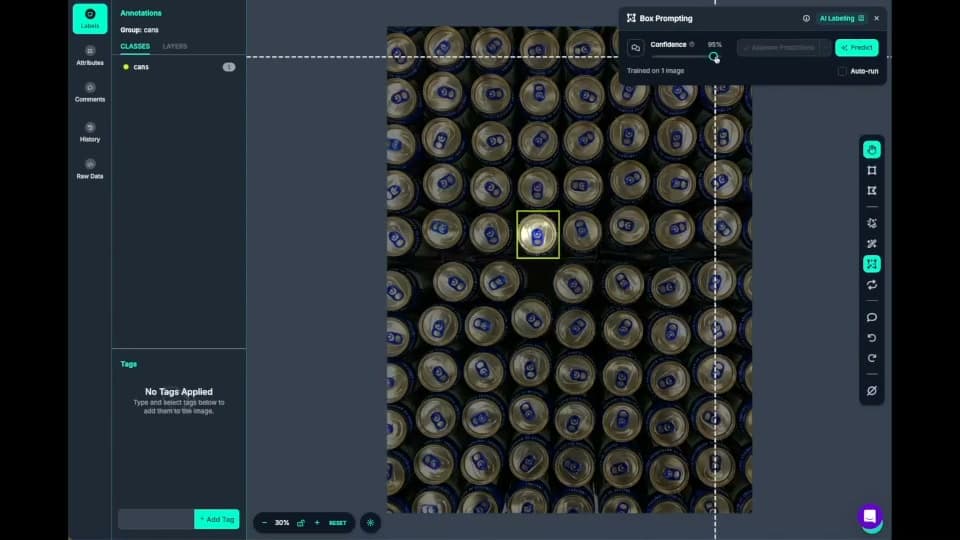
Teams that want to run inspection without an ML team choose Roboflow. GPT-6 Astra is the first foundation model that sees well enough to label production data, so the first pass at labeling happens before anyone on your team has trained anything: describe the classes in plain text, Auto Label with GPT-6 Astra and Gemini does the work, and Smart Polygon handles masks in one click. Training RF-DETR or YOLO26 is a button click. Workflows chains detection, OCR, counting, and PLC output on a drag-and-drop canvas, and the same screen is the line-side HMI where operators flag wrong predictions. Vision Events stores every flagged prediction with its image and sends it straight into the next training set, so the model gets better because a line operator tapped a button, not because a specialist opened a project.
Each trained model is exposed over MCP as a vision sub-agent that GPT-6 Astra and Gemini can call whenever they need to see an asset or a line precisely. And nothing is locked in: the dataset, the weights, the event history, and the deployment are yours to export and move.
Unlike black-box APIs, Roboflow gives you visibility into your model’s performance and the ability to iterate quickly. Teams choose Roboflow because it supports end-to-end development, data privacy, and long-term ownership of their vision systems.
Both let a team label images, train a detection model, and run it at the edge. The difference is who has to be in the room every time the model needs to change, and whether the work you put in can ever leave the vendor's system.
| Feature | Roboflow | IBM Maximo Visual Inspection |
|---|---|---|
| Who stands it up | Anyone; sign up in a browser, upload images, start labeling the same day | Platform engineers plus an IBM partner; Red Hat OpenShift, NVIDIA GPUs, and a MAS entitlement before the first image is labeled |
| Who labels the data | A quality engineer or an operator; Auto Label with GPT-6 Astra and Gemini does the first pass from a text prompt, Smart Polygon powered by Segment Anything handles masks | A person drawing boxes and polygons by hand; auto label only reuses a model you already trained, so someone has to train first |
| Who trains the model | Same person, one click; RF-DETR, YOLO (v8 / v11 / v26), Detectron2, and more, no ML background required | No-code UI, fixed list: GoogLeNet, Faster R-CNN, YOLO v3, Tiny YOLO v3, Detectron2, High Resolution; when one falls short there is no newer option and no custom model import since 8.7 |
| Who keeps it accurate | Operators on the line; flag a wrong prediction from the HMI and it lands in the next training set through Vision Events | Whoever owns the dataset; no operator feedback loop documented, corrections mean relabeling and retraining in the console |
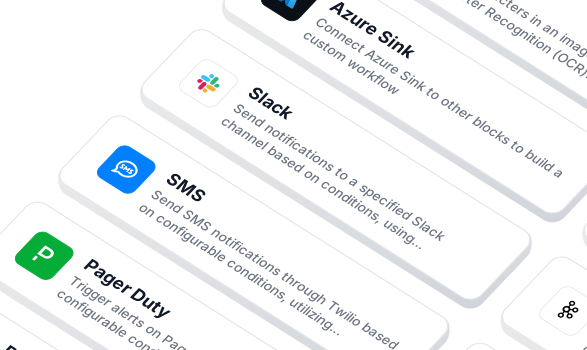
| Who wires it to the line | The same person, in Workflows; drag-and-drop PLC Reader, PLC Writer, and OPC UA blocks (OPC UA, Modbus TCP, EtherNet/IP) | An integrator; PLC triggers over MQTT, results through Maximo Monitor into Manage work orders; OPC UA, Modbus TCP, and EtherNet/IP not documented |
| Who adds the next use case | Same team, same account; new dataset, new model, new Workflow, deployed to the next camera | Same specialists, more AppPoints; each new station needs GPU capacity on the cluster and a fit inside the fixed model list |
| Dashboards | Built in; Vision Events aggregates predictions, images, and metadata from every camera and site, filterable by shift, line, lot, or serial range | Via Maximo Monitor; a second MAS application to license, configure, and maintain |
| Sub-agents for frontier models (MCP) | Yes, every trained model is exposed over MCP so GPT-6 Astra and Gemini can call it as a specialized vision tool, and agents can query Vision Events history over MCP | No for vision; the MAS 9.2 MCP server targets Maximo Manage APIs, not inspection models |
| Can you take the model with you | Yes; export weights, datasets, and event history at any time | Only to another MVI instance, or Core ML and TensorFlow Lite for three architectures; no ONNX or PyTorch export documented |
| Can you take the data with you | Yes; export in any standard annotation format | MVI zip; built for import into another MVI instance |
| Camera support | Any RTSP, USB, GigE, or industrial camera, plus the Roboflow AI1 device with integrated camera and lighting | RTSP/IP, USB, GigE Vision (Basler), image folders, and video via MVI Edge; iPhone camera via MVI Mobile |
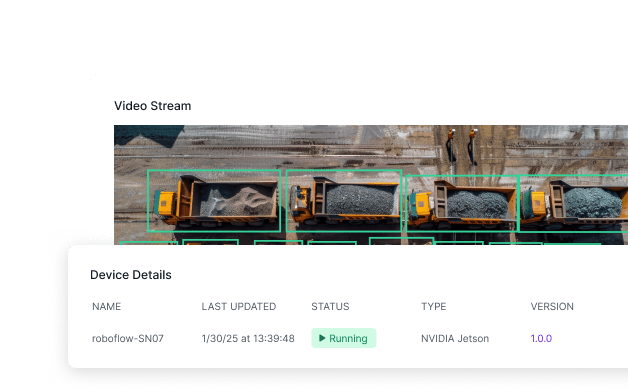
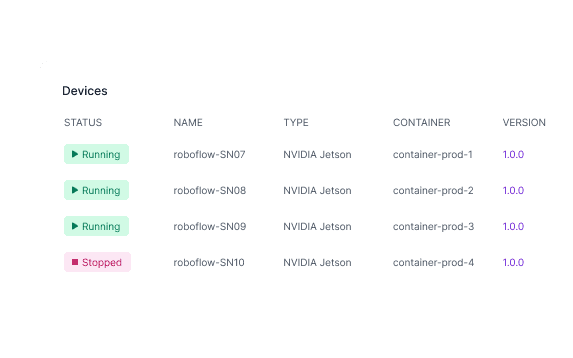
| Edge deployment | Yes, NVIDIA Jetson, x86 servers, Roboflow AI1, fully offline; open-source inference server runs on hardware you already own | Yes, MVI Edge on x86 or ARM64 with an NVIDIA GPU required, Docker or Podman, managed from the central Edge Manager |
| Self-serve sign-up and free tier | Yes | No; product tour and demo request; 12-month minimum on SaaS |
| Time to first model | Days, on your own images, starting the same day | Gated on standing up OpenShift, GPUs, and MAS; the one Gartner Peer Insights review notes onboarding requires technical experience |
| API and SDK | Yes, Python SDK, REST API, MCP server, public docs | REST API with API keys; open-source Python client and CLI (IBM/vision-tools) last pinned to MVI 8.5 |
| Open source | Yes, supervision and inference libraries | Client only; the platform is proprietary |
| Compliance | SOC 2 Type II, HIPAA with BAAs, PCI DSS | MAS SaaS holds FedRAMP Moderate for Manage and Mobile; IBM states Visual Inspection authorization is in process; SOC 2 scope for MVI not published |
| Air-gapped deployment | Yes, Docker-based offline install | Yes, on customer-managed OpenShift on-premises |
| Pricing | Published plans; free tier; usage you can see before you sign | AppPoints; Inspection Essentials SaaS on AWS Marketplace at $46,412 per year per unit of 5 devices, 12-month non-cancellable |
Maximo Visual Inspection assumes you have, or will hire, people who administer OpenShift, size GPUs, configure MAS, and wire MQTT into Monitor, and it assumes you will keep them, because the models and the data are built to stay inside the suite. Roboflow assumes the person who understands the parts is the person who should own the model, and gives them the tools to do it without an ML team.
Maximo Visual Inspection fits enterprises standardized on Maximo with a platform team to run it. Roboflow fits teams who want the quality engineer, not an ML department, to build, tune, and own their vision models, from the first defect detection station to every camera and drone in the fleet, with Vision Events tracking the results and frontier models calling the models over MCP.
| RoboflowEnd-to-end computer vision platform (annotate, train, deploy) | IBM Maximo Visual InspectionComputer vision application inside IBM Maximo Application Suite |
|---|---|
| Scale & Ecosystem | |
|
|
| Product Capabilities (Computer Vision) | |
|
|
| Developer Experience | |
|
|
| Enterprise & Security | |
|
|
Sources: roboflow.com, docs.roboflow.com, blog.roboflow.com, security.roboflow.com, universe.roboflow.com, github.com/roboflow, ibm.com/products/maximo/asset-inspection, ibm.com/products/maximo/pricing, ibm.com/docs (Maximo Visual Inspection), ibm.com/support (MVI service updates), ibm.com/new/announcements, aws.amazon.com/marketplace, github.com/IBM/vision-tools, apps.apple.com, gartner.com/reviews, and IBM partner documentation. Figures reflect publicly available information as of September 2026.