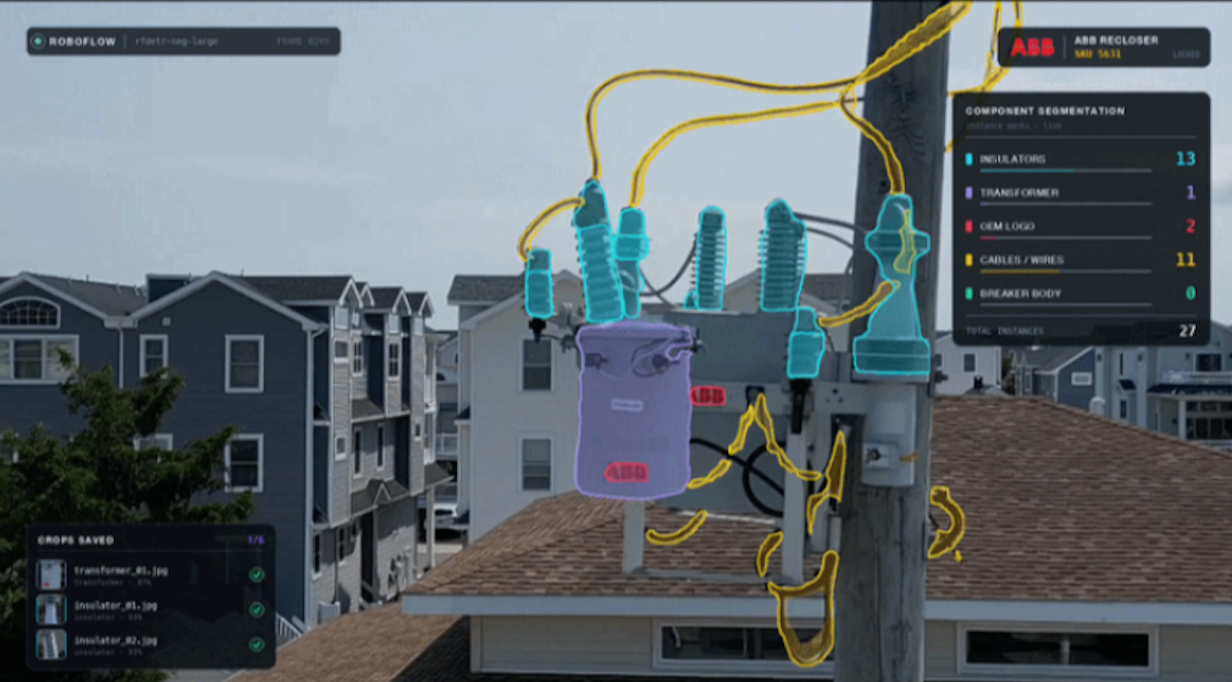
Add a real-time inspection layer to every asset in your service territory with Vision AI for utility asset inspection. Built for the operations where a cracked insulator, a corroded recloser, or a missing ground wire can mean a flashover outage, a wildfire ignition, or an emergency truck roll in the middle of a storm. Whether you're flying distribution feeders with drones, patrolling transmission corridors by helicopter, or walking substations with handheld cameras, Roboflow extends inspection coverage to every pole and every component, on the imagery your crews already capture, with records that support NERC reliability standards and NESC requirements.
Component Segmentation and Asset Inventory:
- Segment and crop utility pole components including insulators, transformers, cables, crossarms, and breaker bodies from drone imagery, frame by frame
- Read OEM logos, nameplates, and serial numbers to identify equipment make and model in the field
- Build a GPS-tagged inventory of every component in your service territory, updated on every flight
Defect Detection and Pass/Fail Classification:
- Classify each component as pass or fail and highlight detected defects on the image record
- Catch cracked or contaminated insulators, corroded connections, damaged conductors, and woodpecker holes, the subtle features that only show at a specific angle
- Flag damaged or missing equipment, from cotter pins to ground wires to guy guards, to improve inspection speed and consistency
Inspection Reports and Preventative Maintenance Planning:
- Generate inspection reports with defect summaries, component inventory, and GPS location for every structure
- Produce an auditable inspection record that supports preventative maintenance planning, rate-case documentation, and regulator reviews
- Feed pass/fail results into EAM, GIS, and work order systems so crews roll to the right pole with the right parts
Bring intelligence to every asset today. Stop cracked insulators and corroded connections from becoming outages and ignition events.
More About Utility Asset Inspection
What is utility asset inspection with Vision AI?
Utility asset inspection with Vision AI uses computer vision models to evaluate the condition of transmission, distribution, and substation equipment from drone, helicopter, and fixed-camera imagery. The system segments and crops components including insulators, transformers, cables, crossarms, and breaker bodies, classifies each one as pass or fail, flags damaged or missing equipment, and generates inspection reports with defect summaries, component inventory, and GPS location. Investor-owned utilities, co-ops, municipal utilities, and inspection service providers use it to shorten inspection cycles, standardize defect calls across crews, and maintain auditable records that support NERC reliability standards, NESC (IEEE C2) requirements, and wildfire mitigation plan filings.
Can Vision AI detect cracked insulators and missing hardware from drone imagery?
Insulator and hardware condition is exactly where utility inspection teams feel the most pressure: the defects are small, the assets number in the millions, and a miss can become an outage or an ignition event. Roboflow models are trained on your actual flight imagery, your equipment types, and your defect standards, so they learn the difference between surface weathering and a crack that matters. Segmentation isolates each component before classification, which keeps a hairline fracture from being lost in a full-frame image. Reviewers stay in the loop on borderline calls, and every confirmed defect goes back into training, so accuracy compounds flight over flight.
Does utility asset inspection support NERC reliability standards and NESC requirements?
Yes. Roboflow produces the inspection evidence layer that supports NERC reliability standards (the FERC-approved mandatory standards for the bulk power system, including the FAC facilities design and maintenance family), NESC (IEEE C2, the National Electrical Safety Code), OSHA 1910.269 requirements for electric power generation, transmission, and distribution work, and state wildfire mitigation plan filings. Your engineering and standards teams own the acceptance criteria and inspection intervals; Roboflow applies them consistently to every image and maintains the GPS-tagged, time-stamped record that regulators and auditors ask for.
Can it integrate with our EAM, GIS, and drone data pipeline?
Yes. Roboflow Inference (opens in a new tab) exposes a standard API that fits existing utility data pipelines. Customers integrate with EAM and work management platforms (IBM Maximo, SAP PM, Oracle Utilities Work and Asset Management), GIS (Esri ArcGIS Utility Network, GE Smallworld), drone data and flight platforms (DJI Terra, Skydio, DroneDeploy, Pix4D), and OMS and ADMS systems through REST, MQTT, and direct database writes. Pass/fail results, defect crops, and GPS coordinates flow straight into work orders, so a failed insulator becomes a scheduled repair without a manual re-review step.