Amazon Rekognition vs Google Vision

Rekognition and Google Vision need an ML team to customize. Roboflow doesn't.

Getting Amazon Rekognition or Google Cloud Vision to recognize your own objects means labeling images by hand, setting up custom training in the cloud console, and managing model versions and retraining yourself. Roboflow puts labeling, training, and deployment in one platform your team can run without dedicated ML engineers. Over 2 million developers build with Roboflow.

A factory worker holding a tablet displaying automated visual inspection software to detect defects in manufactured parts along a conveyor belt.

Why are companies choosing Roboflow?

Roboflow is enterprise vision AI infrastructure, used by more than half of the Fortune 100, with SOC 2 Type II, HIPAA, and air-gapped deployment. Create datasets, train models, and deploy to production.

  • No ML Team Required

    Label, train, and deploy from one platform your engineers and domain experts can run, without stitching cloud services together.

  • Labels Drafted for You

    Auto Label drafts annotations from a text prompt, so nobody draws every box by hand in a cloud console.

  • Upkeep Built In

    Active learning sends flagged production images back into your dataset, so retraining doesn't turn into a project.

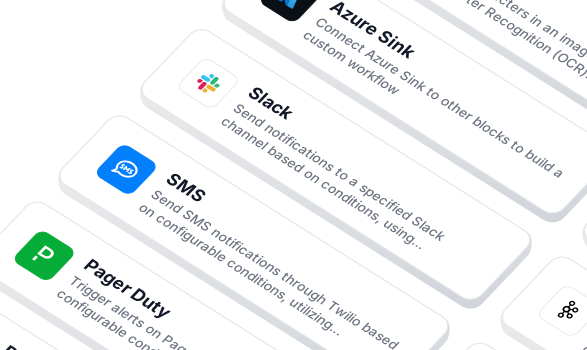
  • Workflow blocks for notifications and integrations

    Build vision AI applications with ease

    Use a low-code open source platform to simplify building and deploying vision AI applications.
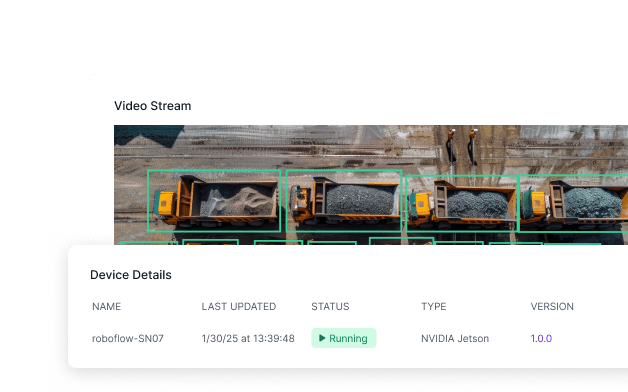
  • A video stream with detections and its NVIDIA Jetson device running

    Edge deployment

    Cloud and edge deployments (NVIDIA Jetson, Raspberry Pi, or mobile devices) for real-time, on-premise inference.
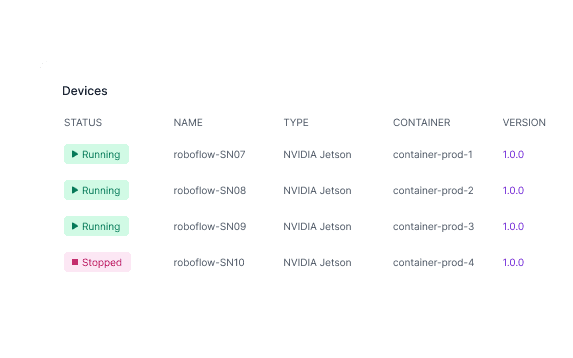
  • A list of NVIDIA Jetson devices and their status

    Devices for every scenario

    Software, compute, cameras: all the tools you need to deploy vision AI.
  • Logos of OpenAI, Microsoft, Meta, Anthropic, Google and Qwen

    Flexible model licensing

    Choose from a range of licensing options to fit your needs, whether for commercial use, private deployment, or collaboration across teams.

Moving beyond Rekognition or Google Vision?

  • Import images to Roboflow

    Bring your images and any existing labels, in COCO, YOLO, or 40+ other formats, into Roboflow.

  • Deploy with Roboflow

    No matter where you train your model, use Roboflow's trusted deployment solutions.

  • Automate data labeling

    Use AI labeling in Roboflow to automate 90% of human labeling.

OK I’m ready, how do I use Roboflow?

Roboflow makes it easy to build, train, and deploy custom computer vision models, even if you’re not a machine learning expert.

Talk to a Vision AI engineer before you staff up an ML team

Weighing Amazon Rekognition and Google Vision? Bring Roboflow images of what you need to detect and we'll show you a model trained on your data on the first call.

Ask us about:

  • A live demo of Auto Label on your own images, reviewed by your team
  • A custom model trained on your parts, products, or defects
  • Deployment options: cloud, VPC, on-prem, edge, or air-gapped
  • Your trained model served over MCP, so frontier models can call it

Over 80,000 organizations build with Roboflow.

  • Rivian
  • Pella
  • Chobani
  • USG Corporation
  • BNSF Railway
  • American Woodmark
Start where you are

Compare Amazon Rekognition, Google Vision and Roboflow

Amazon Rekognition, Google Vision, and Roboflow all analyze images, but they serve different needs.

Amazon Rekognition is AWS's image and video analysis service, with pre-trained APIs for labels, faces, text, unsafe content, and PPE, plus Rekognition Custom Labels for training your own classification and object detection models. Google Cloud Vision API offers pre-trained features for labels, objects, OCR, logos, landmarks, and explicit content; training custom models requires a separate Google service, AutoML in Gemini Enterprise Agent Platform (formerly Vertex AI). Roboflow is an end-to-end computer vision platform that enables developers and enterprises to build, train, evaluate, and deploy vision AI applications without managing separate tools for each stage.

The pre-trained APIs are quick to start, but customizing them is where the work begins. On AWS, Custom Labels training starts with drawing labels and bounding boxes by hand in the console, and each model version has to be started and stopped, billed by the hour while it runs. On Google Cloud, custom models move to a separate service, AutoML in Gemini Enterprise Agent Platform, and Google's Data Labeling Service shut down in 2024. Keeping either one accurate as products and conditions change means adding and labeling new images and training new versions yourself, work that usually falls to an ML team.

Roboflow is built so your own engineers and domain experts can do that work. Auto Label drafts annotations from a text prompt, your team reviews them, and the reviewed images become a versioned dataset. Train a model such as RF-DETR (opens in a new tab) Roboflow's open-source object detection, segmentation, and keypoint model released under the Apache 2.0 license for commercial use on it, then deploy through a hosted API that scales with traffic, with no model versions to start or stop, or run it on your own hardware with Roboflow's open-source Inference server (opens in a new tab). When conditions change, active learning sends flagged production images back into your dataset for the next training run.

Enterprises can also use Roboflow Workflows to build applications that combine computer vision models with business logic, then deploy them to the cloud, on-premises infrastructure, or edge devices such as NVIDIA Jetson.

And teams can also use Roboflow MCP to build and manage computer vision applications directly from AI assistants like ChatGPT and Claude, or Roboflow Agent to get AI-powered guidance on selecting models, building Workflows, and deploying vision AI applications.

For organizations building production computer vision applications in manufacturing, logistics, robotics, healthcare, or retail, Roboflow offers a more complete training-to-deployment solution.

Amazon Rekognition vs Google Vision vs Roboflow: Feature by Feature

FeatureRoboflowAmazon RekognitionGoogle Vision
Pre-trained image analysisYes, 250,000+ pre-trained models and 1,000,000+ datasets on Roboflow UniverseYes, labels, faces, face liveness, text, unsafe content, celebrities, and PPEYes, labels, objects, text, faces, logos, landmarks, explicit content, and web entities
Custom model trainingYes, RF-DETR, YOLO (v8 / v11 / v26), Detectron2, and moreCustom Labels; trains an AWS-managed model; architecture choice not documentedSeparate service; AutoML in Gemini Enterprise Agent Platform (formerly Vertex AI); legacy AutoML Vision shut down July 31, 2024
Custom vision tasksObject detection, instance and semantic segmentation, classification, keypoints, OCR, depth estimation, and multimodal tasksClassification and detection only; AWS says Custom Labels is not designed for faces, text, or unsafe contentClassification and object detection with AutoML image training
Labeling your imagesAI-drafted; Auto Label labels the classes you describe in a text prompt; Smart Polygon powered by Meta AI's Segment Anything; Label Assist pre-annotates with your own trained modelsBy hand; image-level labels and bounding boxes drawn in the console, or import a SageMaker Ground Truth manifestManual; labels are added in the Google Cloud console, and the Data Labeling Service shut down October 3, 2024
Keeping models accurateBuilt in; active learning and operator feedback send flagged production images back into your dataset, and Vision Events logs every prediction and imageManual; add and label new images, then train a new model version, or install the separate Model Feedback sample solution from GitHubManual; Cloud Vision API models are fixed; custom models are relabeled and retrained in a separate service
Export and own model weightsYesNot documented; models are called through the Custom Labels APIAutoML Edge only; not documented for Cloud Vision API models
Edge and offline deploymentYes, NVIDIA Jetson, GPU servers, Raspberry Pi, x86, or Roboflow AI1, online or fully offlineAWS cloud only; Custom Labels models run on inference units in an AWS Region; edge or offline use not documentedPartial; exported AutoML Edge models only; Cloud Vision API is a cloud REST and RPC API
Video and camerasAny RTSP, USB, GigE, or industrial cameraStored video, analyzed from Amazon S3; Streaming Video closed to new customers as of April 30, 2026Images and files; video analysis is a separate product, the Video Intelligence API
Running a trained modelServerless hosted API that scales with traffic, or self-hosted on your own hardware, with no model to start or stopStart and stop each model version; inference units bill per hour while running, even when idleCloud Vision API runs on Google's endpoints; custom AutoML models are served through Google Cloud
Self-hosted inferenceYes, open-source inference server for custom and foundation modelsNo; Custom Labels models are served as AWS-managed endpoints billed in inference unitsNo; the Cloud Vision API is not self-hostable
Uptime SLAYes, on Enterprise, with a public status pageYes, 99.9% monthly uptime per AWS Region, with service creditsYes, 99.9% monthly uptime for Cloud Vision, with financial credits
ComplianceSOC 2 Type II, HIPAA with BAAs, PCI DSSAssessed under AWS programs including SOC, PCI, FedRAMP, and HIPAAIn scope for ISO 27001 / 27017 / 27018, SOC 1 / 2 / 3, and PCI DSS; HIPAA-covered under Google's BAA
SDKs and APIsYes, Python SDK, REST API, MCP server, public docs; open-source inference server and supervision libraryYes, AWS SDKs (boto3 for Python, plus Java, .NET, Go, JavaScript, Ruby, PHP) and the AWS CLIYes, Google Cloud client libraries for Python, Node.js, Go, Java, Ruby, PHP, and C#, plus REST and gRPC APIs
PricingPublished plans; every plan, including Free, includes self-hosted inference, model weights download, and a private workspaceImage APIs from $0.001 per image for the first 1 million images a month; Custom Labels $1 per training hour and $4 per inference hourBilled per image per feature; first 1,000 units per feature free each month, then $1.50 per 1,000 for most features

Which One Should You Choose?

  • Choose Amazon Rekognition if a pre-trained API already recognizes what you need, such as faces, text, or unsafe content, you build on AWS, and you won't need to customize it.
  • Choose Google Vision if a pre-trained API already covers your use case, such as OCR, logos, or landmarks, you build on Google Cloud, and you won't need to customize it.
  • Choose Roboflow if you need a model trained on your own parts, products, or defects, and want labeling, training, deployment, and retraining in one platform your team can run without dedicated ML engineers.

More Comparisons