Amazon Rekognition Custom Labels runs on your team's time, Roboflow automates the labeling, retraining, and upkeep

Amazon Rekognition alternatives? Custom Labels leaves your team hand-labeling images, retraining each new model version, and starting and stopping models to manage cost. Over 2,000,000 engineers use Roboflow to auto-label with GPT-6 Astra and Gemini, feed production images back into training, and deploy without the upkeep.
Why are companies choosing Roboflow?

The turnkey solution for vision AI used by over 2 million engineers to create datasets, train models, and deploy to production.

  • Label in minutes, not weeks

    Auto Label drafts labels with GPT-6 Astra and Gemini for the classes you describe, so your team reviews labels instead of drawing every box.

  • Models that stay current

    Active learning sends flagged production images back into your dataset, so each retrain starts from real-world misses instead of a manual hunt.

  • Experts who share the work

    Roboflow AI specialists and Field Engineers help with dataset design, training, and deployment, so your engineers aren't carrying it alone.

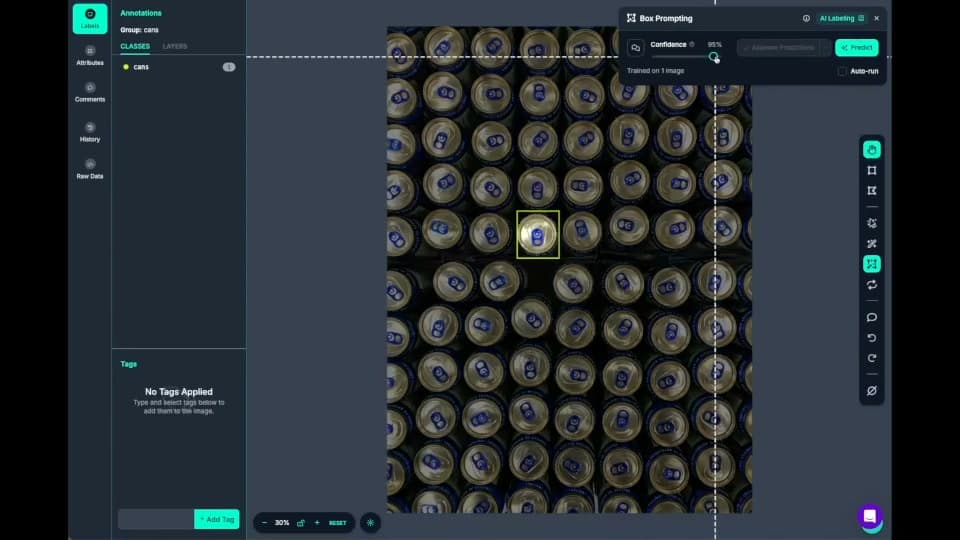
  • Roboflow Annotate labeling cans with AI box prompting

    Fast data labeling

    Label data quickly with a suite of AI-assisted annotation tools to augment human labeling or fully automate your data labeling pipeline.
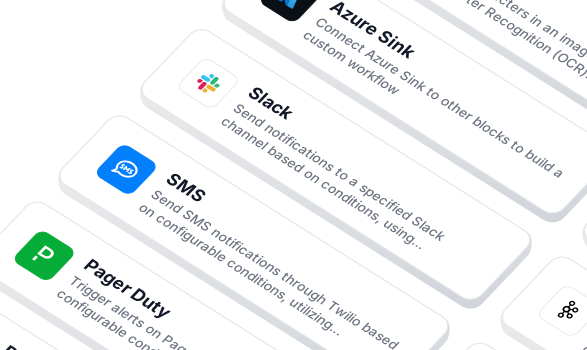
  • Workflow blocks for notifications and integrations

    Build vision AI applications with ease

    Use a low-code open source platform to simplify building and deploying vision AI applications.
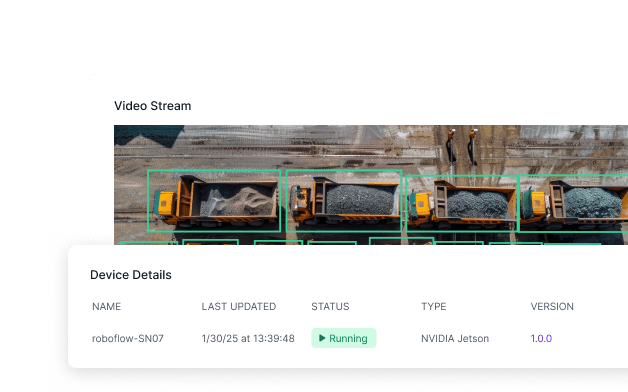
  • A video stream with detections and its NVIDIA Jetson device running

    Edge deployment

    Cloud and edge deployments (NVIDIA Jetson, Raspberry Pi, or mobile devices) for real-time, on-premise inference.
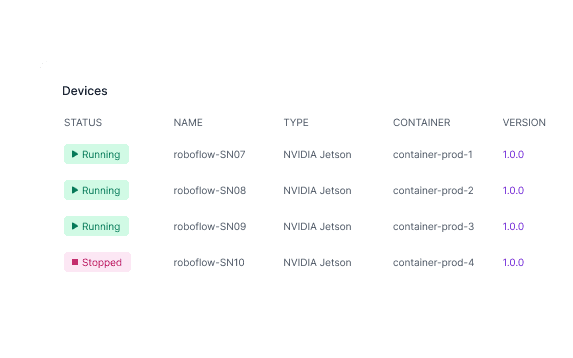
  • A list of NVIDIA Jetson devices and their status

    Devices for every scenario

    Software, compute, cameras: all the tools you need to deploy vision AI.
  • Logos of OpenAI, Microsoft, Meta, Anthropic, Google and Qwen

    Flexible model licensing

    Choose from a range of licensing options to fit your needs, whether for commercial use, private deployment, or collaboration across teams.

Want to move from Amazon Rekognition to Roboflow?

  • Import your images and labels

    Bring your images from Amazon S3 and your Custom Labels manifest files into Roboflow. Existing labels carry over, no relabeling needed.

  • Deploy with Roboflow

    Run models on Roboflow's serverless API, in your own AWS account, or on edge devices, with no model to start or stop.

  • Automate data labeling

    Use AI labeling in Roboflow to automate 90% of human labeling.

OK I’m ready, how do I use Roboflow?

Roboflow makes it easy to build, train, and deploy custom computer vision models, even if you’re not a machine learning expert.

Speak with an AI expert

Our team will help you start solving business problems on the first call.

Ask us about:

  • Solution architecting
  • Live demonstration
  • Pricing and specifications
  • Feasibility assessment

Over 80,000 organizations build with Roboflow.

  • Rivian
  • Pella
  • Chobani
  • USG Corporation
  • BNSF Railway
  • American Woodmark
Start where you are
Stay connected

Get the Latest in Computer Vision First

Unsubscribe at any time. Review our Privacy Policy.

Compare Roboflow and Amazon Rekognition

Amazon Rekognition offers pre-trained APIs for common labels, faces, and text, plus Custom Labels for training your own image classification and object detection models. The pre-trained APIs are quick to start with. Custom models are where the time goes: your team labels images by hand in the console, trains a new model version each time the data changes, and starts and stops each model to manage hourly charges. Roboflow takes that work off your team. Auto Label drafts labels with GPT-6 Astra and Gemini from a text prompt, active learning sends flagged production images back into your dataset, and models deploy to a serverless API or your own hardware without being started or stopped by hand. Teams choose Roboflow so their engineers spend time improving the application, not maintaining the model.

Amazon Rekognition vs Roboflow: feature by feature

Both train custom models on your own images. The difference is how much of your team's time it takes to build them and keep them accurate: Rekognition leaves labeling, retraining, and model start-up to your team, while Roboflow automates labeling and feeds production images back into training.

FeatureRoboflowAmazon Rekognition
Labeling your imagesAI-drafted, Auto Label (GPT-6 Astra, Gemini) labels the classes you describe in a text prompt; Smart Polygon powered by Meta AI's Segment Anything; Label Assist pre-annotates with your own trained modelsBy hand, image-level labels and bounding boxes drawn in the console, or import a SageMaker Ground Truth manifest
Improving a model after launchBuilt in, active learning and operator feedback send flagged production images back into your dataset, and Vision Events logs every prediction and imageManual, add and label new images, then train a new model version, or install the separate Model Feedback sample solution from GitHub
Running a trained modelReady when you call it, serverless hosted API that scales with traffic, or self-hosted on your own hardware, with no model to start or stopStart and stop each version, a model must be started before it can analyze images; inference units autoscale to a set maximum and bill per hour while running, even when idle
Ready-made models1,000,000+ datasets and 100,000+ pre-trained models on Roboflow UniverseYes, pre-trained APIs for labels, faces, face liveness, text, unsafe content, celebrities, and PPE
Vision tasks you can trainObject detection, instance and semantic segmentation, classification, keypoints, OCR, depth estimation, and multimodal tasksClassification and detection only; AWS says Custom Labels is not designed for faces, text, or unsafe content
Choose your model architectureYes, RF-DETR, YOLO (v8 / v11 / v26), Detectron2, and moreNot documented; Custom Labels trains an AWS-managed model
Export and own model weightsYesNot documented; models are called through the Custom Labels API
Data formats and limits40+ formats, including COCO, YOLO, and Pascal VOC; dataset versioning, preprocessing, and augmentation built inPNG and JPEG only; up to 250 labels per dataset, 50 bounding boxes per image, and 4096 x 4096 pixels per image
Edge and offline deploymentYes, NVIDIA Jetson, GPU servers, Raspberry Pi, x86, or Roboflow AI1, online or fully offlineAWS cloud only; Custom Labels models run on inference units in an AWS Region; edge or offline use not documented
Video and camera streamsAny RTSP, USB, GigE, or industrial cameraStored video, analyzed from Amazon S3; Streaming Video closed to new customers as of April 30, 2026
Sub-agents for frontier models (MCP)Yes, every trained model is exposed over MCP so GPT-6 Astra and Gemini can call it as a specialized vision toolNot documented
Uptime SLAYes, on Enterprise, with a public status pageYes, 99.9% monthly uptime per AWS Region, with service credits
ComplianceSOC 2 Type II, HIPAA with BAAs, PCI DSSAssessed under AWS programs including SOC, PCI, FedRAMP, and HIPAA
Free tierYes, with free self-hosted inference, model weights download, and a private workspacePay as you go; Custom Labels $1 per training hour and $4 per inference hour
PricingPublished plans; Enterprise adds volume pricing and an uptime SLAImage APIs from $0.001 per image for the first 1 million images a month; Custom Labels $1 per training hour and $4 per inference hour

Roboflow

End-to-end, CV-specific platform (annotate, train, deploy)

Amazon Rekognition

AWS pre-trained vision APIs + Rekognition Custom Labels

Scale & Ecosystem

Roboflow

  • 2,000,000+ developers on the platform
  • 1,000,000+ public datasets on Roboflow Universe
  • 100,000+ pre-trained models hosted publicly
  • 80,000+ organizations building with the platform, including more than half of the Fortune 100 (publicly cited: GE Vernova, Rivian, Chobani, USG, Pella)
  • Cloud-agnostic: runs in managed cloud, on AWS, GCP, or Azure customer accounts, on-premises, or air-gapped

Amazon Rekognition

  • Delivered as part of Amazon Web Services; scale is the broader AWS platform footprint
  • No publicly disclosed developer or organization count specific to the Rekognition service
  • No public catalog of community-contributed datasets or pre-trained models comparable to Roboflow Universe
  • Use of the service requires an AWS account, IAM roles, S3 storage, and AWS billing; not available outside the AWS ecosystem

Product Capabilities (Computer Vision)

Roboflow

  • End-to-end platform: dataset management, annotation, model training, hosted inference, and deployment
  • Native custom-training support for object detection, instance and semantic segmentation, image classification, keypoint detection, OCR, depth estimation, and multimodal tasks
  • Auto Label uses foundation models (GPT-6 Astra, Gemini) to label images for classes you define in a text prompt; Smart Polygon creates one-click polygon annotations powered by Meta AI's Segment Anything
  • Roboflow Workflows for chaining detection, classification, OCR, and business logic into a single pipeline
  • Active model registry covering RF-DETR, YOLO (v8 / v11 / v26), Detectron2, and other current architectures; no per-image or per-dataset label caps

Amazon Rekognition

  • Pre-trained APIs: DetectLabels, DetectFaces, CompareFaces, DetectText, DetectModerationLabels, and Face Liveness
  • Rekognition Custom Labels supports image classification and object/bounding-box detection only; instance and semantic segmentation, keypoint detection, depth estimation, and multimodal training are not supported as custom-training tasks
  • Per AWS documentation, Custom Labels is "not designed for analyzing faces, detecting text, or finding unsafe image content"; those tasks must be served by the pre-trained APIs and cannot be fine-tuned to customer data
  • Hard quotas on Custom Labels include a maximum of 50 labels per image, 50 bounding boxes per image, 250 unique labels per dataset, 4096×4096 pixel maximum image dimension, 15 MB max file size, and PNG/JPEG only
  • As of April 30, 2026, Rekognition Streaming Video and Bulk Image Analysis are closed to new customers; accounts that used them in the prior 12 months keep access

Developer Experience

Roboflow

  • Open-source supervision library - model-agnostic utilities for detections, tracking, annotation, and evaluation
  • Open-source inference server - self-hostable HTTP inference for custom and foundation models
  • Native integrations with Hugging Face Transformers, MMDetection, and the broader open-source CV stack
  • Python SDK plus REST/HTTP APIs; standardized I/O lets teams swap model weights without changing application code

Amazon Rekognition

  • Access via the AWS SDK family (boto3 for Python, plus official SDKs for Java, .NET, Go, JavaScript, Ruby, PHP) and the AWS CLI
  • REST API surface is anchored to AWS authentication (IAM / SigV4), AWS regions, and S3-backed inputs
  • Trained Custom Labels models are served as AWS-managed inference endpoints billed in inference units; self-hostable inference of customer-trained models is not part of the service
  • No comparable open-source CV utility library or self-hostable inference server in mainstream community use; the developer surface is tied to the AWS cloud

Enterprise & Security

Roboflow

  • SOC 2 Type II compliant
  • HIPAA-compliant infrastructure with BAAs available
  • PCI DSS (SAQ A and AOC) compliance
  • Deployment options: managed cloud, customer VPC, on-premises, and fully air-gapped / offline (Docker-based) for firewalled environments
  • Training and inference can run on customer-owned bare metal or in the customer's own cloud account
  • Independent of any hyperscale cloud provider; data does not need to traverse a single vendor's infrastructure

Amazon Rekognition

  • Inherits the AWS compliance portfolio: SOC 1 / 2 / 3, ISO 27001 / 27017 / 27018, PCI DSS Level 1, HIPAA (BAA-eligible), and FedRAMP (Commercial and GovCloud)
  • Deployment is the AWS managed cloud (Commercial or GovCloud regions); customer-VPC, on-premises, and fully air-gapped self-serve deployments are not offered for Rekognition
  • Data residency is determined by the AWS region selected; outside-AWS deployment is not supported
  • Vendor concentration: workloads, identity, billing, storage, and data plane all sit within a single hyperscale provider

Sources: roboflow.com, docs.roboflow.com, security.roboflow.com, universe.roboflow.com, github.com/roboflow, aws.amazon.com/rekognition, aws.amazon.com/rekognition/pricing, docs.aws.amazon.com/rekognition, docs.aws.amazon.com/rekognition/latest/dg/rekognition-availability-changes.html, docs.aws.amazon.com/rekognition/latest/customlabels-dg, aws.amazon.com/compliance, aws.amazon.com/about-aws/whats-new. Figures reflect publicly available information as of October 2026.