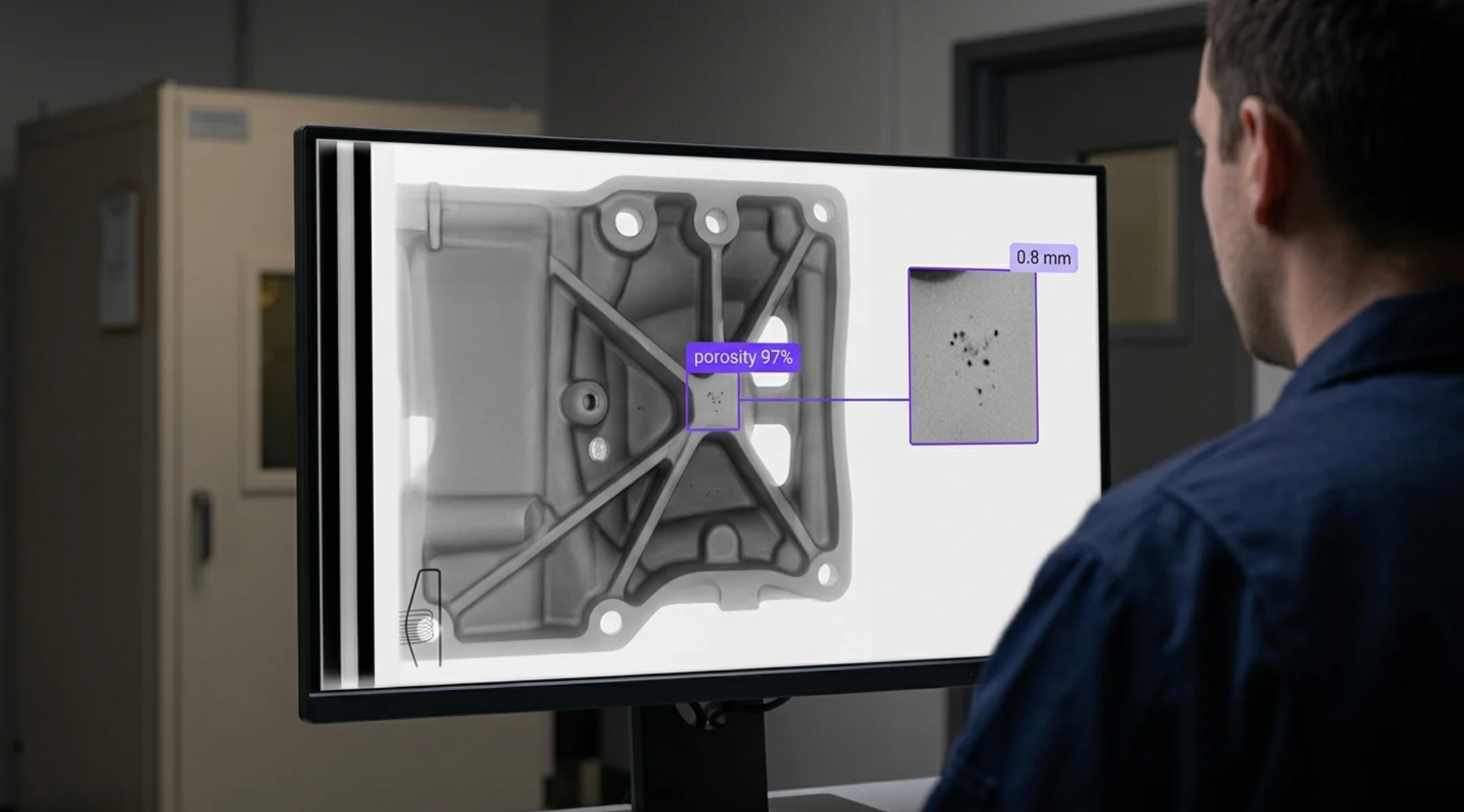
Add a real-time analysis layer to every radiograph, AXI image, and CT slice your facility already produces with Roboflow Vision AI for automated x-ray inspection.
Castings, welds, and structural parts:
- Detect gas porosity, shrinkage voids, cracks, inclusions, and cold shuts in 2D radiographs of aluminum, steel, and superalloy castings, with a model trained on your own images and your own acceptance classes from ASTM E2597 reference radiographs.
- Flag lack of fusion, incomplete penetration, and linear indications in weld radiographs read under ISO 17636 and ASME BPVC Section V, and size each indication in pixels calibrated to the image quality indicator in frame.
- Run the same model across CT slice stacks exported as TIFF or PNG so an indication is tracked slice to slice and reported with its location, size, and extent in the part.
Electronics AXI and connectors:
- Measure solder void percentage under BGA, QFN, and LGA packages against IPC-7095 and IPC-A-610 limits, and flag head-in-pillow, bridging, insufficient solder, and open joints in the AXI images from your Viscom, Nordson, or Nikon system.
- Inspect molded connectors and overmolded cable assemblies for internal voids, shifted pins, and gaps between insert and housing that no optical camera can see.
- Segment electrode layers in cylindrical and prismatic battery cell radiographs to measure anode overhang and layer alignment against your cell design spec.
Foreign material, disposition, and the record:
- Detect bone, glass, stone, metal, and dense plastic fragments in x-ray images of packaged food and pharma product, on the images your inline x-ray system already saves.
- Route every indication to a certified radiographer with the image, the overlay, and a proposed classification, so the inspector qualified under NAS 410 or ASNT SNT-TC-1A makes the accept or reject call.
- Log every image, indication, measurement, and disposition with a timestamp and user, and push results to your MES, QMS, or NDT reporting system.
Bring intelligence to every radiograph today. Stop voids, cracks, and solder defects from becoming field failures, scrapped lots, and customer escapes.
Frequently asked questions
What is automated x-ray inspection with Vision AI?
Automated x-ray inspection with Vision AI runs a trained computer vision model (opens in a new tab) on the 2D radiographs, AXI images, and CT slices your existing x-ray and CT systems export, and detects and measures voids, porosity, cracks, inclusions, cold shuts, solder defects, foreign material, and electrode misalignment. The model is trained on your own images and your own acceptance classes, works on DICONDE, TIFF, and PNG exports from Nikon, Zeiss, Yxlon, Nordson, Viscom, and North Star Imaging systems, and presents each indication to a certified inspector for disposition. It complements radiographic procedures written to ASTM E1742, ASTM E2597, ISO 17636, and ASME BPVC Section V, and AXI acceptance criteria from IPC-A-610 and IPC-7095, rather than replacing them. It is a broader spoke of automated NDT inspection and sits alongside casting defect detection and solder joint inspection on the optical side.
Can Vision AI find a small void or crack in a low-contrast radiograph of a thick casting?
Low-contrast indications in thick sections are one of the highest-stakes inspection tasks in aerospace and automotive castings, and it is where radiographers spend the most time per image. A detection or segmentation model such as RF-DETR (opens in a new tab)trained on your own radiographs learns what a shrinkage void, a gas pore, or a hot tear looks like against the grain, noise, and thickness variation of your specific part and technique, and sliced inference lets it run at full resolution on a 3,000 by 3,000 pixel image so a 0.3 mm indication is not lost to downscaling.
Does automated x-ray inspection support ASTM E1742, ISO 17636, and IPC-7095?
Automated x-ray inspection on Roboflow supports procedures written to ASTM E1742 (the standard practice for radiographic examination), ASTM E2597 (the standard practice for manufacturing characterization of digital detector arrays), ISO 17636 (radiographic testing of fusion-welded joints), and ASME BPVC Section V (nondestructive examination requirements for pressure vessels and piping), and to IPC-A-610 (acceptability of electronic assemblies) and IPC-7095 (design and assembly process implementation for BGAs), by detecting, measuring, and logging indications against the acceptance classes your quality team defines. Roboflow is the analysis engine. Inspectors certified under NAS 410 or ASNT SNT-TC-1A keep disposition authority, and your NDT Level III, quality, and regulatory teams own the written procedure, the acceptance criteria, and the validation evidence under AS9100, IATF 16949, or ISO 13485.
Can it integrate with our x-ray systems, MES, and NDT reporting software?
Yes. Roboflow reads DICONDE, TIFF, and PNG exports from Nikon, Zeiss, Yxlon, Nordson, Viscom, and North Star Imaging systems from a watched folder or over REST (opens in a new tab), and returns indications, measurements, and overlays that can be written to a database or pushed to an MES such as SAP, Siemens Opcenter, or Rockwell Plex and to QMS platforms such as ETQ or MasterControl with the serial number and lot. For inline food and pharma x-ray systems and AXI stations, pass/fail can be written to a PLC over OPC UA or MQTT so Allen-Bradley and Siemens controllers can reject or divert, and events can feed SCADA dashboards in Ignition or AVEVA. Every inference is logged with image, model version, timestamp, and user, which supports the audit trail your PCB, casting, and battery quality records require.