Casting Defect Detection AI

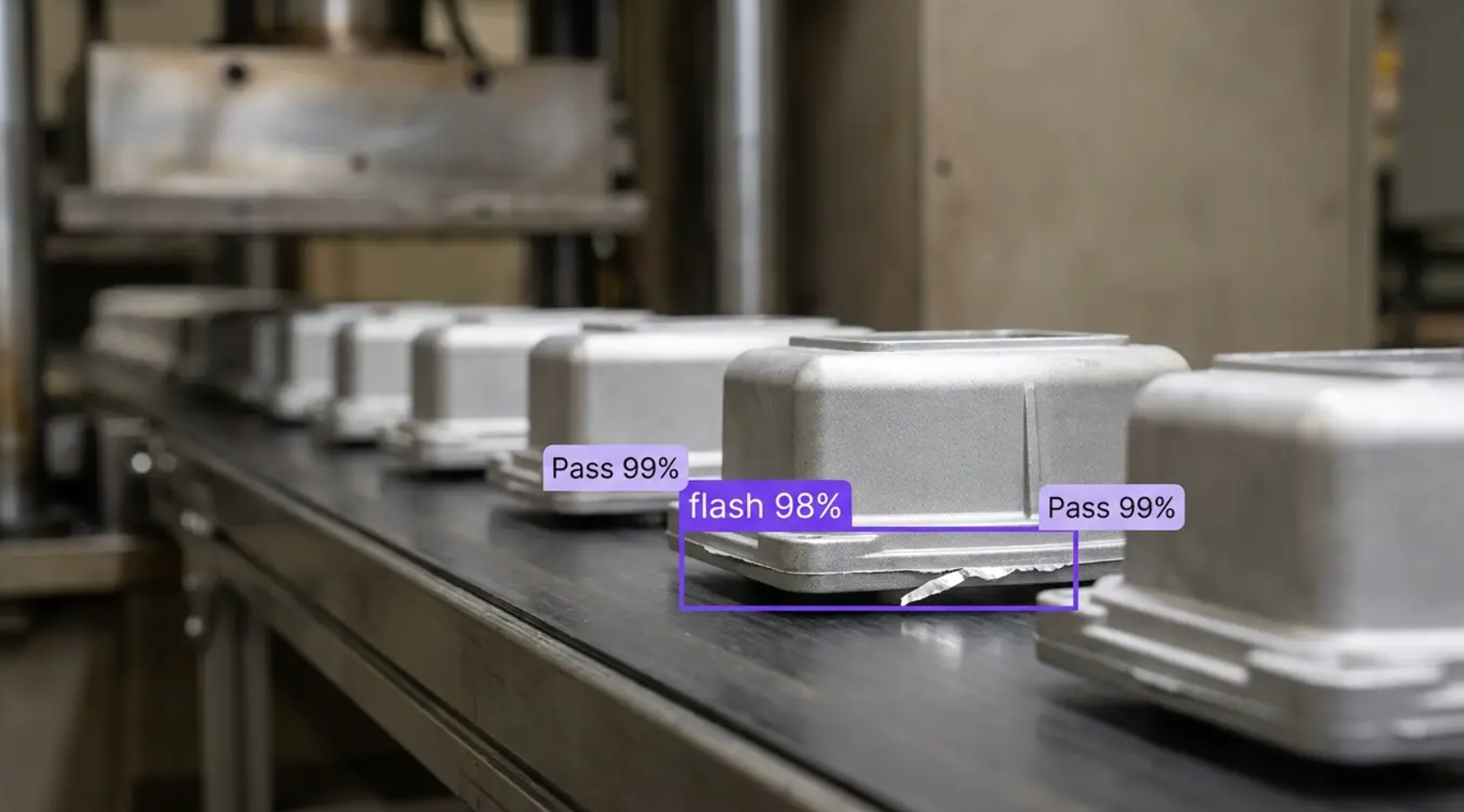
Catch porosity, cold shuts, and flash on every casting, before machining turns a defect into expensive scrap.
Shipping container with OCR output

Casting Defect Detection AI Across Die Casting, Foundries, and Machining

Deploy Anywhere, Run Everywhere

Run casting defect detection on the edge, on-prem, in your VPC, or via API, wherever your casting cells and machining lines need it.

One Platform, Full Adoption

Tools every foundry and casting team can adopt, from process and die engineers to cell operators, machining leads, and quality engineers, no separate ML team required to ship and own inspection models.

Secure, Compliant, and Audit-Ready

Data stays safe with SOC 2 Type II compliance, encrypted data, and an uptime SLA, with validation documentation that supports IATF 16949, AS9100, ISO 9001, and customer-specific PPAP audit requirements.
Porosity & Blister Detection
Cold Shut & Flow Line
Flash & Short Shot
Shrinkage & Misrun
Machined Face & Sealing Surface
Die & Cavity Trend Alerts
Porosity & Blister Detection
Cold Shut & Flow Line
Flash & Short Shot
Shrinkage & Misrun
Machined Face & Sealing Surface
Die & Cavity Trend Alerts
Porosity & Blister Detection
Cold Shut & Flow Line
Flash & Short Shot
Shrinkage & Misrun
Machined Face & Sealing Surface
Die & Cavity Trend Alerts
Porosity & Blister Detection
Cold Shut & Flow Line
Flash & Short Shot
Shrinkage & Misrun
Machined Face & Sealing Surface
Die & Cavity Trend Alerts

Talk to a vision AI engineer who's shipped casting inspection in a foundry.

A single porous casting that gets machined, assembled, and fails leak test at the end of the line, cold shut that becomes a crack in service, or flash that reaches a customer can mean scrap discovered after the value was added, a warranty claim, or a containment across a die's whole run. Bring us your toughest casting defect detection problem and we'll map a working solution.
  • Solution architecture for IATF 16949, AS9100, ISO 9001, and customer-specific PPAP environments
  • Live demo on your casting imagery, as-cast and machined part samples, or cell footage
  • Deployment options: edge, on-prem, air-gapped, robot-mounted, or VPC, with integration into casting cells, machining lines, PLCs, MES, and ERP
  • ROI modeling against machined scrap, leak-test failures, containments, and die maintenance surprises
  • We will connect you with an AI subject matter expert on our team based on your answers.
    What challenges would you like to solve with vision AI?
    Where will you run vision AI?
    Are you replacing a current solution with AI or will this be a new solution?
    How many detections do you anticipate per month?
    Describe the business problem you would like to solve.
    Oops! Something went wrong while submitting the form.

    Over 16,000 organizations build with Roboflow.

    “Roboflow has been instrumental in accelerating our learning and deployment of innovative AI solutions”
    Travis Turnbull Vice President & CIO, Pella Corporation
    See customer stories
    Trusted by top manufacturers

    Vision AI is transforming manufacturing

    Customers are deploying solutions across the entire business and driving meaningful impact
    $0 million
    Saved by automatically detecting defects
    0%
    Less time spent manually tracking inventory
    0%
    Reduction in customer return rate

    Catch Casting Defects Before the Value Gets Added, with Vision AI

    Add a real-time inspection layer to every casting with vision AI for casting defect detection. Built for the operations where one porous housing that rides through machining, assembly, and leak test before failing, cold shut hiding in an as-cast corner, or cavity that starts throwing flash mid-shift can mean scrap that carries an hour of added value, a field leak on a shipped unit, or a containment across everything that die produced. Whether you're running high-pressure die casting, sand and investment foundries, or the machining lines downstream, Roboflow extends your inspection coverage to every casting at every stage, with per-part records tied to die and cavity.

    Die Casting and Surface Defects:

    • Catch porosity, blisters, and surface voids on as-cast surfaces the moment parts leave the cell
    • Detect cold shuts, flow lines, and misruns where fill went wrong before anyone downstream builds on it
    • Flag flash, short shots, and trim defects on every shot, not just the shift's sampled parts

    Machined Faces and Sealing Surfaces:

    • Catch porosity revealed on machined faces and sealing surfaces, where a pinhole becomes a leak path in service
    • Detect inclusions, pitting, and tool-tear on the critical faces gaskets and o-rings have to seal against
    • Inspect before the next value-added step, so a bad casting scraps for the cost of a casting, not a finished assembly

    Cells, Die Health, and Line Integration:

    • Trend defects by die, cavity, and shift, so a cavity drifting toward porosity or flash reaches die maintenance as an early warning
    • Inspect robot-presented parts in the cell, at trim, and after machining with the same platform
    • Trigger diverts, holds, and containment flags in real time through PLC and MES integration, with per-part records tied to die, cavity, and heat

    Bring intelligence to every casting today. Stop casting defects from becoming machined scrap, field leaks, or containments.

    More About Casting Defect Detection

    What is casting defect detection with Vision AI?

    Casting defect detection with vision AI uses computer vision models to inspect castings at every stage: as-cast surfaces out of the cell, trimmed parts, and machined faces downstream. Models trained on your actual alloys, finishes, and parts catch porosity, blisters, cold shuts, flow lines, misruns, flash, and short shots on every casting rather than sampled parts, with per-part records tied to die and cavity that support IATF 16949, AS9100, and PPAP requirements.

    Can Vision AI tell porosity from dirt and tool marks on as-cast surfaces?

    As-cast surfaces are the hard case: shot-blast texture, parting lines, die lubricant residue, and cosmetic marks that all look like defects to a threshold-based system. Deep-learning models trained on your actual castings learn the difference between true porosity and the surface character your process normally produces, hold that judgment across alloys and finishes, and improve as flagged parts get dispositioned. Surface and machined-face inspection pairs with your X-ray or CT program for subsurface porosity, with both feeding the same per-part record.

    Does casting defect detection support IATF 16949 and PPAP?

    Yes. Roboflow models can run as documented inspection controls inside your IATF 16949 (automotive quality management), AS9100 (aerospace), and ISO 9001 processes, with per-part inspection records, die and cavity traceability, model version history, and training data lineage that support PPAP submissions, containment reviews, and customer audits. Roboflow is the inspection engine; your quality team owns the acceptance criteria.

    Can it integrate with our casting cells, machining lines, and MES?

    Yes. Roboflow Inference exposes a standard API and supports common industrial protocols, so casting inspection events flow into your existing systems: cell and line PLCs from Allen-Bradley and Siemens, SCADA and HMI platforms like Ignition and AVEVA, MES and ERP systems like SAP and Oracle, through REST, MQTT, OPC UA, and direct database writes. PLC-level integration drives diverts, holds, and containment flags the moment a defect appears, and every event carries die, cavity, shift, and imagery, with a full audit trail behind every casting.

    Stay Connected

    Get the Latest in Computer Vision First

    Thank you for subscribing!
    Oops! Something went wrong!.
    Unsubscribe at any time. Review our Privacy Policy.

    Additional resources

    Vision AI is transforming every industry. Let’s transform yours.