Solder Joint Inspection AI
Catch bridges, voids, cold joints, insufficient solder, and cracked fillets on every joint, from reflow to wave solder to rework.
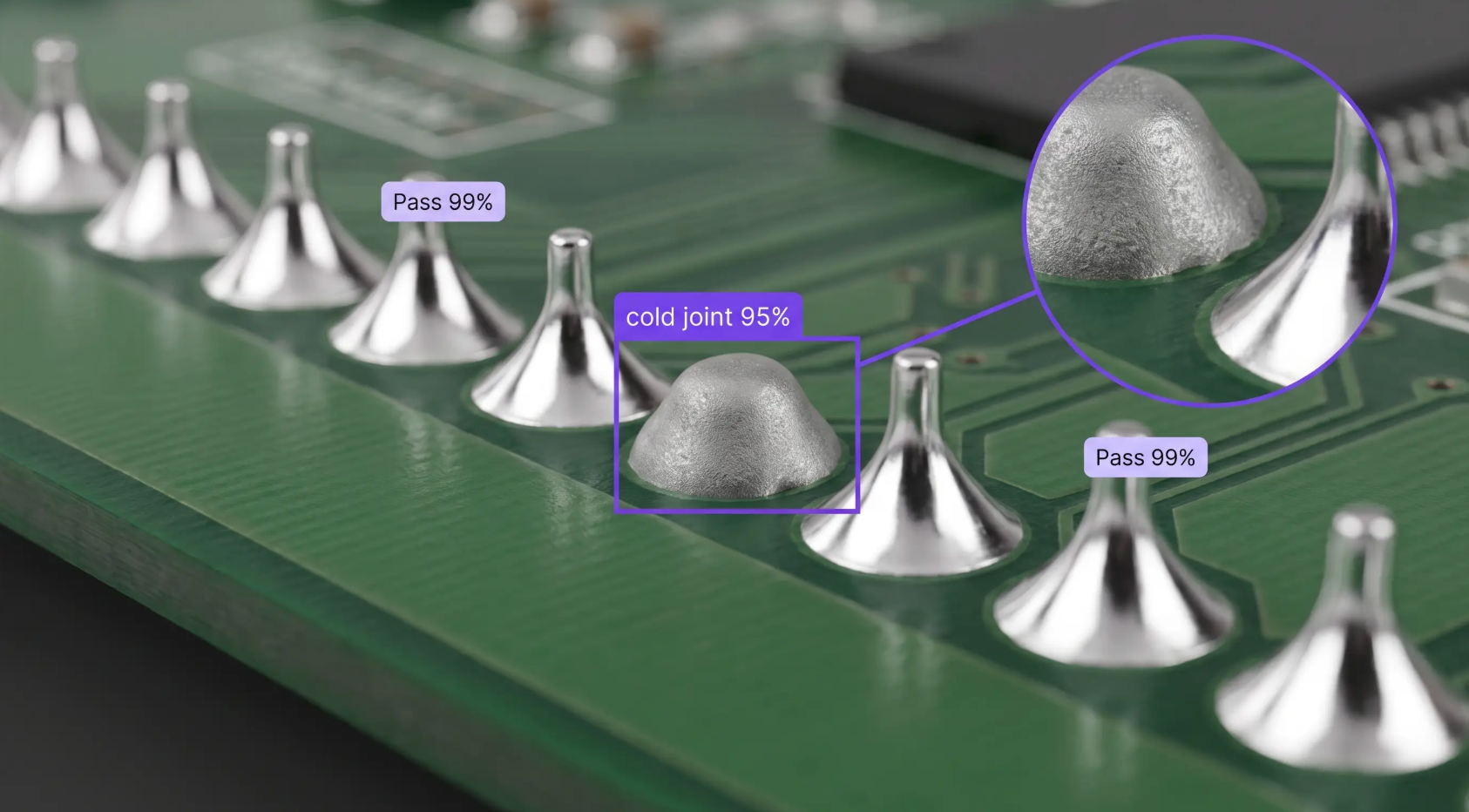
Solder Joint Inspection AI Across Reflow, Wave, Selective, and Rework
Deploy Anywhere, Run Everywhere
Run solder joint inspection on the edge, on-prem, in your VPC, or via API, wherever your soldering process needs it.
One Platform, Full Adoption
Tools every electronics assembly team can adopt, from SMT process engineers and soldering and rework technicians to quality engineers and NPI leads, no separate ML team required to ship and own inspection models.
Secure, Compliant, and Audit-Ready
Data stays safe with SOC 2 Type II compliance, encrypted data, and an uptime SLA, with validation documentation that supports IPC-A-610, J-STD-001, IPC-7711 and IPC-7721, and IATF 16949 audit requirements.
- Solder Bridge & Short Detection
- Insufficient Solder & Cold Joint
- Solder Void & Wetting Defects
- Tombstoning & Lifted Lead
- Through-Hole & Wave Solder Fillets
- Rework & Touch-Up Verification
“Roboflow has been instrumental in accelerating our deployment of innovative AI solutions.”
Travis Turnbull
Vice President & CIO, Pella Corporation
Talk to a vision AI engineer who's shipped solder joint inspection.
A single solder bridge under a fine-pitch QFP, cold joint on a power connector, or cracked fillet that passes electrical test can mean a field failure months after shipment, a warranty claim, or a recall on an automotive or medical electronics program. Bring us your toughest solder joint inspection problem and we'll map a working solution.
Ask us about:
- Solution architecture for IPC-A-610, J-STD-001, IPC-7711 and IPC-7721, IATF 16949, AS9100, and ISO 13485 programs
- Live demo on your post-reflow imagery, microscope stills, or wave solder footage
- Deployment options: edge, on-prem, air-gapped, robot-mounted, or VPC, with integration into AOI and X-ray systems, SMT line PLCs, MES, and ERP
- ROI modeling against field failures, warranty claims, rework, scrap, and electrical test escapes
Over 16,000 organizations build with Roboflow.
- Rivian
- Pella
- Chobani
- USG Corporation
- BNSF Railway
- American Woodmark
Vision AI is transforming businesses
Customers across the board are solving complex challenges and driving meaningful impact.
- Automotive customer
$10 million
Saved by automatically detecting defects on the production line
- Logistics & freight company
90%
Less time spent manually tracking shipping inventory
- Building materials supplier
60%
Lower customer return rate with improved product quality