PCB Defect Detection AI
Catch tombstoning, solder bridges, missing components, polarity errors, lifted leads, and trace defects across every PCBA on the line.
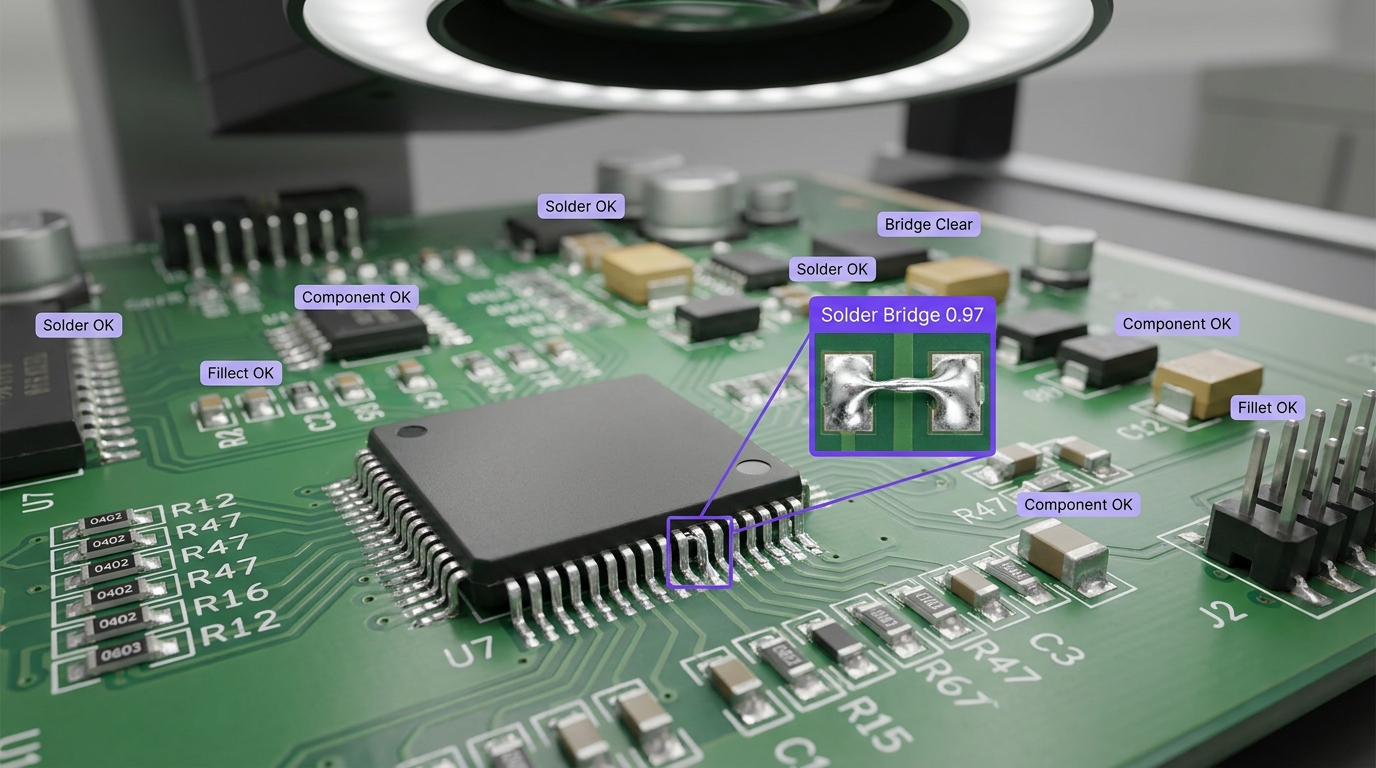
PCB Defect Detection AI Across SMT, Through-Hole, Soldering, and Final QC
Deploy Anywhere, Run Everywhere
Run PCB defect detection on the edge, on-prem, in your VPC, or via API, wherever your electronics manufacturing line needs it.
One Platform, Full Adoption
Tools every electronics manufacturing team can adopt, from SMT process engineers, AOI and AVI operators, and PCBA quality engineers to plant managers.
Built for Electronics Manufacturing Standards and Audit-Ready Records
Update inspection logic in minutes when boards, BOMs, or rework criteria change, with audit-ready records. SOC 2 Type II compliance, encrypted data, HIPAA compliance, and an uptime SLA on every deployment.
- Tombstoning & Billboarding Detection
- Solder Bridge & Short Detection
- Missing & Wrong Component Detection
- Polarity, Orientation & Lifted Lead
- Insufficient Solder & Solder Void
- Trace Defect & PCB Scratch
“Roboflow has been instrumental in accelerating our deployment of innovative AI solutions.”
Travis Turnbull
Vice President & CIO, Pella Corporation
Talk to a Vision AI engineer who's shipped PCB defect detection on the SMT line.
A single missed tombstoned chip, undetected solder bridge, or polarity error on a polarized capacitor can mean a field-return event, an automotive electronics recall on a deployed program, or a customer chargeback that hits your margin and reputation. Bring us your toughest PCB defect detection problem and we'll map a working solution.
Ask us about:
- Solution architecture for IPC-A-610, IPC-A-600, J-STD-001, IPC-7711 and IPC-7721, IATF 16949, AS9100, ISO 13485, and customer-specific PPAP and APQP environments
- Live demo on your AOI imagery, post-reflow inspection footage, post-wave solder video, or finished PCBA samples
- Deployment options: edge, on-prem, air-gapped, robot-mounted, or VPC, with integration into AOI and AVI systems, SMT line PLCs, MES, and ERP
- ROI modeling against rework, scrap, field returns, customer chargebacks, and recall risk on board-level defects
Over 16,000 organizations build with Roboflow.
- Rivian
- Pella
- Chobani
- USG Corporation
- BNSF Railway
- American Woodmark
Catch Every PCBA Defect from First Component Place Through Final Inspection, with Vision AI
Add a real-time inspection layer to every PCBA on the line with Vision AI for PCB defect detection. Built for the operations where one missed tombstoned chip resistor, solder bridge between adjacent pads, missing component on a high-density board, polarity error on a polarized capacitor, lifted lead on a SOIC or QFP, insufficient solder joint, or PCB trace defect can mean a field-return event, an automotive electronics recall on a deployed program, a customer chargeback that hits your margin and reputation, or a regulatory enforcement action on a regulated electronics program (medical, aerospace, automotive). Whether you're inspecting post-paste solder paste deposition, post-place pre-reflow component placement, post-reflow AOI on populated boards, post-wave solder for through-hole, BGA underside coordinated with X-ray, or finished PCBA before final pack-out, Roboflow extends your QC coverage to every board on the line, on the AOI and AVI inspection stations your facility already runs.
SMT and Surface Mount Defect Detection:
- Catch tombstoning, billboarding, lifted leads, and skewed component placement on chip passives (0402, 0603, 0805), QFN, SOIC, QFP, and BGA packages
- Detect solder bridges between adjacent pads, insufficient solder volume, solder voids, and cold joints across every populated board
- Verify component presence, correct part value, polarity orientation on polarized capacitors and ICs, and correct reference designator match across the BOM
Through-Hole, Wave Solder, and Trace Defects:
- Verify through-hole component placement, lead clinching, and wave solder joint integrity on every connector, transformer, and through-hole part
- Catch PCB trace defects (open traces, short traces, copper scratches, solder mask defects) on the bare board and on populated boards
- Detect via and pad defects, gold finger contamination, and silkscreen reference designator errors that affect rework traceability
AOI Co-Pilot, Standards Compliance, and Field-Return Defense:
- Co-pilot existing AOI and AVI systems (Koh Young, ViTrox, Saki, Mirtec, Test Research Inc, Omron) with deep-learning visual verification on borderline rejects to reduce false-positive scrap and increase true-positive confidence on safety-critical assemblies
- Maintain validated inspection records that support IPC-A-610 (Acceptability of Electronic Assemblies), IPC-A-600 (Acceptability of Printed Boards), J-STD-001 (Soldering Requirements for Electrical and Electronic Assemblies), IPC-7711 and IPC-7721 (Rework and Repair), IATF 16949 for automotive electronics, AS9100 for aerospace electronics, and ISO 13485 for medical electronics
- Trigger line-level reject and rework-station routing in real time through PLC and MES integration when inspection criteria fail, with full audit trail for customer audits, automotive electronics PPAP submissions, and field-return investigation
Bring intelligence to every PCBA today. Stop board-level defects from becoming field returns, automotive electronics recalls, or customer chargebacks.
More About PCB Defect Detection
What is PCB defect detection with Vision AI?
PCB defect detection with Vision AI uses computer vision models to inspect printed circuit board assemblies at every stage of electronics manufacturing, from post-paste solder paste deposition through post-place pre-reflow component placement, post-reflow automated optical inspection (AOI) on populated boards, post-wave solder for through-hole assemblies, BGA underside inspection coordinated with X-ray, and finished PCBA before final pack-out. The system extends QC coverage to every board on the line, catching tombstoning and billboarding on chip passives, solder bridges between adjacent pads, missing components and wrong-value components, polarity errors on polarized capacitors and ICs, lifted leads on SOIC and QFP packages, insufficient solder volume and solder voids, cold joints, PCB trace defects (open traces, short traces, copper scratches, solder mask defects), and silkscreen reference designator errors that affect rework traceability.
Can Vision AI catch the defects existing AOI systems miss?
Yes. Tombstoning, billboarding, lifted leads, and subtle solder joint defects on high-density mixed-technology boards are exactly where existing rule-based and template-matching AOI systems feel the most pressure. Rule-based AOI excels at deterministic measurement tasks with high-contrast features, fixed lighting, and consistent component presentation (precise dimensional measurement of solder fillet height with 3D AOI, barcode and reference designator OCR on uniform silkscreen), but struggles with morphological variation (subtle component skew that varies lot to lot, solder joint variation from reflow profile drift), color and reflectivity variation from solder finish lot to lot, SKU complexity across hundreds of board variants and BOM revisions, and high-density placement where templating fails.
Roboflow models add a deep-learning inspection layer trained on your actual board appearance, lot variation, and BOM revision differences, catching the defect categories rule-based AOI struggles with and co-piloting existing AOI and AVI installations from Koh Young, ViTrox, Saki, Mirtec, and Omron by adding visual verification on borderline rejects (reducing false-positive scrap from over-sensitive thresholds, increasing true-positive confidence on safety-critical assemblies destined for automotive, aerospace, or medical programs).
Does PCB defect detection support IPC-A-610, J-STD-001, and IATF 16949?
Yes. Roboflow models can be trained against your specific IPC-A-610 (Acceptability of Electronic Assemblies, the universal electronics assembly acceptance standard covering Class 1, Class 2, and Class 3 quality levels), IPC-A-600 (Acceptability of Printed Boards, covering bare PCB acceptance criteria), J-STD-001 (Requirements for Soldered Electrical and Electronic Assemblies, the universal soldering standard), IPC-7711 and IPC-7721 (Rework, Modification and Repair of Electronic Assemblies), IATF 16949 for automotive electronics quality management, AS9100 and AS9110 for aerospace electronics quality management, ISO 13485 for medical electronics quality management, ESD S20.20 for electrostatic discharge control, and customer-specific PPAP (Production Part Approval Process) and APQP (Advanced Product Quality Planning) acceptance criteria for automotive electronics programs.
Can it integrate with our AOI systems, SMT line PLCs, MES, eQMS, and ERP?
Yes. Roboflow Inference exposes a standard API and supports common electronics manufacturing automation protocols, so Vision AI PCB defect detection events flow into your existing AOI and AVI systems, SMT line PLCs, MES, eQMS, ERP, and field-return traceability platforms. Customers integrate with AOI and AVI systems from Koh Young, ViTrox, Saki, Mirtec, Test Research Inc, and Omron, SMT placement equipment from ASMPT (SIPLACE), Fuji, Yamaha, Panasonic, and Hanwha, reflow ovens from Heller, Vitronics Soltec, and BTU, X-ray systems from Yxlon, Nordson DAGE, and Nikon, SMT MES platforms (Cogiscan, Aegis FactoryLogix, Critical Manufacturing, iTAC), eQMS platforms (MasterControl, Veeva Vault QMS, Sparta TrackWise, ETQ Reliance), and ERP systems (SAP, Oracle) through REST, MQTT, OPC UA, and direct database writes, with PLC-level integration to SMT line conveyors, AOI gate decisions, and rework station routing where pass/fail decisions need to drive line behavior or downstream sorting.
Models support full IQ/OQ/PQ documentation, audit trails for training data, model versions, and inspection results that pass customer audits, automotive Tier 1 PPAP submissions, IPC Class 3 audits, field-return investigation requirements, and medical and aerospace electronics regulatory enforcement defense.