Sanitaryware Inspection AI

Catch pinholes, cracks, and glaze defects on every toilet, sink, tub, and shower base, even on high-gloss surfaces.
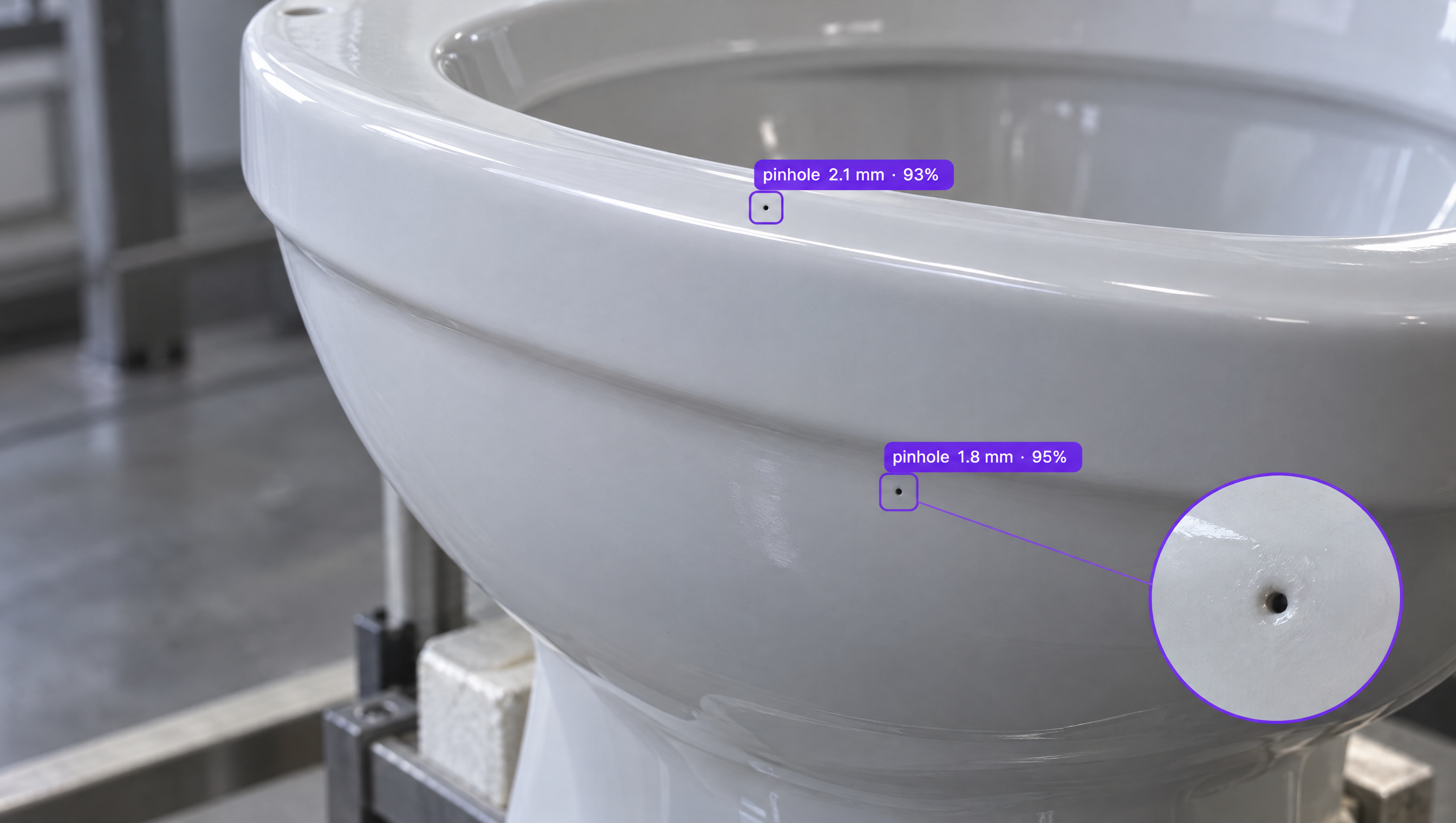
White ceramic toilet bowl with two labeled pinhole defects, one magnified in an inset.

Sanitaryware Inspection AI for the Toughest Vitreous China and Bath Plants

  • Deploy Anywhere, Run Everywhere

    Run sanitaryware inspection on cameras at glaze lines, kiln exits, final inspection booths, and robot cells, on the edge, on-prem, in your VPC, or via API.

  • One Platform, Full Adoption

    Tools every bathware plant can adopt, from inspectors and kiln operators to process and quality engineers, no separate ML team required.

  • Secure, Compliant, and Audit-Ready

    Data stays safe with SOC 2 Type II compliance, encrypted data, and an uptime SLA, with an image of every defect tied to its piece, kiln car, and shift.

  • Glaze Pinholes on Glossy Surfaces
  • Firing Cracks & Hairlines
  • Crawl, Blisters & Thin Glaze
  • Specks, Black Spots & Contamination
  • Fiberglass & Acrylic Porosity
  • Chips, Warp & Shape Defects
“The vision AI solutions we developed with Roboflow have been a core component of connecting our teams and unlocking their ability to collaborate.”

Lou Stocco

Director of Manufacturing Advanced Analytics, USG

Talk to a Vision AI engineer who's shipped in building products manufacturing.

Bring us your toughest sanitaryware defect and we'll map a working solution.

Ask us about:

  • Solution architecture that fits your glaze lines, kilns, and inspection booths
  • A live demo on images of your own pieces and defects
  • Deployment options: edge, on-prem, air-gapped, or VPC
  • ROI modeling against refires, scrap, warranty returns, and inspection hours

Over 80,000 organizations build with Roboflow.

  • Rivian
  • Pella
  • Chobani
  • USG Corporation
  • BNSF Railway
  • American Woodmark
Start where you are

Vision AI is transforming businesses

Customers across the board are solving complex challenges and driving meaningful impact.

  • Automotive customer

    $10 million

    Saved by automatically detecting defects on the production line

  • Logistics & freight company

    90%

    Less time spent manually tracking shipping inventory

  • Building materials supplier

    60%

    Lower customer return rate with improved product quality

Inspect Every Piece, from the Glaze Line to the Pack Station

Add a real-time inspection layer to every piece with Roboflow vision AI for sanitaryware inspection. Built for vitreous china toilets, sinks, and urinals, and fiberglass and acrylic tubs and shower bases, where a pinhole a couple of millimeters across hides in the reflections of a high-gloss surface, inspectors check curved pieces by hand under lights, and a defect found after firing means a refire or a scrapped piece.

Vitreous china after firing:

  • Detect glaze pinholes, blisters, crawl, and thin glaze on bowls, rims, tanks, and basins, alongside ceramic defect detection.
  • Catch firing cracks, hairlines, and dunting, and chips on edges and feet.
  • Flag specks, black spots, and contamination in the glaze, and grade them by size and severity.

Fiberglass and acrylic bathware:

  • Find pinholes, porosity, and air voids in gelcoat and acrylic surfaces, alongside gelcoat defect detection.
  • Detect blisters, scratches, chips, and color variation on tubs, shower bases, and wall surrounds.
  • Spot fiber print-through and resin-rich areas before trim and pack.

Glossy surfaces and curved pieces:

  • Separate small pinholes from reflections on high-gloss surfaces, alongside reflective part inspection.
  • Inspect curved and deep pieces from several cameras or a robot-held camera, and combine every view into one result per piece.
  • Trend defects by mold, kiln car, glaze batch, and shift, and tie them back to kiln monitoring.

Bring intelligence to every piece today. Stop pinholes and cracks from becoming refires, scrap, and warranty returns.

‍

Frequently asked questions

What is sanitaryware inspection with Vision AI?

Sanitaryware inspection with Vision AI uses cameras at the glaze line, kiln exit, and final inspection and a trained computer vision model (opens in a new tab) to find pinholes, cracks, glaze defects, and surface flaws on vitreous china and on fiberglass and acrylic bathware, and to keep a record for every piece. It pairs with pinhole inspection for films and coatings.

Can it find tiny pinholes on high-gloss glaze?

Yes. Low-angle or dome lighting turns a pinhole into a dark spot against the glaze instead of a reflection, high-resolution cameras keep it several pixels wide, and image tiling runs detection on each section of the image so small defects stay visible. A model trained on your own pieces learns the difference between a pinhole and a highlight.

Do we need a large library of defect images to start?

No. Start with few-shot defect detection or compare each piece to a golden sample, and grow a defect model as confirmed rejects come in.

Can it integrate with our line, MES, and quality systems?

Yes. Roboflow writes pass, refire, and reject results to a PLC tag over OPC UA or MQTT so each piece is routed before pack, and sends images and results over REST (opens in a new tab) or to a database for MES and quality systems.

Roboflow serves as the inspection engine, and your quality teams own the grading standards, refire rules, and accept decisions.

‍

Stay connected

Get the Latest in Computer Vision First

Unsubscribe at any time. Review our Privacy Policy.