Gelcoat Defect Detection AI
Find the porosity and print-through at demold, and hand the finishing team a map instead of a flashlight.
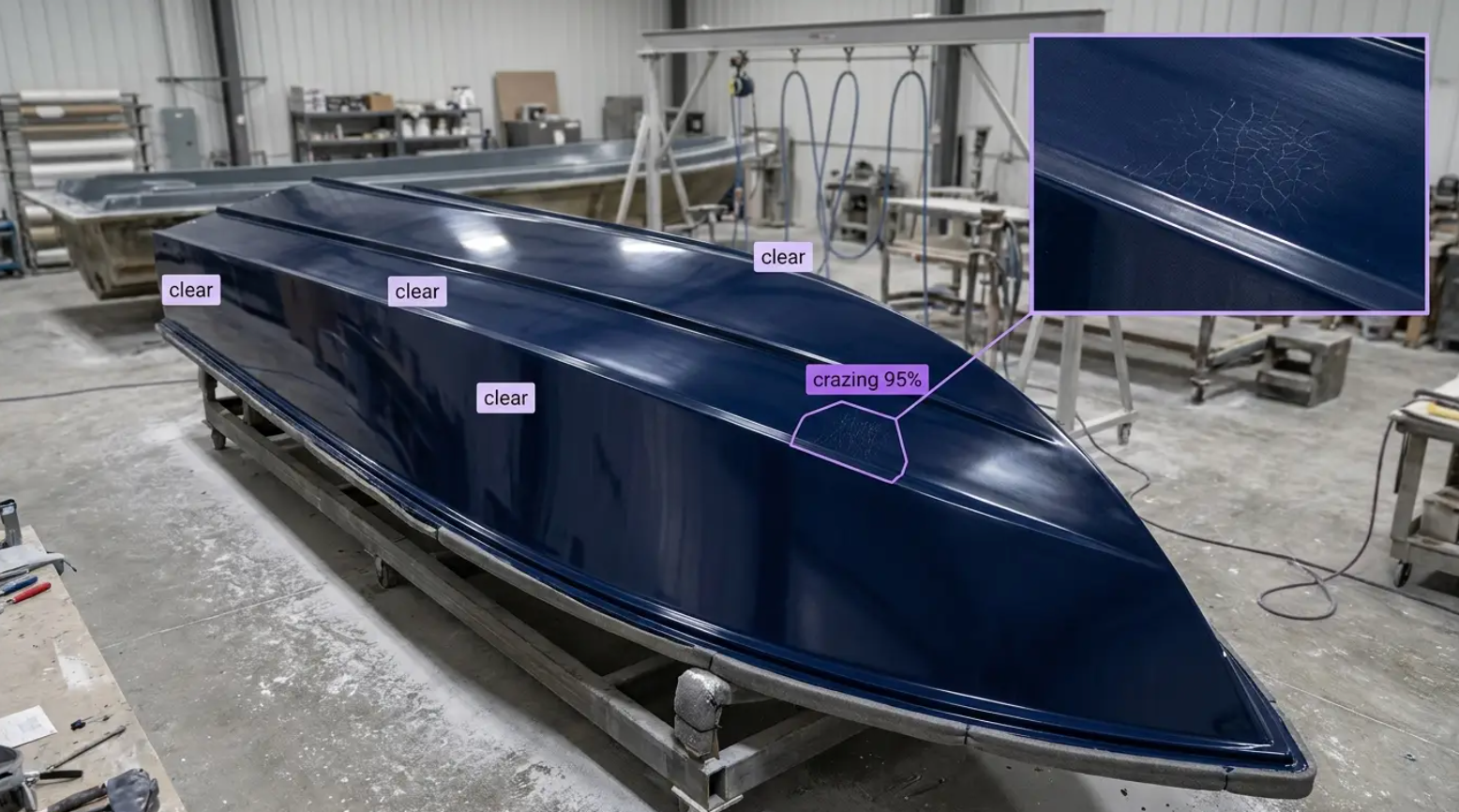
Gelcoat Defect Detection AI Across Boat Hulls, RV Panels, and Powersports Bodywork
Deploy Anywhere, Run Everywhere
Run gelcoat defect detection at demold, on finishing bay and buff line cameras, on handheld and cart-mounted rigs for large hulls, the edge, on-prem, in your VPC, or via API, wherever your molds, finishing bays, and rigging line need it.
One Platform, Full Adoption
Tools every manufacturing organization can adopt, from gelcoat sprayers and laminators to finishing leads, quality, and the plant manager watching rework hours, no separate ML team required to ship and own inspection models.
Secure and Audit-Ready
Data stays safe with SOC 2 Type II compliance, encrypted data, and an uptime SLA, with per-hull defect records that support your internal and dealer cosmetic acceptance standards, NMMA certification programs, ISO 12215 build documentation, and ISO 9001 quality systems.
- Porosity & Pinholes
- Print-Through & Fiber Pattern
- Blisters, Voids & Craters
- Sags, Runs & Orange Peel
- Color Variation & Mottling
- Per-Hull Defect Maps
“Roboflow has been instrumental in accelerating our deployment of innovative AI solutions.”
Travis Turnbull
Vice President & CIO, Pella Corporation
Talk to a vision AI engineer who's shipped surface inspection on high-gloss finishes.
A field of porosity on a dark hull that nobody sees until the boat is sitting in the sun at a dealer, print-through that develops three days after demold on a hull already moving down the rigging line, or a run on a topside that costs eight hours of sand, spot-gelcoat, and buff can mean a rework bill that dwarfs the part, a delivery slipping in the middle of season, or a first impression made in a showroom you do not control. Bring us your toughest gelcoat problem and we'll map a working solution.
Ask us about:
- Solution architecture for your internal and dealer cosmetic acceptance standards, NMMA certification programs, ISO 12215 build documentation, and ISO 9001 quality systems
- Live demo on your own hull and panel imagery, across your gelcoat colors, metallics, and high-gloss dark finishes
- Deployment options: demold, finishing bay, and buff line cameras, handheld and cart-mounted rigs for large hulls, edge, on-prem, air-gapped, or VPC, with integration into MES and rework routing
- ROI modeling against finishing and buff hours per hull, spot-gelcoat repair rates, warranty and dealer prep claims, and delivery schedule slip
Over 16,000 organizations build with Roboflow.
- Rivian
- Pella
- Chobani
- USG Corporation
- BNSF Railway
- American Woodmark
Vision AI is transforming businesses
Customers across the board are solving complex challenges and driving meaningful impact.
- Automotive customer
$10 million
Saved by automatically detecting defects on the production line
- Logistics & freight company
90%
Less time spent manually tracking shipping inventory
- Building materials supplier
60%
Lower customer return rate with improved product quality