Visual Intelligence Summit: Oct 22 in San Francisco Get your ticket

Porosity Detection AI

Find, size, and map gas and shrinkage porosity in castings, welds, and additively manufactured parts.
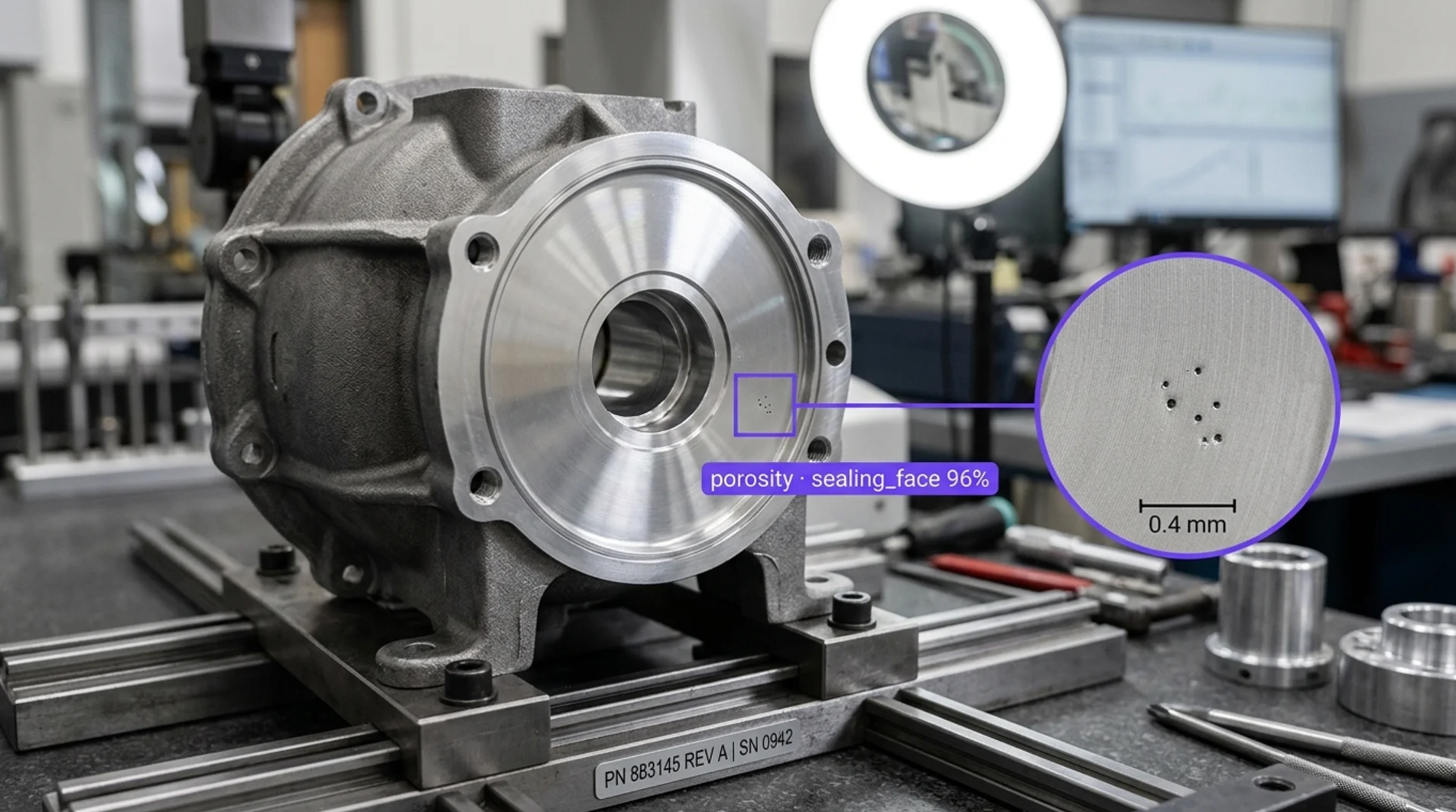
Porosity Detection AI Across Castings, Welds, and Additive Manufacturing

  • Deploy Anywhere, Run Everywhere

    Run porosity detection on surface cameras, X-ray, and CT inspection stations on the edge, on-prem, in your VPC, or via API.

  • One Platform, Full Adoption

    Tools every quality and NDT team can adopt, from Level II and III inspectors to foundry, welding, and quality engineers, no separate ML team required.

  • Secure, Compliant, and Audit-Ready

    Data stays safe with SOC 2 Type II compliance, encrypted data, HIPAA compliance, and an uptime SLA.

  • Gas & Shrinkage Porosity in Castings
  • Weld Porosity, Wormholes & Cluster Porosity
  • Lack-of-Fusion & Keyhole Pores in AM Parts
  • Pore Size, Count & Area Measurement
  • Surface Porosity on Machined Faces
  • X-Ray & CT Porosity Grading
“Roboflow has been instrumental in accelerating our deployment of innovative AI solutions.”

Travis Turnbull

Vice President & CIO, Pella Corporation

Talk to a Vision AI engineer who's shipped in castings, welding, and additive manufacturing.

Bring us your toughest porosity detection problem and we'll map a working solution.

Ask us about:

  • Solution architecture that fits ASTM E505, ASTM E446, ISO 5817, AWS D1.1, NADCAP, and AS9100 environments
  • A live demo on your own surface images, radiographs, or CT slices
  • Deployment options: edge, on-prem, air-gapped, VPC, or on your X-ray, CT, and surface inspection stations
  • ROI modeling against scrap, machining time spent on bad castings, leak test failures, and inspector hours per part

Over 16,000 organizations build with Roboflow.

  • Rivian
  • Pella
  • Chobani
  • USG Corporation
  • BNSF Railway
  • American Woodmark
Start where you are

Vision AI is transforming businesses

Customers across the board are solving complex challenges and driving meaningful impact.

  • Automotive customer

    $10 million

    Saved by automatically detecting defects on the production line

  • Logistics & freight company

    90%

    Less time spent manually tracking shipping inventory

  • Building materials supplier

    60%

    Lower customer return rate with improved product quality

Find and Grade Porosity on Every Part, from the Casting Cell to the Final X-Ray

Add a real-time inspection layer to every casting, weld, and printed part with Roboflow Vision AI for porosity detection. Built for foundries, fabricators, and additive manufacturers where porosity found after machining wastes hours of spindle time, and porosity missed becomes a leak or a fatigue failure.

Castings and machined surfaces:

  • Detect gas and shrinkage porosity on as-cast and machined surfaces, and on radiographs of aluminum and iron castings, with a model trained on your own parts.
  • Measure pore size, count, and area per zone and compare to your acceptance standard, including tighter limits on sealing faces.
  • Catch porosity before machining so bad castings are scrapped before they use spindle time.

Welds and joints:

  • Find porosity, wormholes, and cluster porosity in welds from surface cameras and radiographs.
  • Grade weld porosity against ISO 5817 and AWS D1.1 quality levels your engineering team sets.
  • Trend porosity by welding cell, wire lot, and shielding gas to find the process cause.

Additive parts, X-ray, and CT:

  • Detect lack-of-fusion and keyhole pores in CT slices and layer images of additively manufactured parts.
  • Help Level II and III inspectors review X-ray and CT results faster by highlighting the indications that need a decision.
  • Keep an image and measurement record per part for the traveler, the NADCAP audit, and the customer.

Bring intelligence to every casting, weld, and printed part today.

‍

Frequently asked questions

What is porosity detection with Vision AI?

Porosity detection with Vision AI uses surface cameras or X-ray and CT images and a trained computer vision model to find gas porosity, shrinkage porosity, wormholes, and lack-of-fusion pores, measure their size, count, and area, and compare them to your acceptance criteria. It applies to castings, welds, and additively manufactured parts, and it complements automated NDT inspection and pinhole inspection, with records that support ASTM, ISO 5817, AWS D1.1, and AS9100 requirements.

Can Vision AI detect internal porosity, or only what is on the surface?

A camera only sees the surface, so internal porosity needs X-ray or CT images, and Vision AI works on those images just as it does on photos. A segmentation model trained on your own radiographs or CT slices learns to separate pores from noise, grain, and edge artifacts, and it measures each indication so the part can be graded. Image quality and the reference standards your inspectors use set how small a pore can be reliably graded, so a pilot compares model calls to your Level III decisions.

Does porosity detection support ASTM E505, ISO 5817, and AS9100?

Porosity detection supports grading against ASTM E505 and ASTM E446 (reference radiographs for aluminum, magnesium, and steel castings), ISO 5817 (quality levels for imperfections in fusion welds), and AWS D1.1 (the structural welding code for steel), and it produces per-part records for AS9100 (the aerospace quality management system standard) and NADCAP (the aerospace special process accreditation program) audits.

Roboflow serves as the inspection engine, and your NDT Level III, quality, and engineering teams own the acceptance criteria and the final disposition of each part.

Can it integrate with our X-ray, CT, and quality systems?

Yes. Roboflow takes images from X-ray and CT systems as files or over REST, and it writes results, measurements, and marked-up images to a database or quality system, including MES and QMS platforms such as Ignition, SAP QM, and ETQ. Inline, it writes pass/fail to a PLC tag over OPC UA or MQTT so a failing casting is diverted before machining.

‍

Stay connected

Get the Latest in Computer Vision First

Unsubscribe at any time. Review our Privacy Policy.