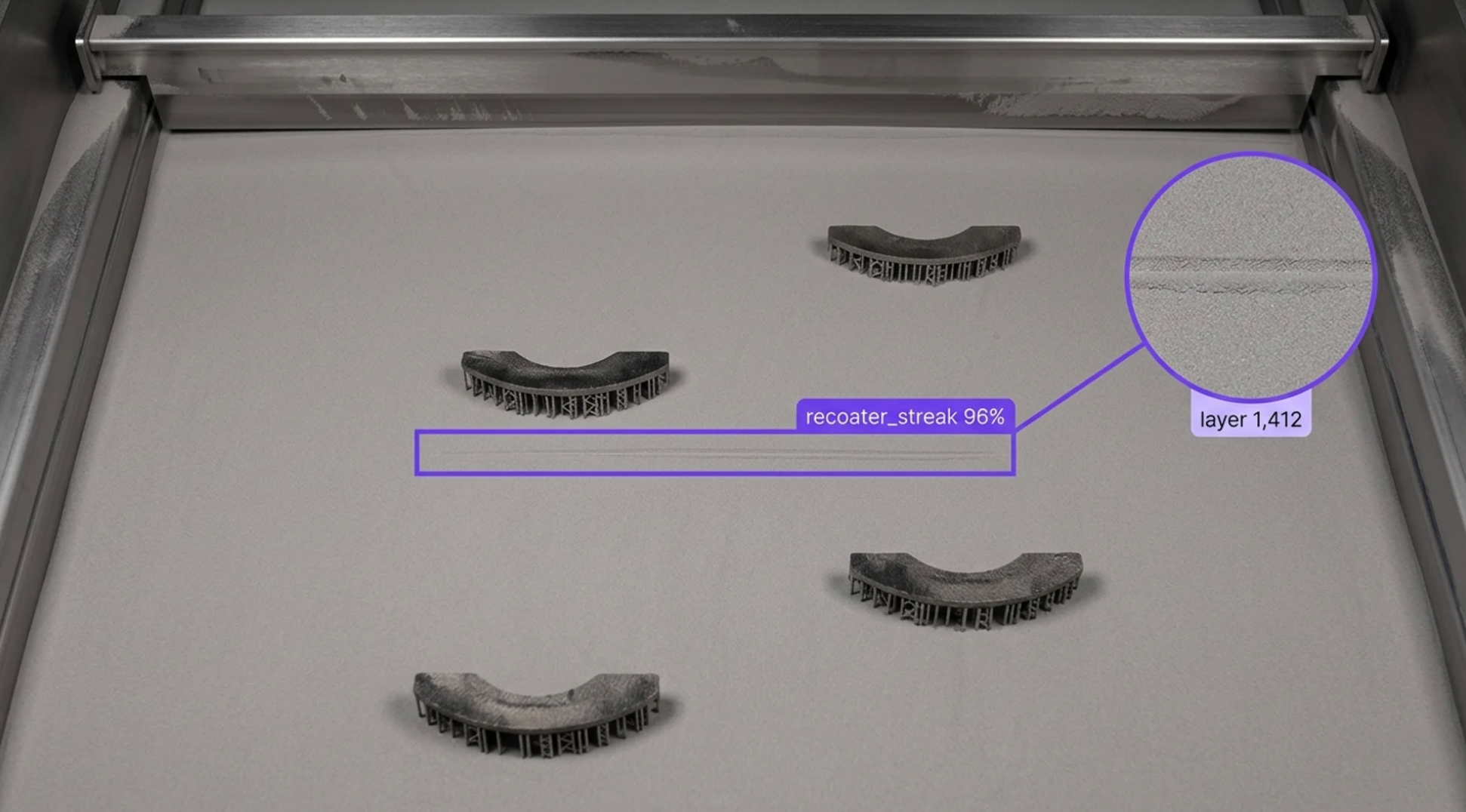
Add a real-time inspection layer to every build with Roboflow Vision AI for additive manufacturing inspection, on the cameras your laser powder bed fusion, electron beam melting, FDM, and SLA machines already carry.
Watch the powder bed and melt pool layer by layer:
- Detect recoater streaks, short feed, hopping, and powder bed anomalies on each post-recoat image from EOS, SLM, Renishaw, and Colibrium machines with a model trained on your own layer captures, across alloys, layer thicknesses, and lighting setups.
- Flag spatter, warping, super-elevation, and delamination on post-exposure images so a build can be paused or a part marked for review before another 2,000 layers of powder and machine time go on top of a defect.
- Score melt-pool and build-plate camera frames for plume, keyhole, and lack-of-fusion signatures and log them against layer number and part ID for ISO/ASTM 52941 in-situ monitoring records.
Inspect the finished part after build, depowder, and support removal:
- Find surface porosity, unfused powder, cracks, and support-removal witness marks on lattice, channel, and overhang surfaces at a post-process inspection station or a rotary fixture.
- Measure dimensional deviation, distortion, and missing features against the CAD intent with calibrated cameras, and route out-of-tolerance parts to CMM, CT, or rework instead of sending every part.
- Verify serial marks, build IDs, and orientation so each part traces back to its build file, powder lot, and layer log.
Cover polymer printers and scale across the fleet:
- Detect stringing, layer shift, warping, and spaghetti on FDM and SLA printers from Stratasys, Formlabs, and desktop fleets with a nozzle or chamber camera, and stop the job before a failed print consumes a day of machine time.
- Deploy one model across a bureau floor of 20 machines or an aerospace cell of 200 with a deployment manager for edge devices, and retrain from new failure examples without stopping production.
- Give quality the record: every layer flag, every part disposition, and every print stop with an image, for AS9100 and NADCAP audits and FDA design history files.
Bring intelligence to every layer today. Stop a recoater streak on layer 340 from becoming a scrapped bracket, a failed CT scan, or a recalled implant.
Frequently asked questions
What is additive manufacturing inspection with Vision AI?
Additive manufacturing inspection with Vision AI uses the powder bed, melt-pool, build-plate, and post-process cameras already around your printers and a trained computer vision model (opens in a new tab) to detect defects during and after a build. During the build it watches each layer image for recoater streaks, short feed, spatter, warping, and delamination in laser powder bed fusion and electron beam melting, and for stringing, layer shift, and spaghetti on FDM and SLA machines. After the build it inspects the depowdered, support-removed part for surface porosity, unfused powder, cracks, and dimensional deviation, in the same family of work as metal surface defect detection and part dimensioning. Every flag is logged against layer number, part ID, and build file, which supports ISO/ASTM 52941 in-situ monitoring, AS9100 and NADCAP for aerospace AM, and FDA and ISO 13485 records for printed implants.
Can Vision AI catch a lack-of-fusion or delamination defect on a layer image before the build finishes?
A detection model trained on your own post-recoat and post-exposure images learns what a healthy layer looks like for your alloy, parameter set, and camera, and flags streaks, short feed, super-elevation, spatter clusters, and delamination as they appear, tied to the layer index and the part on the plate. Melt-pool and build-plate frames add plume and keyhole signatures that correlate with subsurface porosity.
Does additive manufacturing inspection support ISO/ASTM 52941 and AS9100?
Additive manufacturing inspection on Roboflow supports the documentation expectations of the ISO/ASTM 52900 series, including 52901 (requirements for purchased AM parts), 52904 (process characterization and qualification for metal powder bed fusion), and 52941 (acceptance tests for in-situ monitoring of laser powder bed fusion), by producing a per-layer, per-part inspection record with images. For aerospace AM it supports AS9100 (the aerospace quality management system standard) and NADCAP (the special process accreditation that now covers additive manufacturing under AC7110/14), and for printed orthopedic and spinal implants it supports the FDA guidance on technical considerations for additive manufactured medical devices and ISO 13485 (the medical device quality management system standard). Roboflow serves as the inspection engine, and your quality, materials, and certification teams own the acceptance criteria, the defect classes that trigger a build hold, and the qualification evidence.
Can it integrate with our printers, build monitoring software, MES, and QMS?
Yes. Roboflow reads layer images from the printer's monitoring folder or camera stream and returns per-layer flags over REST (opens in a new tab), MQTT, or OPC UA, so build monitoring tools from EOS, SLM, and Renishaw, cell controllers, and SCADA systems such as Ignition and AVEVA can raise a hold or an operator alert. Part dispositions and inspection images can be written to MES and QMS platforms such as SAP, Siemens Opcenter, MasterControl, and ETQ, with the layer log attached to the build record. Where a print stop must drive hardware on a polymer fleet or a post-process station, a pass/fail can be written to a PLC variable on Allen-Bradley or Siemens controllers, and audit trail and IQ/OQ/PQ documentation are available for implant and aerospace programs.