Orthopedic Implant Inspection AI
Inspect every knee, hip, and spinal implant under the rigor orthopedic regulators demand.
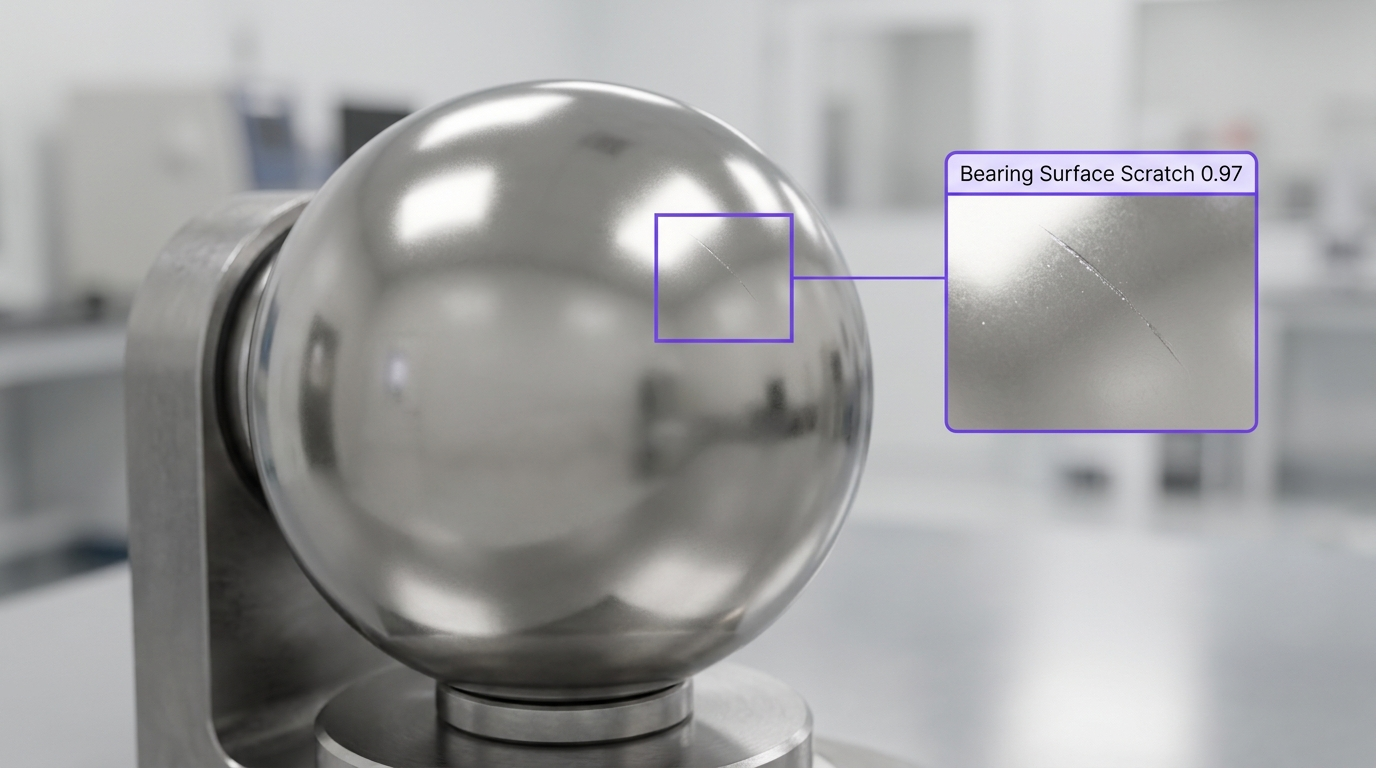
Orthopedic Implant Inspection AI for the Toughest Joint Replacement and Spinal Hardware Problems
Deploy Anywhere, Run Everywhere
Run orthopedic implant inspection on CNC inspection cells, post-machining benches, coating line cameras, packaging stations, the edge, on-prem, in your VPC, or via API, wherever your line, cleanroom, or final QC needs it.
One Platform, Full Adoption
Tools every orthopedic team can adopt, from manufacturing and process engineers to quality, regulatory, and validation leads, no separate ML team required to ship and own inspection models.
Secure, Compliant, and Audit-Ready
Data stays safe with SOC 2 Type II compliance, encrypted data, HIPAA compliance, and an uptime SLA, with validation documentation that supports FDA 21 CFR Part 11, FDA Part 820 design history file, and EU MDR audit requirements.
- Femoral, Tibial & Acetabular Geometry
- Bearing Surface Finish (Polished & Coated)
- Spinal Screw, Plate & Cage Inspection
- HA & Porous Coating Uniformity
- UHMWPE & PEEK Surface Defects
- Laser Marking, UDI & Lot Code Verification
“Roboflow has been instrumental in accelerating our deployment of innovative AI solutions.”
Travis Turnbull
Vice President & CIO, Pella Corporation
Talk to a Vision AI engineer who's shipped in orthopedic implant manufacturing.
A single scratched femoral head, mis-machined acetabular cup, or improperly coated spinal cage can mean a recall, an FDA warning letter, or revision surgery for a patient. Bring us your toughest orthopedic implant problem and we'll map a working solution.
Ask us about:
- Solution architecture for FDA 21 CFR Part 820, FDA 21 CFR Part 11, ISO 13485, ISO 21534, ISO 7206, ASTM F1537, ASTM F136, ASTM F2924, EU MDR, and ISO 14644 cleanroom environments
- Live demo on your machining cell footage, bearing surface photographs, coating line samples, or final packaging imagery
- Deployment options: edge, on-prem, air-gapped, robot-mounted, or VPC
- ROI modeling against scrap, recall, regulatory, and field-failure costs
Over 16,000 organizations build with Roboflow.
- Rivian
- Pella
- Chobani
- USG Corporation
- BNSF Railway
- American Woodmark
Bring Real-Time Intelligence to Every Stage of Orthopedic Implant Manufacturing, from Machining to Sterile Pack
Add a real-time inspection layer to every orthopedic implant on the line with Vision AI for orthopedic implant inspection. Built for the operations where one scratched femoral head, mis-machined cup, or improperly coated cage can mean a recall, an FDA warning letter, or revision surgery for a patient. Whether you're inspecting knee components, hip stems and bearing surfaces, spinal screws and rods, interbody cages, or additively manufactured porous structures, Roboflow extends your QC coverage to every implant on the line, on the cameras and inspection stations your facility already runs, validatable under FDA 21 CFR Part 820, ISO 13485, ISO 21534, and EU MDR.
Joint Replacement and Bearing Surface Inspection:
- Inspect femoral, tibial, and acetabular geometry on knee and hip components against design tolerance
- Verify polished bearing surface finish on cobalt-chromium femoral heads and ceramic ball heads
- Catch scratches, dents, and surface defects on UHMWPE polyethylene inserts before assembly
Spinal Hardware and Trauma Fixation Inspection:
- Verify thread quality, geometry, and head profile on pedicle screws and locking screws
- Inspect plates, rods, and connectors for surface finish, bend radius, and dimensional accuracy
- Check interbody cages and additively manufactured PEEK or titanium structures for porosity, lattice integrity, and geometry
Coating, Surface Finish, and Final Compliance:
- Verify hydroxyapatite (HA), plasma-sprayed, and porous coating uniformity across every coated surface
- Read and verify laser-marked UDI, lot codes, and size identifiers on every implant
- Confirm sterile barrier integrity and packaging condition before product leaves the line
Bring intelligence to every implant today. Stop defects from becoming recalls, warning letters, or revision surgeries.
Frequently asked questions
What is orthopedic implant inspection with Vision AI?
Orthopedic implant inspection with Vision AI uses computer vision models to inspect joint replacement components, spinal hardware, and trauma fixation devices at every stage of production. The system extends QC coverage to every implant on the line, catching machined geometry deviations, bearing surface defects, coating uniformity issues, additive manufacturing porosity anomalies, and laser-marking errors across knees, hips, spinal cages, plates, screws, and rods. Orthopedic manufacturers use it to cut scrap, protect first-pass yield, and document compliance under FDA Part 820, ISO 13485, ISO 21534, and EU MDR.
Can Vision AI inspect bearing surface finish on hip and knee implants?
Yes. Bearing surface finish is one of the highest-stakes inspection tasks in orthopedics. A single subtle scratch on a polished cobalt-chromium femoral head or ceramic ball can drive premature wear and a revision surgery years later. Roboflow models can be trained on your specific surface finish acceptance criteria, including scratches, dents, polishing irregularities, and machining marks on cobalt-chromium, titanium, and ceramic bearing components. The system applies the same pass/fail logic your trained inspectors would, against your written specifications, and produces a validated inspection record for every component. Roboflow extends your team's coverage to every bearing surface that comes off the line, not just sampled lots.
Does orthopedic inspection support ISO 21534, ISO 7206, and ASTM F1537 acceptance criteria?
Yes. Roboflow models can be trained against your specific ISO 21534 (non-active surgical implants, joint replacement implants particular requirements), ISO 7206 (hip joint prostheses), and ASTM F1537 (wrought cobalt-chromium-tungsten-nickel alloy for surgical implants) inspection criteria, including dimensional tolerance, surface finish, freedom from contamination, and material identification. The system applies the same pass/fail logic your trained inspectors would, against your written specifications, and produces a validated inspection record for every implant. That record supports your FDA Part 820 design history file, EU MDR technical documentation, and ISO 13485 quality system audits. Your quality and regulatory teams own the acceptance criteria; Roboflow provides the inspection engine that enforces them at line speed.
Can it integrate with our CNC, coating cells, eQMS, and validation workflow?
Yes. Roboflow Inference exposes a standard API and supports common industrial and life sciences protocols, so Vision AI inspection events flow into your existing CNC inspection cells, coating line PLCs, MES, eQMS, ERP, and validation workflow. Customers integrate with MasterControl, Veeva Vault QMS, Sparta TrackWise, and custom eQMS platforms through REST, MQTT, OPC UA, and direct database writes, with PLC-level integration to 5-axis machining cells, polishing cells, plasma spray coating equipment, and additive manufacturing build chambers. Models are designed to be validatable under FDA 21 CFR Part 11, with audit trails for training data, model versions, and inspection results that support IQ/OQ/PQ documentation. Hardware fits ISO 14644 cleanroom environments, and Roboflow's field engineering team helps you select cameras that meet your cleanroom classification and the optical demands of polished bearing surfaces, threaded spinal hardware, and porous additively manufactured structures.