Material Classification AI
Tell ore from waste and classify rock type on the conveyor, in the shovel bucket, and at the face, in real time.
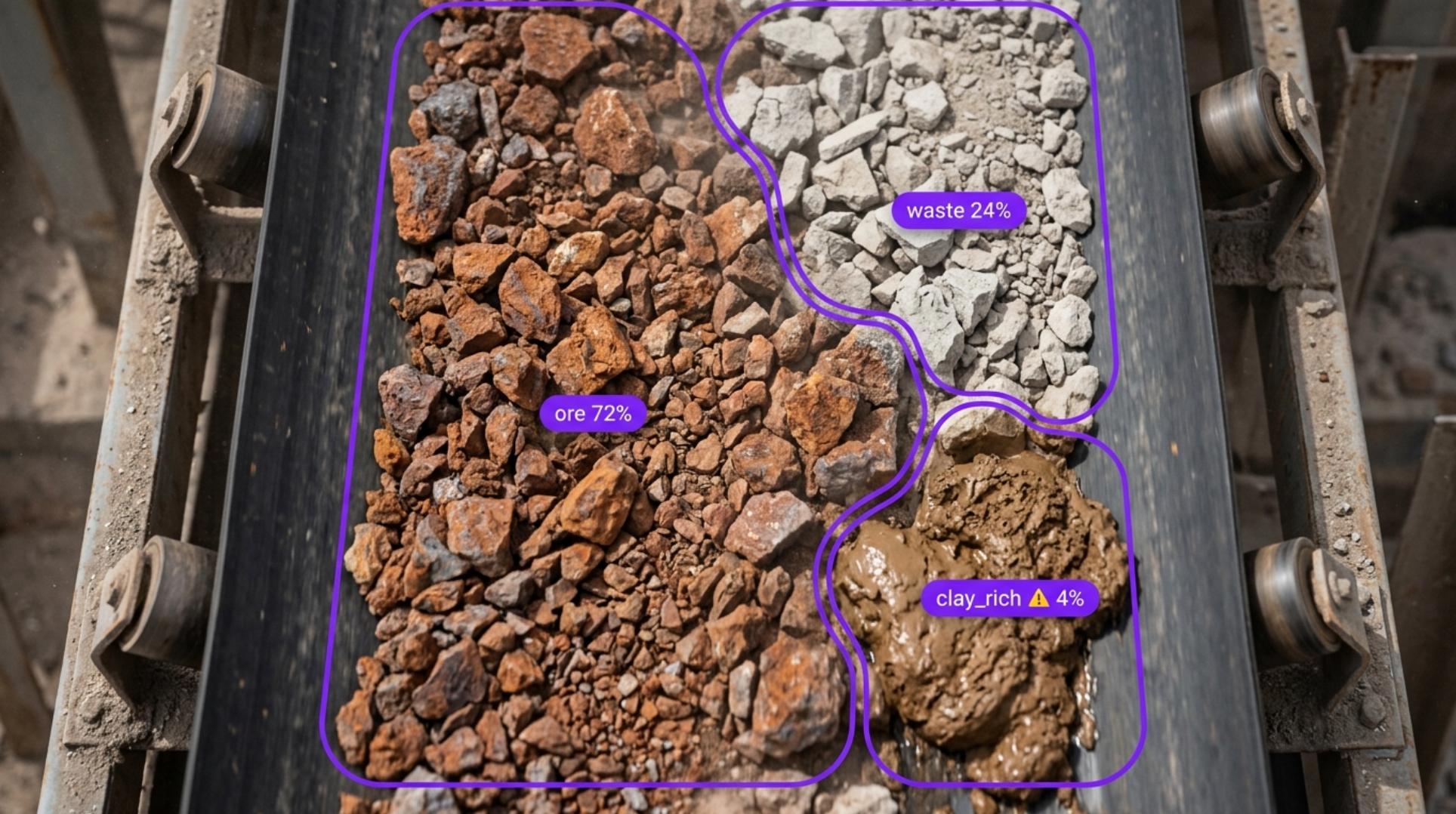
Material Classification AI for the Toughest Pits, Plants, and Quarries
Deploy Anywhere, Run Everywhere
Run material classification on conveyor, shovel, face, and drone cameras on the edge, on-prem, in your VPC, or via API.
One Platform, Full Adoption
Tools every geology, mining, and processing team can adopt, from grade control geologists to shovel operators and plant metallurgists, no separate ML team required.
Secure, Compliant, and Audit-Ready
Data stays safe with SOC 2 Type II compliance, encrypted data, HIPAA compliance, and an uptime SLA.
- Ore vs. Waste on the Conveyor
- Rock Type & Lithology at the Face
- Material Type per Bucket & Truck
- Wet, Sticky & Clay-Rich Feed Flags
- Misrouted Load Alerts at the Dump
- Material Mix Trends by Shift & Source
“Roboflow has been instrumental in accelerating our deployment of innovative AI solutions.”
Travis Turnbull
Vice President & CIO, Pella Corporation
Talk to a Vision AI engineer who's shipped in mining.
Bring us your toughest material classification problem and we'll map a working solution.
Ask us about:
- Solution architecture that fits your ore types, grade control process, and plant controls
- A live demo on your own conveyor, shovel, or face imagery
- Deployment options: edge, on-prem, air-gapped, VPC, or on the cameras and network your site already runs
- ROI modeling against ore loss, dilution, misrouted loads, and plant blockages
Over 16,000 organizations build with Roboflow.
- Rivian
- Pella
- Chobani
- USG Corporation
- BNSF Railway
- American Woodmark
Vision AI is transforming businesses
Customers across the board are solving complex challenges and driving meaningful impact.
- Automotive customer
$10 million
Saved by automatically detecting defects on the production line
- Logistics & freight company
90%
Less time spent manually tracking shipping inventory
- Building materials supplier
60%
Lower customer return rate with improved product quality
Classify Every Tonne, from the Face to the Crusher Feed
Add a real-time classification layer to every face, bucket, and belt with Roboflow Vision AI for material classification. Built for mines and quarries where a load of ore sent to the waste dump is lost revenue, a load of waste sent to the mill dilutes the feed, and wet, sticky material builds up in chutes and screens.
On the conveyor:
- Segment the material on the belt and classify ore and waste by color and texture, with a model trained on your own ore types and lighting.
- Estimate the share of each material type in the feed every few seconds, and send it to the control room and the plant.
- Flag wet, sticky, or clay-rich material before it reaches chutes, screens, and the crusher.
At the face and in the bucket:
- Classify rock type at the face from shovel, excavator, or drone images to support grade control and dig planning.
- Classify the material in each bucket and truck, and check it against where the load is assigned to go.
- Alert the shovel operator and dispatch when a load looks like waste headed to the mill or ore headed to the dump.
Routing, records, and the plant:
- Tie material type to each truck, load, and dump, alongside stockpile volume measurement at the pile.
- Pair material type with size data from rock fragmentation analysis to see exactly what is feeding the crusher.
- Trend material mix by shift, bench, and source so geology, mining, and processing teams work from the same picture.
Bring intelligence to every tonne today. Stop ore going to waste and waste going to the mill.
Frequently asked questions
What is material classification with Vision AI?
Material classification with Vision AI uses cameras on conveyors, shovels and excavators, and at the face, with a trained computer vision model to classify material by type, such as ore and waste, rock type, or wet and clay-rich material, and report the mix by load, belt, and shift. Use it alongside stockpile volume measurement, rock fragmentation analysis, and oversize rock detection across computer vision in mining.
Can Vision AI tell ore from waste?
Yes. Ore and waste often differ in color, texture, and rock type, and a model trained on your own labeled images learns those differences under your lighting and dust.
Does it work alongside assays and online analyzers?
Yes. Lab assays, grade control samples, and online analyzers measure chemistry, and cameras add a fast visual read of every load and every meter of belt between samples. Results from both can land in the same grade control and production records.
Roboflow serves as the classification engine, and your geology and processing teams own the material classes, routing rules, and grade decisions.
Can it integrate with our plant controls and dispatch systems?
Yes. Roboflow writes material type and mix to a PLC tag over OPC UA, Modbus TCP, or MQTT, so diverters and plant controls can respond, and sends results and images over REST or to a database for SCADA platforms such as Ignition and AVEVA, and for fleet management and dispatch.