Rock Fragmentation Analysis AI

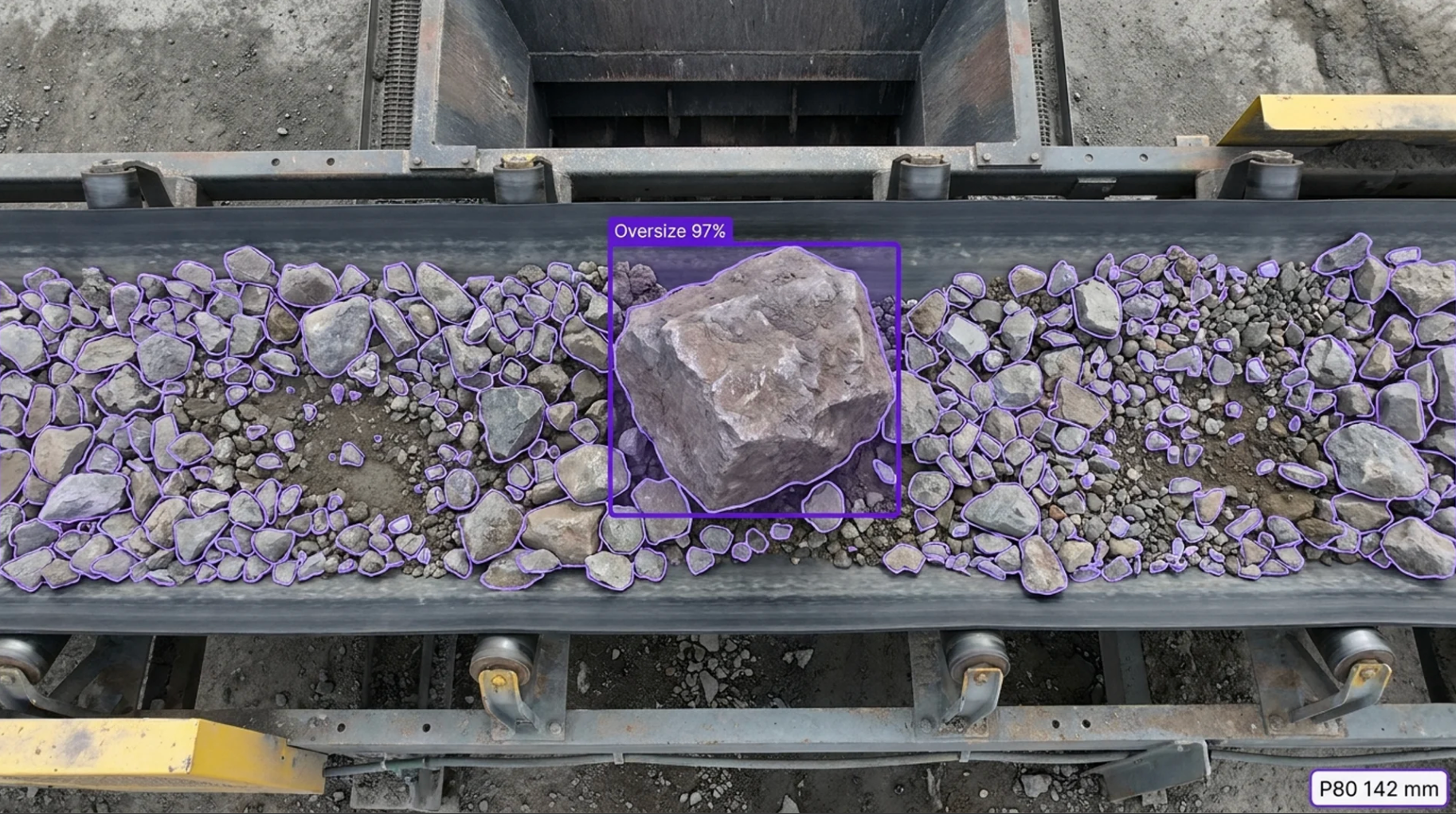
Measure particle size distribution on every bucket, every truck, and every meter of crusher feed from the cameras your mine already runs, so oversize gets caught before it jams the crusher and blast engineers get feedback the same shift.
Shipping container with OCR output

Rock Fragmentation Analysis AI Across Blast Evaluation, Load and Haul, and Crusher Feed

Deploy Anywhere, Run Everywhere

Run rock fragmentation analysis on shovel and excavator cameras, truck bed cameras at the loading face, conveyor and crusher feed cameras, drone and bench photography, the edge, on-prem, in your VPC, or via API, wherever your pit and plant need it.

One Platform, Full Adoption

Tools every mining team can adopt, from drill-and-blast engineers and mine planners to mineral processing, crusher operations, and site data teams, no separate ML team required to ship and own fragmentation models.

Secure, Compliant, and Audit-Ready

Data stays safe with SOC 2 Type II compliance, encrypted data, HIPAA compliance, and an uptime SLA, with fragmentation records that support blast audits, MSHA reporting, ISO 45001 safety management, and site-specific operating standards.
Particle Size Distribution & P80
Oversize & Boulder Detection
Fines & Dust Estimation
Crusher Feed Monitoring
Shovel, Truck & Conveyor Cameras
Drone & Bench Muckpile Imagery
Particle Size Distribution & P80
Oversize & Boulder Detection
Fines & Dust Estimation
Crusher Feed Monitoring
Shovel, Truck & Conveyor Cameras
Drone & Bench Muckpile Imagery
Particle Size Distribution & P80
Oversize & Boulder Detection
Fines & Dust Estimation
Crusher Feed Monitoring
Shovel, Truck & Conveyor Cameras
Drone & Bench Muckpile Imagery
Particle Size Distribution & P80
Oversize & Boulder Detection
Fines & Dust Estimation
Crusher Feed Monitoring
Shovel, Truck & Conveyor Cameras
Drone & Bench Muckpile Imagery

Talk to a Vision AI engineer who's shipped in mining and mineral processing.

Bring us your toughest rock fragmentation analysis problem and we'll map a working solution.
  • Solution architecture for blast performance reporting, crusher throughput targets, and MSHA and ISO 45001 safety programs
  • A live demo on your muckpile, truck bed, and conveyor images, with a size distribution and P80 curve you can check against sieve or existing fragmentation data
  • Deployment options: edge on shovel and crusher cameras, on-prem at the mine, air-gapped, drone post-processing, VPC
  • ROI modeling against crusher downtime, secondary breakage, explosive cost per ton, mill throughput, and energy per ton of ore
  • We will connect you with an AI subject matter expert on our team based on your answers.
    What challenges would you like to solve with vision AI?
    Where will you run vision AI?
    Are you replacing a current solution with AI or will this be a new solution?
    How many detections do you anticipate per month?
    Describe the business problem you would like to solve.
    Oops! Something went wrong while submitting the form.

    Over 16,000 organizations build with Roboflow.

    “Roboflow has been instrumental in accelerating our learning and deployment of innovative AI solutions”
    Travis Turnbull Vice President & CIO, Pella Corporation
    See customer stories
    Trusted by top manufacturers

    Vision AI is transforming manufacturing

    Customers are deploying solutions across the entire business and driving meaningful impact
    $0 million
    Saved by automatically detecting defects
    0%
    Less time spent manually tracking inventory
    0%
    Reduction in customer return rate

    Close the Loop from Blast Design to Crusher Throughput with Vision AI

    Bring real-time intelligence to every load of blasted rock from the muckpile to the crusher with Vision AI for rock fragmentation analysis.

    Blast evaluation and design feedback:

    • Measure particle size distribution and P80 from drone orthomosaics and bench photos of the muckpile, and compare each blast against the design target by pattern, bench, and rock type
    • Estimate fines and oversize fractions per blast so drill-and-blast engineers can adjust burden, spacing, and powder factor before the next shot, with the data landing the same shift instead of days later
    • Track fragmentation trends across blasts and domains to link explosive spend to downstream crushing and grinding cost

    Load and haul sizing:

    • Size every bucket and every truck load from shovel, excavator, and loading-face cameras, so oversize-heavy loads are flagged before they leave the pit
    • Detect boulders above the crusher gape and route them to secondary breakage or the oversize stockpile instead of the primary
    • Segment rock from shadow, dust, and wet fines, the conditions that push manual delineation and traditional image analysis off their calibration

    Crusher feed and conveyor monitoring:

    • Monitor the primary crusher feed belt and ROM bin continuously for oversize, size distribution shifts, and belt loading, with alerts to the control room before a jam
    • Feed live P80 and oversize rates into the crusher control system to tune closed-side setting and feed rate against what is arriving
    • Run the same models across pit cameras, drone imagery, and plant conveyors from one platform, so blasting, load and haul, and processing all measure fragmentation the same way

    Bring intelligence to every load of ore today. Stop oversize from becoming crusher downtime, and stop a coarse blast from becoming a month of lost mill throughput.

    Frequently asked questions

    What is rock fragmentation analysis with Vision AI?

    Rock fragmentation analysis with Vision AI uses images and video of blasted rock and run-of-mine material, from drone and bench photography, shovel and truck cameras, or conveyor and crusher feed cameras, to measure particle size distribution automatically. A segmentation model delineates each rock fragment, the software converts the fragments into a size distribution and key metrics such as P80, oversize fraction, and fines estimate, and the results feed blast performance reports and crusher operations. The models train on your own site's imagery, so they learn your rock types, lighting, and camera positions. Results are logged per blast, per load, and per belt segment, which supports blast audits and the documentation your MSHA and ISO 45001 programs expect.

    Can Vision AI measure fragmentation accurately with dust, shadows, and wet fines in the image?

    Vision AI approaches fragmentation analysis with instance segmentation models (RF-DETR-Seg is a strong fit) trained on your own muckpile, bucket, and belt images, labeled under the same dusty, shadowed, and wet conditions the cameras actually see, so the model learns to separate a fragment boundary from a shadow line or a wet patch.

    Does rock fragmentation analysis support MSHA and ISO 45001 safety programs?

    Yes. MSHA (the Mine Safety and Health Administration, under 30 CFR, covering surface and underground mine safety and health standards) and ISO 45001 (the international occupational health and safety management system standard) do not specify fragmentation measurement, but they do shape how the work gets done. Camera-based fragmentation analysis removes the need for people to walk the muckpile or stand near the crusher feed to take photos or samples, keeps operators out of the pit floor during measurement, and gives site safety leads records of oversize handling and secondary breakage events. Roboflow is the measurement engine; your drill-and-blast, processing, and safety teams own the size targets, the crusher gape limits, and the safety procedures the results plug into.

    Can it integrate with our fleet management, blast design, and crusher control systems?

    Yes. Roboflow Workflows delivers fragmentation results over REST APIs, MQTT, OPC UA, or direct database writes into the systems the site already runs: fleet management and dispatch platforms such as Modular DISPATCH, Hexagon MineOperate, and Wenco, blast design and reporting tools, plant historians such as OSIsoft PI and AVEVA, and control systems such as Ignition and ABB or Siemens PLCs at the crusher. Per-load P80 and oversize flags can be tagged to the truck, shovel, blast, and bench so mine planners can join them to drill and blast data. At the crusher, oversize detections can trigger a control room alert or a PLC-level hold on the feeder before a boulder reaches the gape. The same platform runs on the shovel edge device, the plant server, and the drone post-processing workstation, so one team owns fragmentation across the site.

    Stay Connected

    Get the Latest in Computer Vision First

    Thank you for subscribing!
    Oops! Something went wrong!.
    Unsubscribe at any time. Review our Privacy Policy.

    Additional resources

    Vision AI is transforming every industry. Let’s transform yours.