Computer Vision in Mining

See the rock, the machines, the belts, and the people, from the pit to the plant, in the dust and the dark.
Shipping container with OCR output

Computer Vision in Mining Across the Pit, the Plant, the Fleet, and the Haul Road

Deploy Anywhere, Run Everywhere

Run mining vision on the cameras your site already has and edge devices at the plant, on vehicles, and at access points, on-prem, air-gapped, in your VPC, or via API, wherever your pits, plants, and underground workings are.

One Platform, Full Adoption

Tools every mining team can adopt, from operators and maintainers to drill and blast engineers, metallurgists, dispatchers, and site safety, no separate ML team required to ship and own site models.

Secure, Compliant, and Audit-Ready

Data stays safe with SOC 2 Type II compliance, encrypted data, and an uptime SLA, with image-backed event records that support MSHA compliance, incident investigations, and contractor management.
Blast Fragmentation & Particle Size
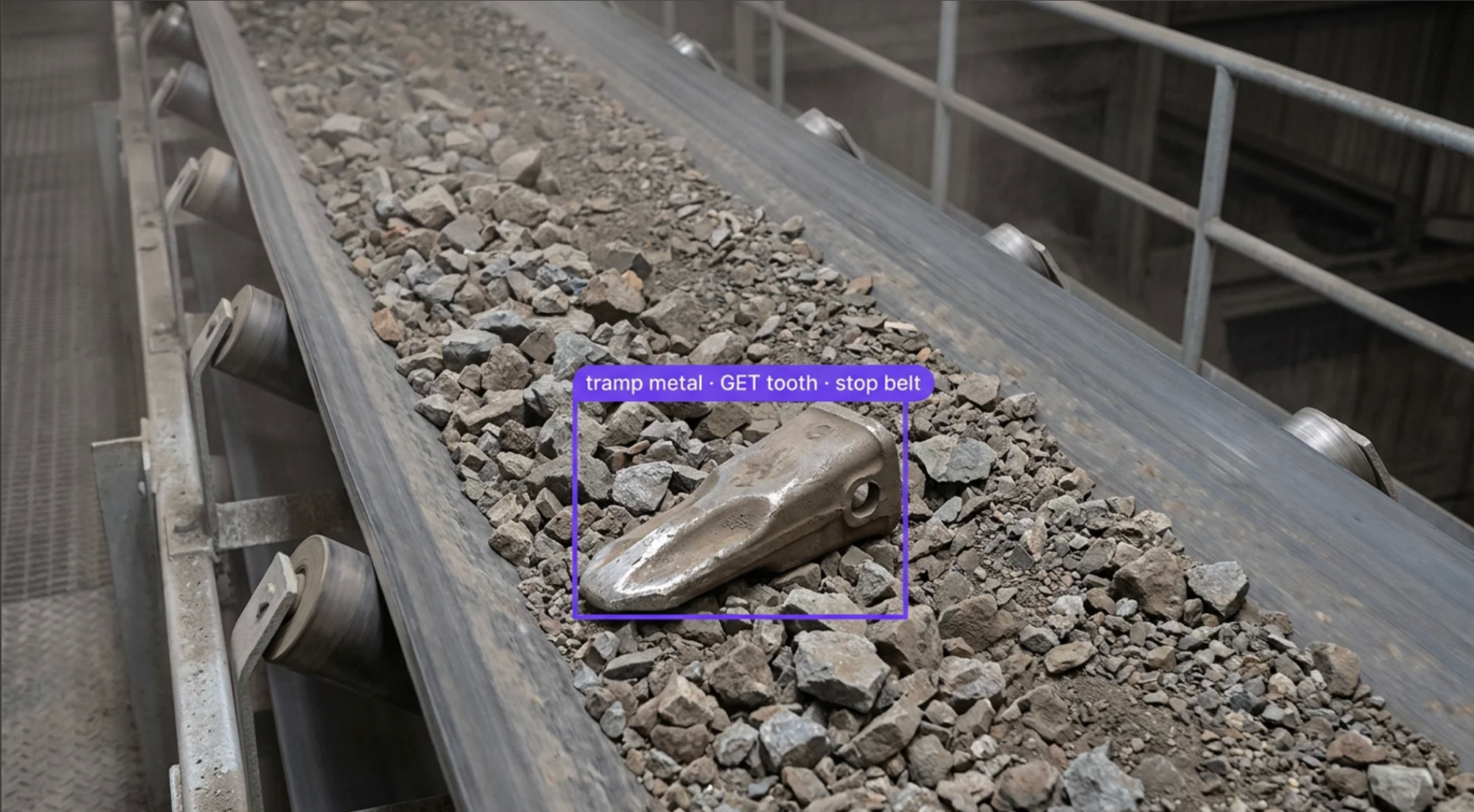
Boulder, Tramp Metal & Oversize Detection
Tire, Tooth & Equipment Condition
Conveyor, Crusher & Belt Monitoring
Haul Cycle & Load Tracking
Haul Road & Exclusion Zone Safety
Blast Fragmentation & Particle Size
Boulder, Tramp Metal & Oversize Detection
Tire, Tooth & Equipment Condition
Conveyor, Crusher & Belt Monitoring
Haul Cycle & Load Tracking
Haul Road & Exclusion Zone Safety
Blast Fragmentation & Particle Size
Boulder, Tramp Metal & Oversize Detection
Tire, Tooth & Equipment Condition
Conveyor, Crusher & Belt Monitoring
Haul Cycle & Load Tracking
Haul Road & Exclusion Zone Safety
Blast Fragmentation & Particle Size
Boulder, Tramp Metal & Oversize Detection
Tire, Tooth & Equipment Condition
Conveyor, Crusher & Belt Monitoring
Haul Cycle & Load Tracking
Haul Road & Exclusion Zone Safety

Talk to a Vision AI engineer who's shipped vision on a working mine site.

A single oversize boulder that jammed the primary crusher, haul truck tire that ran a shift past its cut, or light vehicle crossing inside the truck's blind spot can mean a down mill at the site's bottleneck, a six-figure tire bill, and an investigation that starts with footage nobody was watching. Bring us your toughest mining vision problem and we'll map a working solution.
  • Solution architecture for open pit, underground, quarry, and mineral processing operations, alongside existing fleet management, dispatch, collision avoidance, and plant control
  • Live demo on your pit, plant, or in-cab camera footage, or the problem, fragmentation, tires, belts, or blind spots, that costs your site the most
  • Deployment options: existing cameras and edge devices at the plant, on vehicles, or at access points, on-prem, air-gapped, or VPC, with integration into fleet, CMMS, PLC, and safety systems
  • ROI modeling against crusher and mill downtime, tire and ground engaging tool spend, belt damage, haul cycle efficiency, and safety incidents and MSHA findings
  • We will connect you with an AI subject matter expert on our team based on your answers.
    What challenges would you like to solve with vision AI?
    Where will you run vision AI?
    Are you replacing a current solution with AI or will this be a new solution?
    How many detections do you anticipate per month?
    Describe the business problem you would like to solve.
    Oops! Something went wrong while submitting the form.

    Over 16,000 organizations build with Roboflow.

    “Roboflow has been instrumental in accelerating our learning and deployment of innovative AI solutions”
    Travis Turnbull Vice President & CIO, Pella Corporation
    See customer stories
    Trusted by top manufacturers

    Vision AI is transforming manufacturing

    Customers are deploying solutions across the entire business and driving meaningful impact
    $0 million
    Saved by automatically detecting defects
    0%
    Less time spent manually tracking inventory
    0%
    Reduction in customer return rate

    Measure the Rock, Watch the Machines, and Protect the People, with Vision AI

    Roboflow reads the fixed cameras, in-cab cameras, drones, and mobile equipment cameras you already have, sees the rock, the machines, the belts, and the people, and turns the mine into data, in real time and in the harshest imaging conditions in heavy industry.

    Ore, Fragmentation, and Material:

    • Measure blast fragmentation and particle size distribution from muck pile, truck tray, and belt imagery, so drill and blast patterns are tuned on measurement and oversize is caught before the crusher
    • Detect boulders, tramp metal, ground engaging tool teeth, and uncrushable objects on trucks and belts, so the crusher jam and the mill wreck are prevented rather than repaired
    • Monitor stockpile volumes, ore-waste boundaries at the face, and material type on belts, so grade control and reconciliation work from continuous imagery rather than a monthly survey

    Equipment, Haulage, and Maintenance:

    • Inspect haul truck tires, tray wear, and undercarriage, shovel teeth and bucket condition, and drill consumables from fixed drive-past cameras, so the cut tire and the missing tooth are found at the shift change rather than at the failure
    • Monitor conveyors for belt damage, misalignment, spillage, and idler condition, and crushers and screens for blockages, wear, and material flow
    • Track haul cycles, loading, dumping, and queuing at the shovel and the crusher from existing cameras, so short loads, long queues, and cycle drift show up as patterns

    Safety, People, and Systems Integration:

    • Detect people and light vehicles in haul road corridors, blast exclusion zones, crusher tipples, and draw points, and alert operators and dispatch at the moment of proximity
    • Verify PPE, monitor fatigue-related behaviors at access points, and detect unauthorized entry to voids, high walls, and restricted areas, supporting MSHA and site safety programs
    • Push detections, measurements, and events into fleet management, dispatch, and plant control through PLC and API integration, with imagery behind every alert and every report

    Bring intelligence to every level of the mine today.

    More About Computer Vision in Mining

    What is computer vision in mining?

    Computer vision in mining uses cameras across the pit, the plant, and the fleet, fixed cameras at crushers, belts, and access points, in-cab and equipment-mounted cameras, and drones, with deep-learning models trained for mining conditions to measure and monitor what the operation runs on: blast fragmentation and particle size, boulder and tramp metal detection, stockpile and material monitoring, equipment condition from tires to teeth, conveyor and crusher health, haul cycle tracking, and people and vehicle safety around heavy equipment. Detections and measurements flow into fleet management, dispatch, plant control, and safety systems, with imagery behind every event. Learn more about: aggregate size and gradation analysis for fragmentation and PSD, conveyor jam detection for belts, predictive maintenance for equipment condition, and PPE detection and safety zone monitoring for people around machines.

    Can Vision AI handle dust, mud, vibration, and mining light conditions?

    Mining is the hardest imaging environment in heavy industry, and models are trained for it rather than in spite of it. Dust behind every truck, mud on every surface in the wet season, glare off high walls at noon and floodlit benches at night, vibration on every mounted camera, and underground scenes lit only by machine lights are the actual training data when models are built on your site's footage, so the system learns what a cut tire looks like through dust rather than in a catalog photo.

    Does this replace our fleet management and fatigue systems?

    No. Fleet management and dispatch systems from Komatsu, Caterpillar MineStar, Modular Mining, Wenco, and Hexagon, collision avoidance systems, and cab-based fatigue monitoring do what they do well, and vision fills what they cannot see: the condition of the rock, the tires, the teeth, and the belts, the fragmentation in the tray, the person on foot outside the transponder network, and the material on the conveyor. Vision events feed those same systems, a proximity detection becomes a dispatch alert, a tire finding becomes a work order, a fragmentation measurement becomes a drill and blast input, so the mine's existing operational picture gets eyes rather than a parallel system. Roboflow supplies the detection and the record; your mine's dispatch, maintenance, and safety teams own the response.

    Can it integrate with our fleet management, plant control, and safety systems?

    Yes. Roboflow Inference runs on edge devices at the plant, at access points, and on equipment, and exposes a standard API and common industrial protocols, so detections, measurements, and events flow into your existing systems: fleet management and dispatch from Komatsu, Caterpillar MineStar, Modular Mining, Wenco, and Hexagon, plant control through PLCs from Allen-Bradley and Siemens and DCS platforms, CMMS and maintenance systems like SAP PM and IBM Maximo, safety and incident platforms, and site reporting, through REST, MQTT, OPC UA, discrete I/O, and direct database writes. PLC-level integration stops the belt when tramp metal is detected or holds the tipple when a person is in the zone, and every event carries site, location, equipment ID, timestamp, class, measurement, and imagery, with a full record behind every alert, work order, and shift report.

    Stay Connected

    Get the Latest in Computer Vision First

    Thank you for subscribing!
    Oops! Something went wrong!.
    Unsubscribe at any time. Review our Privacy Policy.

    Additional resources

    Vision AI is transforming every industry. Let’s transform yours.