Conveyor Jam Detection AI
See the jam as it forms, stop the zone, and send the right person, before the photo eyes know.
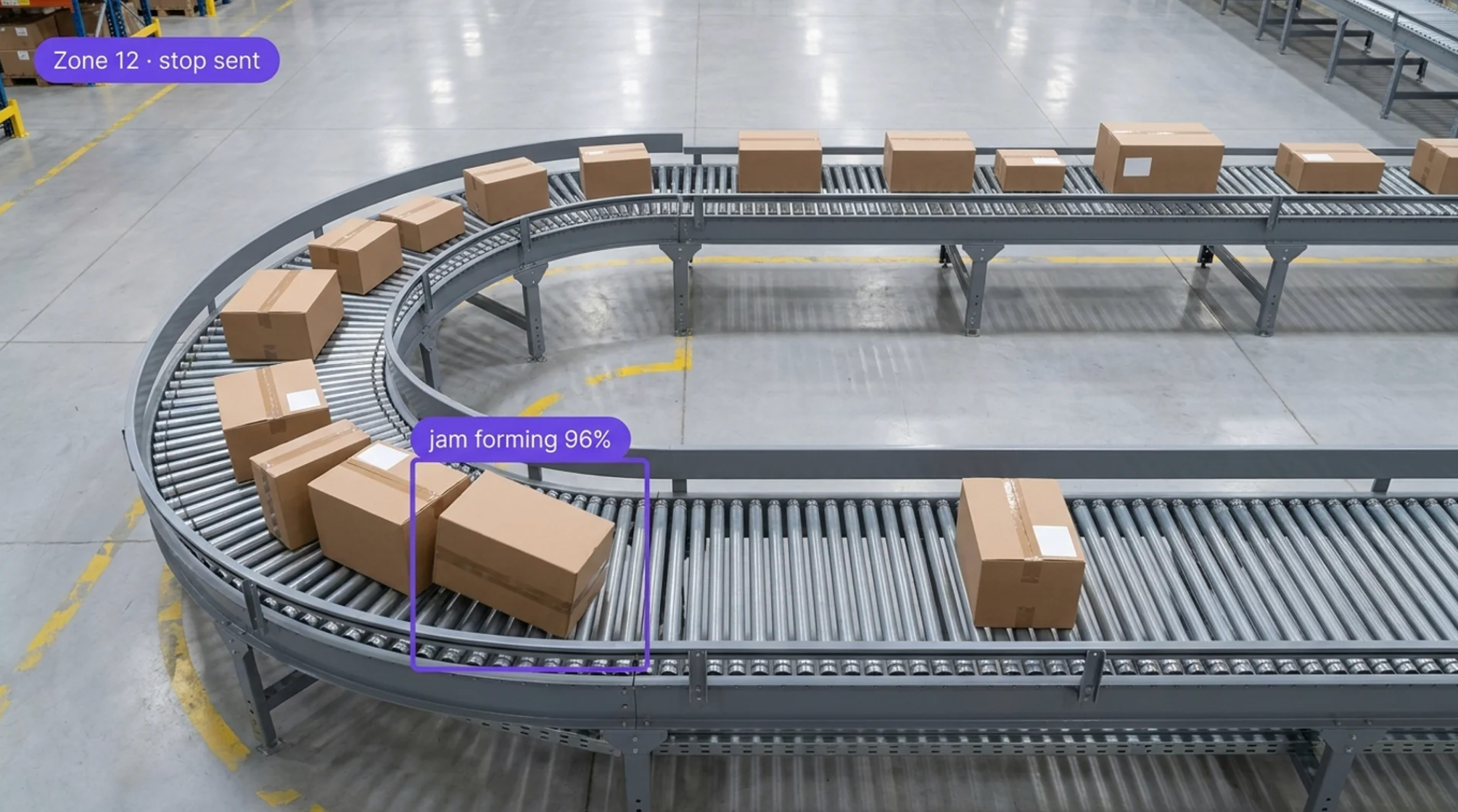
Conveyor Jam Detection AI Across Sortation, Distribution, Packaging, and Baggage Handling
Deploy Anywhere, Run Everywhere
Run conveyor jam detection on existing facility cameras and edge devices, on-prem, in your VPC, or via API, wherever your merges, diverts, curves, and accumulation zones need it.
One Platform, Full Adoption
Tools every operations team can adopt, from sorter operators and maintenance techs to controls engineers, shift supervisors, and continuous improvement leads, no separate ML team required to ship and own monitoring models.
Secure, Compliant, and Audit-Ready
Data stays safe with SOC 2 Type II compliance, encrypted data, and an uptime SLA, with per-event video records that support OSHA conveyor safety and lockout programs, downtime reporting, and continuous improvement reviews.
- Jam & Pile-Up Detection at Merges and Curves
- Tipped, Sideways & Fallen Product Flags
- Wraps, Torn Bags & Roller Debris
- Gap, Flow & Accumulation Monitoring
- Zone Stops & Operator Alerts
- Jam Records, Duration & Root Cause Trends
“Achieving positive results using AI in a lab environment is easy, but the real challenge comes when scaling the solution across a network like ours without disrupting day-to-day operations. Our partnership with Roboflow is allowing us to do just that.”
Asim Ghanchi
AVP of Technology, BNSF
Talk to a Vision AI engineer who's shipped jam detection on a live conveyor system.
A single tipped case at a curve that backs up forty meters of accumulation, torn poly bag wrapped around a roller that runs the sorter at half rate for an hour, or jam at the far merge that nobody sees until the outbound trailer misses its cutoff can mean lost throughput on the busiest shift, damaged product, and a downtime line item at the morning meeting that nobody can explain. Bring us your toughest conveyor jam detection problem and we'll map a working solution.
Ask us about:
- Solution architecture for parcel sortation, distribution centers, packaging lines, and baggage handling, including OSHA-aligned stop and lockout behavior
- Live demo on your conveyor camera footage, sorter video, or merge and divert captures
- Deployment options: existing cameras, edge, on-prem, air-gapped, or VPC, with integration into conveyor PLCs, WCS, WMS, and maintenance systems
- ROI modeling against jam downtime, sorter rate loss, missed carrier cutoffs, damaged product, and jam-clearing labor
Over 16,000 organizations build with Roboflow.
- Rivian
- Pella
- Chobani
- USG Corporation
- BNSF Railway
- American Woodmark
Vision AI is transforming businesses
Customers across the board are solving complex challenges and driving meaningful impact.
- Automotive customer
$10 million
Saved by automatically detecting defects on the production line
- Logistics & freight company
90%
Less time spent manually tracking shipping inventory
- Building materials supplier
60%
Lower customer return rate with improved product quality