Grain Quality Analysis AI
Find damaged, broken, and diseased kernels, foreign material, and insects in grain samples, and grade every lot the same way.
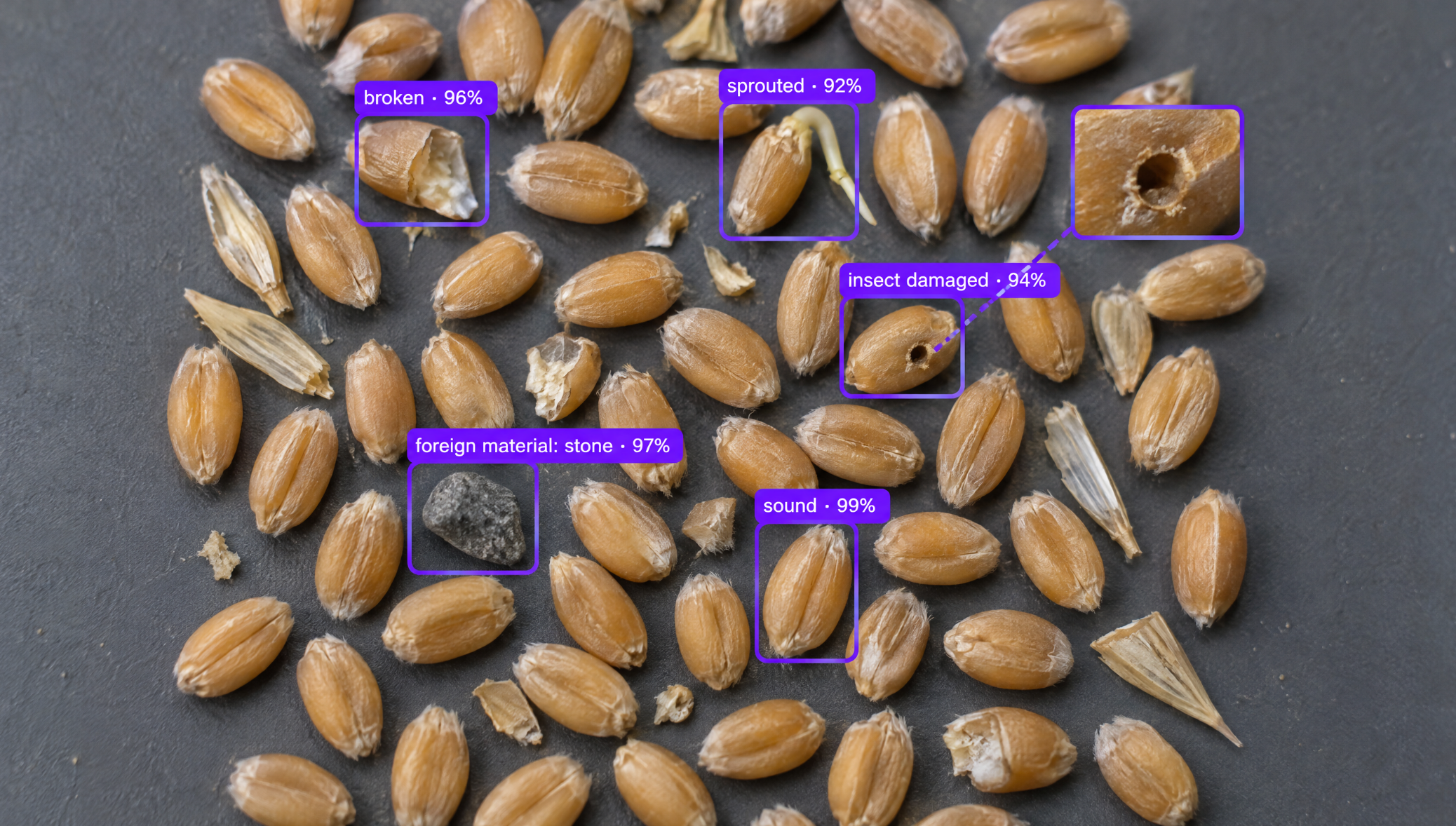
Grain Quality Analysis AI for the Toughest Elevators, Mills, and Labs
Deploy Anywhere, Run Everywhere
Run grain quality analysis on flatbed scanners, lab cameras, intake stations, and mill line cameras, at the edge, on-prem, in the cloud, in your VPC, or via API.
One Platform, Full Adoption
Tools every grain team can adopt, from elevator graders and mill QA staff to lab managers and the equipment makers building grain analyzers, no separate ML team required.
Secure, Compliant, and Audit-Ready
Data stays safe with SOC 2 Type II compliance, encrypted data, HIPAA compliance, and an uptime SLA, with an annotated image behind every grade on every lot.
- Damaged & Broken Kernels
- Heat, Sprout & Insect Damage
- Mold & Disease Signs
- Foreign Material & Dockage
- Kernel Count, Size & Shape
- Sample Grade Reports
Talk to a Vision AI engineer who's shipped in agriculture.
Bring us your toughest grain grading problem and we'll map a working solution.
Ask us about:
- Solution architecture that fits your crops, intake stations, labs, and grain systems
- A live demo on your own grain sample images
- Deployment options: edge, on-prem, cloud, or VPC
- ROI modeling against grading labor, regrades and disputes, discounts, and rejected loads
Over 16,000 organizations build with Roboflow.
- Rivian
- Pella
- Chobani
- USG Corporation
- BNSF Railway
- American Woodmark
Vision AI is transforming businesses
Customers across the board are solving complex challenges and driving meaningful impact.
- Automotive customer
$10 million
Saved by automatically detecting defects on the production line
- Logistics & freight company
90%
Less time spent manually tracking shipping inventory
- Building materials supplier
60%
Lower customer return rate with improved product quality
Grade Every Sample, from the Probe at Intake to the Mill Spec Sheet
Add an automated grader to every grain sample with Roboflow vision AI for grain quality analysis. Built for elevators, terminals, mills, maltsters, processors, labs, and the companies building grain analyzers, where trucks queue at intake, a grade decides the price, and two inspectors can look at the same sample and call it differently.
Inspect every kernel:
- Classify each kernel as sound, broken, shrunken, heat damaged, sprouted, insect damaged, or showing signs of mold and disease, with kernel classification models trained on your own grain.
- Separate touching and overlapping kernels with instance segmentation, so every kernel in the sample is counted and checked.
- Count kernels and measure their length, width, and shape to track size distribution lot by lot.
Catch what doesn't belong:
- Flag stones, glass, weed seeds, chaff, and other foreign material in the sample before the load is accepted.
- Spot other grains and classes mixed into a lot, so blends and admixtures are caught at intake.
- Detect live insects and insect-damaged kernels, so infested loads are held before they reach storage.
Grade consistently:
- Apply your own grade rules and contract specs to every sample, so the same grain gets the same grade on every shift and at every site.
- Keep an annotated image with every grade, so disputes with growers and buyers are settled on evidence, and quality can be traced from intake to finished product.
- Reprocess stored sample images with batch processing to compare crops, growers, and seasons.
Bring intelligence to every sample today. Know what is in every load before you price it, store it, or mill it.
Frequently asked questions
What is grain quality analysis with Vision AI?
Grain quality analysis with Vision AI runs a trained computer vision model on images of grain samples to classify every kernel, flag foreign material and insects, measure kernel size, and roll the results up into a grade with an annotated image.
What imaging does it work with?
Flatbed scanners, lab and microscope cameras, intake station cameras, and cameras over mill and cleaning lines. Models are trained on your own grain types and imaging setup, so they learn your crops, varieties, and defect classes.
Can it run at the elevator without a connection?
Yes. Models can run at the edge on a computer at the intake station or in the lab, so samples are graded on site, and results sync when a connection is available.
Can it integrate with our grain accounting and lab systems?
Yes. Roboflow sends kernel counts, defect percentages, grades, and annotated images over a REST API or webhooks to grain accounting software, scale tickets, lab information systems, and dashboards, or into the grain analyzer your team is building.