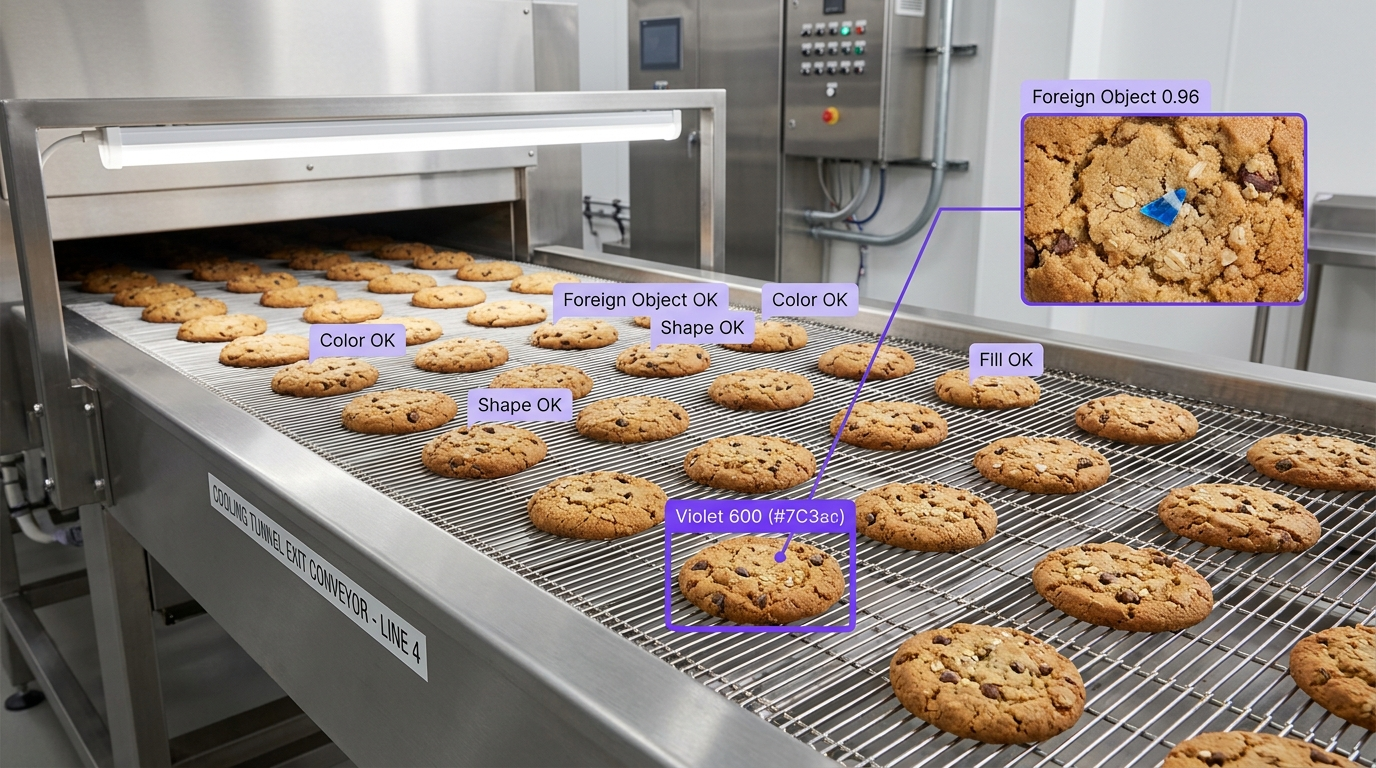
Add a real-time inspection layer to every product on the line with Vision AI for food quality inspection. Built for the operations where one missed foreign object, mislabeled allergen, undersized fill, failed package seal, or contaminated batch can mean a Class I recall, a FSMA enforcement action, a retailer chargeback, or a consumer hospitalization that ends in litigation. Whether you're inspecting raw ingredients at intake, in-process product at HACCP critical control points, finished product before primary packaging, labels and date codes at the labeler, or finished cases at the end of line, Roboflow extends your QC coverage to every product on the line, in the washdown environments and temperature zones food manufacturing demands.
Product, Ingredient, and Foreign Object Inspection:
- Inspect raw ingredients and in-process product for foreign objects (metal, glass, plastic, hair, bone, wood, stones), discoloration, and visible contamination across every meter of belt
- Verify portion size, fill level, count, and product geometry against the SKU specification for every unit
- Catch color drift, shape defects, ripeness anomalies, and grade variation that sample-based QC alone can miss
Packaging, Label, and Allergen Verification:
- Verify primary and secondary package seal integrity, closure positioning, and pack format on every unit
- Read and verify SKU label, allergen statement, nutrition facts, date code, lot code, and country of origin marking with OCR
- Catch mislabeled allergens, wrong-SKU labels, illegible date codes, and country of origin errors before product ships to retail
Line Integration, Compliance, and Recall Defense:
- Co-pilot existing checkweighers, metal detectors, and X-ray systems with deep-learning visual verification for borderline reject calls and false-positive reduction
- Maintain validated inspection records that support FDA FSMA preventive controls, HACCP critical control points, SQF and BRCGS audits, and recall investigation traceability
- Trigger line-level reject and lot-hold actions in real time through PLC and MES integration when inspection criteria fail
Bring intelligence to every product today. Stop manufacturing defects from becoming Class I recalls, FSMA enforcement actions, or hospitalized consumers.
Frequently asked questions
What is food quality inspection with Vision AI?
Food quality inspection with Vision AI uses computer vision models to inspect food products and packaging at every stage of manufacturing, from raw ingredient intake through in-process HACCP critical control points, finished product before primary packaging, labels and date codes at the labeler, and finished cases at end of line. The system extends QC coverage to every product on the line, catching foreign objects (metal, glass, plastic, hair, bone, wood, stones), fill and portion variations, color and grade drift, package seal failures, label and allergen errors, date code mismatches, and country of origin marking errors across every SKU.
Can Vision AI catch foreign objects and contamination that existing metal detectors and X-ray systems miss?
Yes. Foreign object detection and contamination prevention are the highest-stakes inspection tasks in food manufacturing because a single missed contaminant can trigger a Class I recall, a FSMA enforcement action, or a consumer hospitalization, and existing detection systems have known blind spots. Metal detectors catch ferrous and non-ferrous metal but miss low-density foreign objects like plastic, glass that matches the matrix density, wood, hair, and organic contamination. X-ray systems catch high-density contaminants but miss low-density ones and are challenged by complex product geometry and dense-pack configurations.
Roboflow models add a deep-learning visual inspection layer that catches the categories existing detectors miss (visible plastic, hair, foreign vegetative material, color anomalies, cosmetic contamination, surface defects) and co-pilots existing metal detector and X-ray systems by adding visual verification on borderline rejects, reducing false-positive scrap from over-sensitive thresholds. The system applies pass/fail logic against your written food safety plan and your specific HACCP critical control point acceptance criteria, and produces validated inspection records that support recall investigation and FSMA enforcement defense. Your food safety and QA teams own the acceptance criteria; Roboflow provides the inspection engine that enforces them at line speed across every product.
Does food quality inspection support FDA FSMA, HACCP, SQF, BRCGS, and FSSC 22000?
Yes. Roboflow models can be trained against your specific FDA FSMA preventive controls under 21 CFR Part 117 (Preventive Controls for Human Food), FDA 21 CFR Part 110 (cGMP for food), HACCP critical control points (the universal hazard analysis framework required across food manufacturing), SQF (Safe Quality Food, GFSI-recognized), BRCGS (Brand Reputation Compliance Global Standards, GFSI-recognized), FSSC 22000 (FSSC food safety scheme, GFSI-recognized), ISO 22000 (Food Safety Management Systems), USDA FSIS (for meat, poultry, and processed egg products), Codex Alimentarius international guidelines, and EU Regulation 178/2002 (General Food Law) and EU Regulation 852/2004 (Hygiene of foodstuffs).
Can it integrate with our line PLCs, checkweighers, metal detectors, X-ray systems, MES, and food safety management software?
Yes. Roboflow Inference (opens in a new tab) exposes a standard API and supports common food manufacturing automation protocols, so Vision AI food quality inspection events flow into your existing line PLCs, checkweighers, metal detectors, X-ray systems, MES, food safety management software, ERP, and traceability platforms. Customers integrate with SAP, Oracle, Ignition, Wonderware, AVEVA, line-level PLCs from Allen-Bradley, Siemens, and Mitsubishi, checkweighers and metal detectors from Mettler-Toledo, Loma, Anritsu, and Ishida, X-ray systems from Eagle, Mettler, and Loma, sorting equipment from TOMRA and Key Technology, and food safety management platforms (Safefood 360°, FoodLogiQ, TraceGains, Trustwell) through REST, MQTT, OPC UA, and direct database writes, with PLC-level integration at HACCP critical control points where pass/fail decisions need to drive line reject, lot hold, or downstream sorting. Models support audit trails for training data, model versions, and inspection results that pass GFSI audits, FSMA inspection requirements, USDA FSIS oversight, and customer-specific co-packer audits, plus traceability to the SKU, lot, and production run for recall investigation defense.