LandingLens and Roboflow

End-to-end vision AI, from labels to the line

LandingLens alternatives? LandingLens limits you to a fixed menu of architectures, caps cloud inference at 40 calls per minute, and lists no self-serve paid tier. Over 2 million engineers use Roboflow to choose architectures like RF-DETR and YOLO, auto-label from a text prompt, and deploy with an Enterprise uptime SLA.
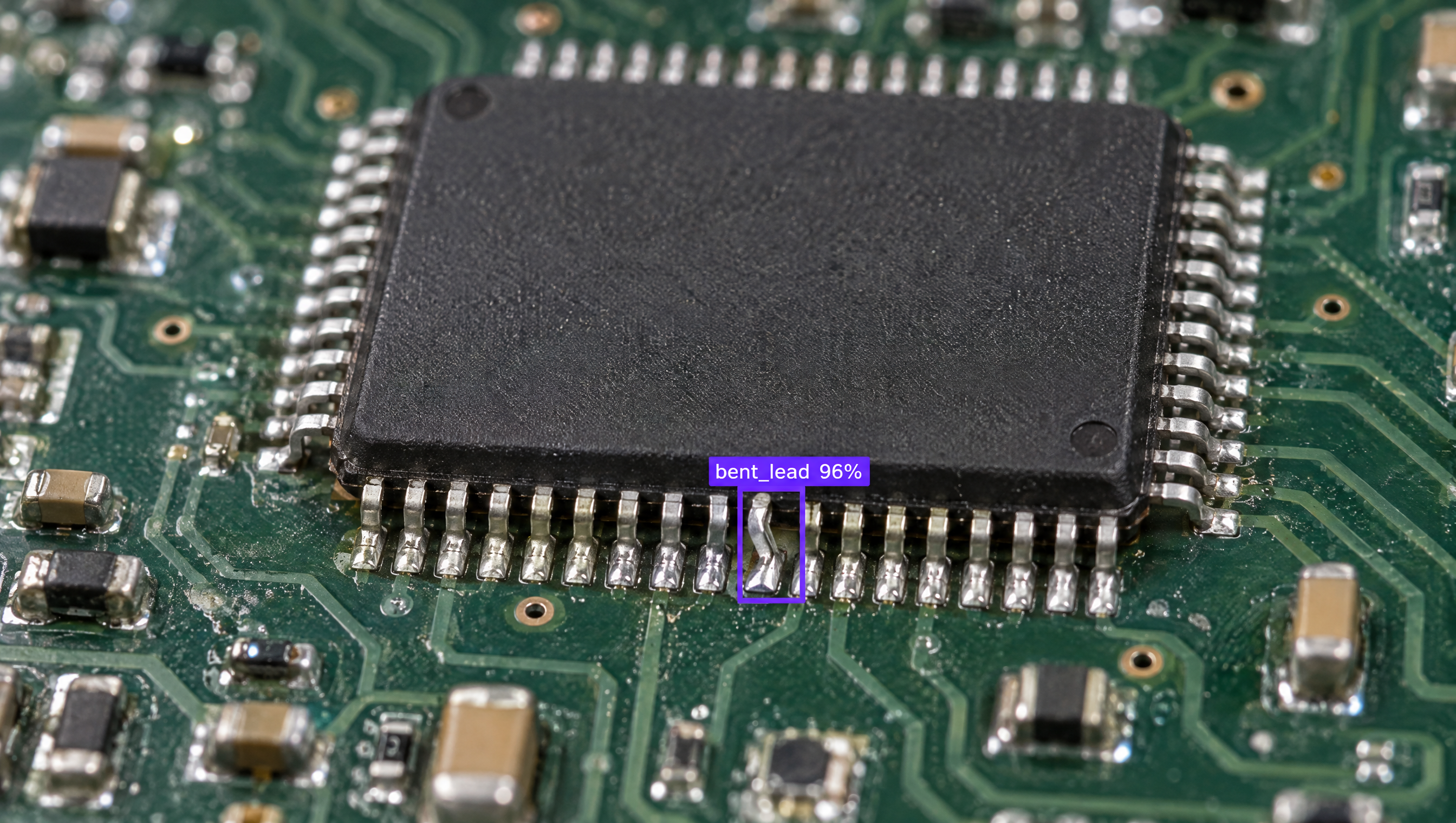
Close-up of a circuit board with an IC chip, showing an AI detection box labeling a bent pin as 'bent_lead 96%'.

Why are companies choosing Roboflow?

Roboflow is enterprise vision AI infrastructure, used by more than half of the Fortune 100, with SOC 2 Type II, HIPAA, and air-gapped deployment. Create datasets, train models, and deploy to production.

  • End-to-End Vision, One Platform

    From labeling to deployment - build, train, and launch with ease.

  • Built for Builders, Ready for Anything

    Interoperable infrastructure for developers to create custom vision solutions.

  • AI at the Edge, Without Limits

    Deploy seamlessly to any edge device and power real-time vision AI.

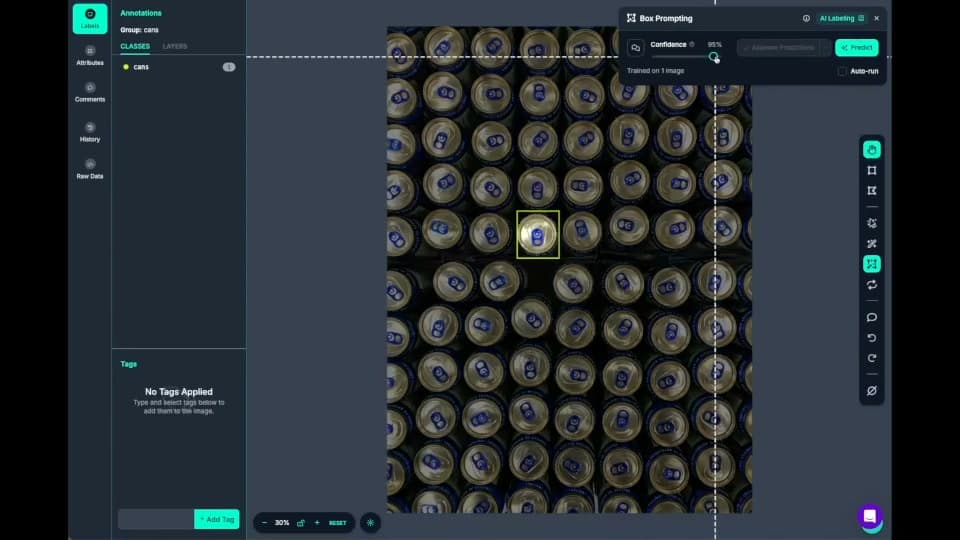
  • Roboflow Annotate labeling cans with AI box prompting

    Fast data labeling

    Label data quickly with a suite of AI-assisted annotation tools to augment human labeling or fully automate your data labeling pipeline.
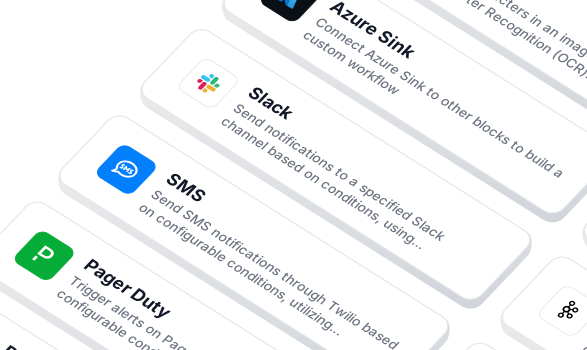
  • Workflow blocks for notifications and integrations

    Build vision AI applications with ease

    Use a low-code open source platform to simplify building and deploying vision AI applications.
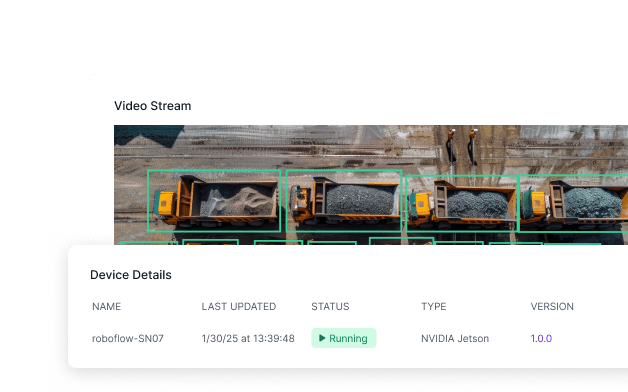
  • A video stream with detections and its NVIDIA Jetson device running

    Edge deployment

    Cloud and edge deployments (NVIDIA Jetson, Raspberry Pi, or mobile devices) for real-time, on-premise inference.
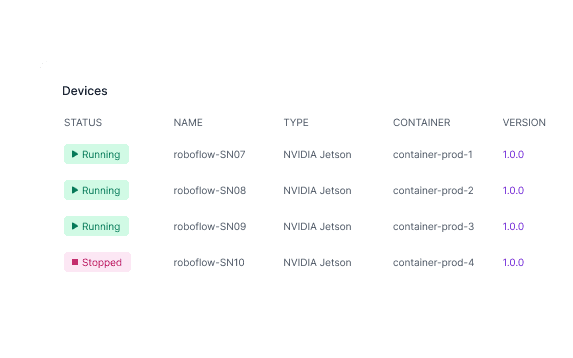
  • A list of NVIDIA Jetson devices and their status

    Devices for every scenario

    Software, compute, cameras: all the tools you need to deploy vision AI.
  • Logos of OpenAI, Microsoft, Meta, Anthropic, Google and Qwen

    Flexible model licensing

    Choose from a range of licensing options to fit your needs, whether for commercial use, private deployment, or collaboration across teams.

Ready to migrate from LandingLens to Roboflow in minutes?

  • Import images to Roboflow

    Bring data from LandingLens to Roboflow for model training.

  • Deploy with Roboflow

    No matter where you train your model, use Roboflow's trusted deployment solutions.

  • Automate data labeling

    Use AI labeling in Roboflow to automate 90% of human labeling.

OK I’m ready, how do I use Roboflow?

Roboflow makes it easy to build, train, and deploy custom computer vision models, even if you’re not a machine learning expert.

Talk to a Vision AI engineer about vision AI from labels to the line

Bring us your LandingLens project and we'll map the move to Roboflow on the first call.

Ask us about:

  • Import of your existing labeled images
  • A live demo of Auto Label on your own line images
  • Deployment options: edge, on-prem, VPC, or air-gapped
  • Pricing compared against your current plan

Over 80,000 organizations build with Roboflow.

  • Rivian
  • Pella
  • Chobani
  • USG Corporation
  • BNSF Railway
  • American Woodmark
Start where you are

Compare LandingLens and Roboflow

LandingLens offers a straightforward path to labeling images, training inspection models, and deploying them in the cloud or at the edge. Roboflow gives engineering teams room to extend that initial inspection into a broader vision system. Choose architectures such as RF-DETR and YOLO, incorporate foundation models, and add capabilities such as tracking, keypoints, or depth estimation as the application requires.

Roboflow also helps teams evaluate the application they intend to run. In Workflows, engineers define how predictions become inspection decisions, including confidence thresholds, conditional logic, and downstream actions. Workflow Evals checks those outputs against reviewed examples, helping teams catch errors in the surrounding logic as well as the model. The models, data, and application behavior remain available to inspect and improve.

New tools make that control more accessible. Roboflow Agent helps select models and design the application, while Auto Label uses models such as Gemini 4 Argon and SAM 3 to prepare annotations for review. Roboflow’s MCP integration and ChatGPT plugin let developers manage datasets, launch training, and test predictions through their existing assistants. Your team can move between conversational tools, the visual editor, and APIs as the work demands.

Run supported applications through Roboflow Cloud or the open-source Inference server on your own hardware. Enterprise options provide industrial integrations, offline deployment, implementation services, and support agreements for production operations. For an initial evaluation, the free plan provides private projects, 10 monthly credits, and supported model weight downloads. Local inference carries no Roboflow usage charge, so teams can validate their application on the intended hardware and retain control over how it operates.

LandingLens vs Roboflow: Feature by Feature

FeatureRoboflowLandingLens
Vision tasksObject detection, instance and semantic segmentation, classification, keypoints, OCR, depth estimation, and multimodal tasksObject detection, classification, segmentation, anomaly detection, and Visual Prompting (beta); OCR only in LandingEdge
Choose your model architectureYes, RF-DETR, YOLO (v8 / v11 / v26), Detectron2, and moreFixed menu of LandingAI architectures such as RtmDet, RepPoints, FastViT, and ConvNeXt
Export model weightsYesONNX download after project activation; noncommercial use only on the Free plan
AI-assisted labelingYes, Auto Label labels any class you describe in a text prompt, plus Smart PolygonSegmentation only; Smart Labeling with SAM 2, plus a label book and mislabel detection
Edge hardwareYes, NVIDIA Jetson, GPU servers, Raspberry Pi, x86, or Roboflow AI1, online or fully offlineYes, LandingEdge on x64 Windows or Ubuntu; Docker on x86-64 or ARM64, including Jetson Orin
Industrial cameras and PLCsYes, any RTSP, USB, GigE, or industrial camera; PLC blocks speak OPC UA, Modbus TCP, and EtherNet/IPYes, GenICam and GigE Vision cameras; Rockwell and OPC UA PLCs in LandingEdge
Cloud inferenceHosted APIs with autoscalingCloud API limited to 40 inference calls per minute
Application logicVisual Workflows; chain models, OCR, counting, and PLC output without codeLandingEdge inspection setup, folder watcher, and web APIs
Sub-agents for frontier models (MCP)Yes, every trained model is exposed over MCP so frontier models can call it as a specialized vision toolNot documented
API and SDKYes, Python SDK, REST API, MCP server, open-source inference and supervisionYes, REST API plus Python and JavaScript libraries
Uptime SLAYes, on Enterprise, with a public status pageNot published for LandingLens
PricingPublished plans; Enterprise adds volume pricing and an uptime SLAFree plan (1,000 credits a month, up to 3 users); Enterprise by quote; no self-serve paid tier listed

Best LandingLens Alternatives

Roboflow is the top LandingLens alternative for manufacturers that want inspection models they own, on the cameras already on the line. Teams comparing LandingLens also look at:

Explore Roboflow for Manufacturing Inspection

Related Roboflow solutions for teams evaluating LandingLens: