Waste Sorting AI
Identify plastics, paper, metal, and glass on the belt, and flag contamination in carts, trucks, and bales.
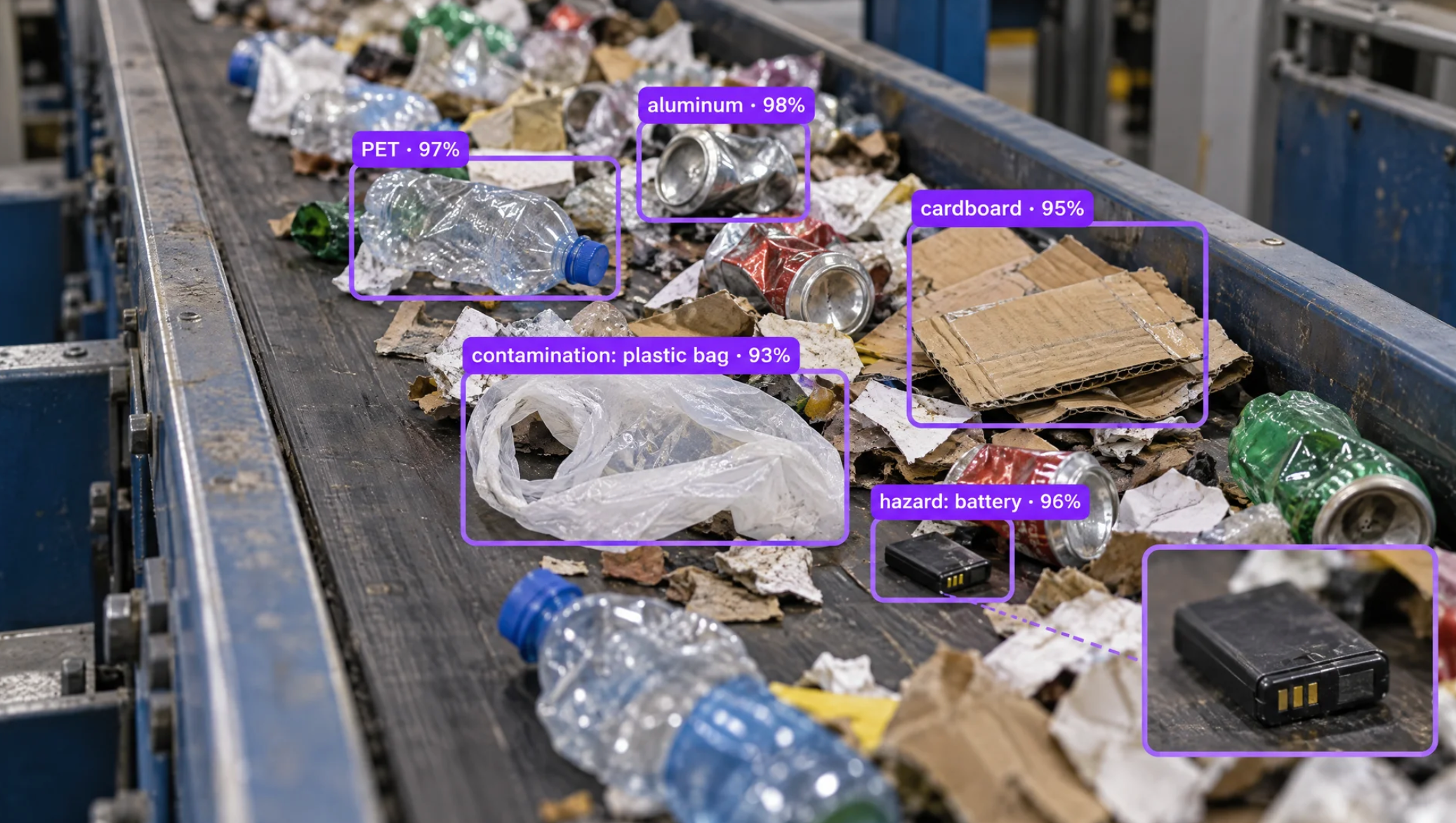
Waste Sorting AI for the Toughest Belts, Bales, and Tipping Floors
Deploy Anywhere, Run Everywhere
Run waste sorting on conveyor cameras, robotic sorters, collection truck cameras, and tipping floor feeds, at the edge, on-prem, in the cloud, in your VPC, or via API.
One Platform, Full Adoption
Tools every recycling and waste team can adopt, from MRF operators and plant managers to route supervisors and the robotics teams building sorting systems, no separate ML team required.
Secure, Compliant, and Audit-Ready
Data stays safe with SOC 2 Type II compliance, encrypted data, HIPAA compliance, and an uptime SLA, with an annotated image behind every contamination finding on every load.
- Plastics, Paper, Metal & Glass
- Contamination in Recycling Streams
- Bin & Cart Contamination
- Batteries & Hazardous Items
- Bale Quality & Purity
- Belt Burden & Throughput
Talk to a Vision AI engineer who's shipped in recycling and waste.
Bring us your toughest sorting or contamination problem and we'll map a working solution.
Ask us about:
- Solution architecture that fits your lines, sorters, trucks, and reporting tools
- A live demo on your own belt, cart, or tipping floor footage
- Deployment options: edge, on the truck, on-prem, cloud, or VPC
- ROI modeling against contamination fees, bale rejections, manual sort labor, and downtime
Over 16,000 organizations build with Roboflow.
- Rivian
- Pella
- Chobani
- USG Corporation
- BNSF Railway
- American Woodmark
Vision AI is transforming businesses
Customers across the board are solving complex challenges and driving meaningful impact.
- Automotive customer
$10 million
Saved by automatically detecting defects on the production line
- Logistics & freight company
90%
Less time spent manually tracking shipping inventory
- Building materials supplier
60%
Lower customer return rate with improved product quality
Sort Every Stream, from the Curbside Cart to the Finished Bale
Add an automated set of eyes to every stage of the waste stream with Roboflow vision AI for waste sorting and contamination detection. Built for material recovery facilities (MRFs), haulers, municipalities, and the robotics teams building sorting systems, where the stream changes every day, contamination lowers bale value, and the wrong item on the belt can jam a screen or start a fire.
Sort the stream:
- Identify PET, HDPE, fiber, aluminum, steel, and glass on the belt with material classification models trained on your own stream.
- Outline each item with instance segmentation, so robotic sorters get a precise pick point, even on a crowded belt.
- Count items and measure belt burden by material, so you know what each line is recovering hour by hour.
Catch contamination:
- Flag bagged recyclables, film, tanglers, food waste, and other contaminants in the recycling stream before they reach screens and balers.
- Spot lithium-ion batteries, propane cylinders, and other hazardous items early, so they are pulled before they can start a fire.
- Check carts and loads from collection truck cameras and on the tipping floor, and log each finding with the route, time, and image.
Prove quality:
- Grade bale and output purity from images, so buyers get material that meets spec.
- Track contamination rates by line, shift, and hauler, and see whether education programs and process changes are working.
- Process a full day of footage overnight with batch processing for audits and reporting.
Bring intelligence to every stream today. Know what is on the belt, what does not belong, and what each bale is worth.
Frequently asked questions
What is waste sorting and contamination detection with Vision AI?
Waste sorting with Vision AI runs a trained computer vision model on images and video from conveyor cameras, robotic sorters, truck cameras, and tipping floors to identify each material, flag items that do not belong, and log every finding with an annotated image.
What cameras and equipment does it work with?
Overhead cameras on sorting lines, cameras on robotic sorters, collection truck hopper and cart cameras, and fixed cameras over tipping floors and balers. Models are trained on your own stream, so they learn your materials, lighting, and belt speed.
Can it run on the line in real time?
Yes. Models can run at the edge on hardware next to the line or on the truck, so results come back in real time without sending video to the cloud.
Can it integrate with our sorting equipment and reporting systems?
Yes. Roboflow sends detections, counts, and annotated images over a REST API or webhooks to PLCs, robot controllers, plant dashboards, and reporting tools, or into the sorting system your team is building.