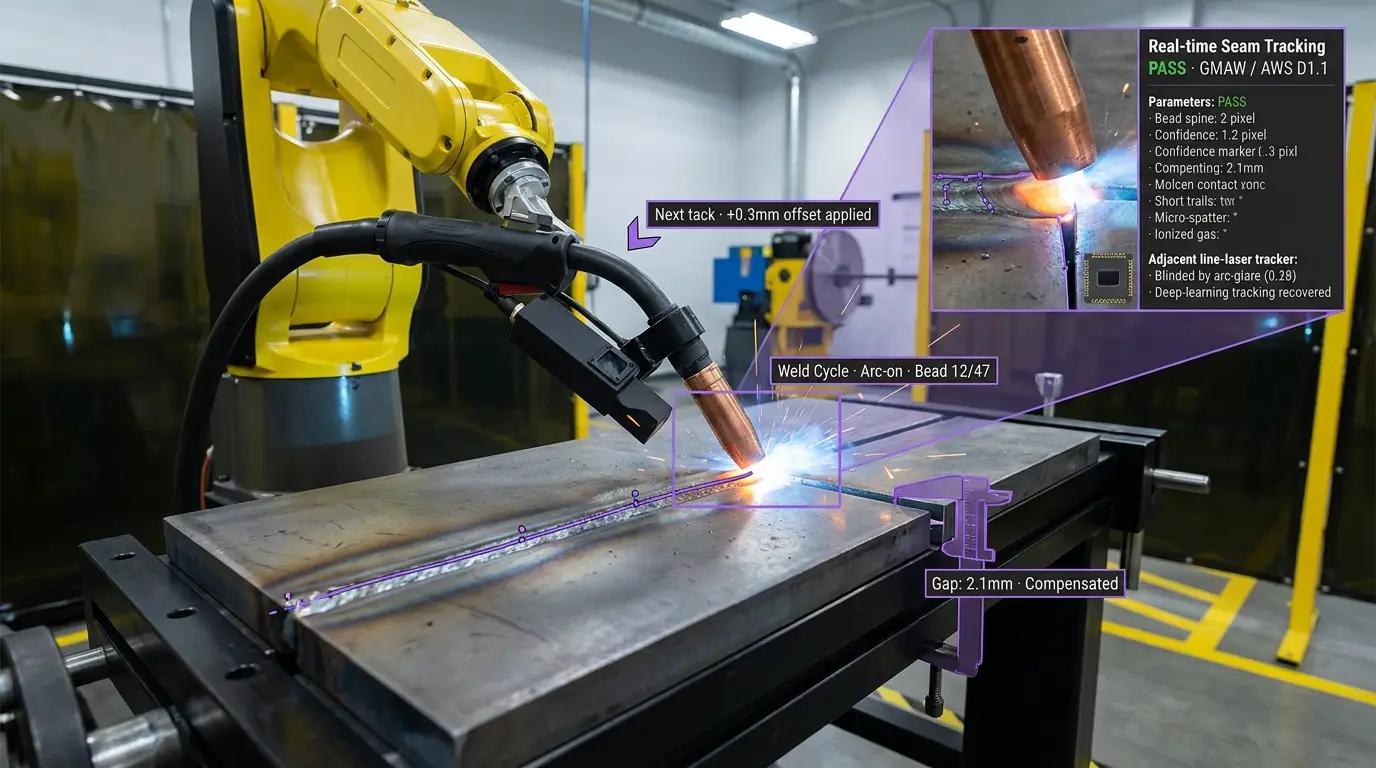
Add a real-time guidance layer to every weld cycle with Vision AI for vision-guided robotic welding. Roboflow extends welding guidance to every seam on every cell, on the cameras and line-laser sensors your welding cells already run.
Real-Time Seam Tracking, Pre-Weld Localization, and Fit-Up Compensation:
- Track the weld seam in real time during arc-on, adapting the torch path to fit-up gap variation (typical 0-3mm part-to-part), mismatch, and offset without pausing the weld or requiring an operator intervention
- Localize the seam pre-weld with 2D and 3D vision, identifying weld start and stop points, joint geometry (butt, lap, tee, corner, edge, groove), and joint prep (V-groove, U-groove, J-groove, square edge), so the robot program selects the correct WPS parameters for the joint it actually sees
- Compensate for thermal distortion mid-weld as the part heats up and shifts on the fixture, and for fixture drift on long production runs where the same fixture location varies part-to-part across a shift
Multi-Process Welding, Multi-Pass Adaptation, and Spot Welding:
- Guide GMAW/MIG, GTAW/TIG, FCAW, laser welding, and plasma-arc welding processes with process-specific arc-glare handling, molten-pool visibility management, and spatter tolerance
- Adapt root-pass and cap-pass paths on thick-section welds (structural steel plate, pressure vessel shells, heavy equipment frames), catching root drop-through and cap crown variation before it becomes rework or a rejected coupon
- Handle robotic spot welding on automotive body-in-white with electrode localization, tip alignment, spot pattern verification, and adaptive control on variant panels across the same cell
Robot Controller Integration, Welding Compliance, and Audit-Ready Records:
- Integrate with arc-welding robot controllers from FANUC ARC Mate and iRVision-compatible workflows, ABB IRB with ArcPack, KUKA arc-welding cells with KUKA.VisionTech-compatible workflows, Yaskawa Motoman ArcWorld, Panasonic TAWERS, and Comau, plus welding power supply integration (Fronius, Miller Electric, Lincoln Electric, ESAB, OTC Daihen, Kemppi) and PLC (Rockwell, Siemens, Beckhoff, Allen-Bradley) through native robot-vendor protocols, EtherNet/IP, PROFINET, EtherCAT, and standard fieldbus protocols
- Support AWS D1.1 (steel structural welding), D1.5 (bridge welding), D14 (industrial machinery welding), D17 (aerospace fusion welding), ASME BPVC Section IX (pressure vessel welding procedure qualification), ISO 3834 (welding quality requirements), ISO 15614 (welding procedure qualification), IATF 16949, AS9100, MIL-STD-2219, and NAVSEA S9074-AR-GIB-010/278 with validation records that support Procedure Qualification Records (PQR), Welding Procedure Specifications (WPS), Welder Performance Qualification Records (WPQ), and customer-specific PPAP submissions
- Log every guidance call with confidence, image crop, seam-tracking trajectory, torch offset history, weld process parameter snapshot (voltage, wire feed speed, travel speed), timestamp, and station ID for weld map documentation, PQR and WPQ records, warranty investigation, and IATF 16949, AS9100, and ASME registrar audits
Bring intelligence to every weld cell today.
More About Vision Guided Robotic Welding
What is vision guided robotic welding with Vision AI?
Vision-guided robotic welding with Vision AI uses computer vision models to guide arc-welding and spot-welding robots to the right seam, at the right offset, at every pass. Coverage spans pre-weld part and seam localization (2D and 3D), joint geometry and joint prep identification (butt, lap, tee, corner, edge; V-groove, U-groove, J-groove, square edge), real-time seam tracking during arc-on, fit-up gap and mismatch compensation, thermal distortion and fixture drift compensation, multi-process guidance (GMAW/MIG, GTAW/TIG, FCAW, laser welding, plasma-arc, resistance spot welding), and multi-pass adaptation on root and cap passes for thick-section welds.
The system deploys on torch-mounted through-arc 2D cameras, torch-mounted line-laser seam trackers, off-torch fixed 2D and 3D cameras, structured-light and stereo 3D sensors, and existing seam-tracking hardware, and integrates with FANUC, ABB, KUKA, Yaskawa Motoman, Panasonic, Comau, and other arc-welding robot controllers plus welding power supplies from Fronius, Miller, Lincoln Electric, ESAB, OTC Daihen, and Kemppi through native robot-vendor and welding-power-supply protocols. Automotive body-in-white shops and Tier 1 suppliers, heavy equipment manufacturers, aerospace fabricators, shipbuilders, structural steel fabricators, pressure vessel manufacturers, and rail and transit fabricators use it to prevent missed seams, weld-quality rejects, procedure qualification failures, and integrator revisits on new part introductions, and to document compliance under AWS D1.1/D1.5/D14/D17, ASME BPVC Section IX, ISO 3834, ISO 15614, IATF 16949, AS9100, MIL-STD-2219, and NAVSEA welding standards.
Can Vision AI handle arc glare, molten pool reflections, and thermal distortion during real-time seam tracking?
Yes. Roboflow models are trained on your actual welding cell footage during arc-on conditions with real arc glare, real spatter, real molten-pool reflections, and real part-to-part fit-up variation, and produce seam-tracking corrections with confidence scores that let the robot controller decide between torch-path correction, pause, or hand-off to a welder for supervisory review.
Does vision guided robotic welding support AWS D1.1, D17, ASME BPVC Section IX, ISO 3834, and IATF 16949?
Yes. Roboflow models can be trained to support welding cells operating under AWS D1.1 (structural steel welding), AWS D1.5 (bridge welding), AWS D1.6 (stainless steel structural welding), AWS D14 (industrial machinery welding, including AWS D14.1 industrial mill cranes, D14.3 earthmoving and mining equipment), AWS D17.1 and D17.2 (aerospace fusion welding and resistance welding), ASME BPVC Section IX (welding, brazing, and fusing qualifications for pressure vessels), ISO 3834 (welding quality requirements, Parts 1 through 6), ISO 15614 (welding procedure qualification specifications), IATF 16949 (automotive quality management including weld traceability), AS9100 (aerospace quality management systems), MIL-STD-2219 (US Navy welding requirements for aerospace and ground applications), NAVSEA S9074-AR-GIB-010/278 (Navy fabrication and inspection), and customer-specific Welding Procedure Specifications (WPS), Procedure Qualification Records (PQR), and Welder Performance Qualification (WPQ) acceptance criteria.
Can it integrate with our welding robot controllers, power supplies, PLC, and existing seam tracking hardware?
Yes. Roboflow Inference (opens in a new tab) exposes a standard API supporting common welding automation protocols. Customers integrate with arc-welding robot controllers (FANUC R-30iB ARC Mate with iRVision-compatible workflows, ABB IRC5 with ArcPack, KUKA KRC with KUKA.VisionTech-compatible workflows, Yaskawa Motoman DX and YRC1000 ArcWorld cells, Panasonic TAWERS TM-series, Comau NJ, and Kawasaki RA-series arc-welding controllers), welding power supplies (Fronius TPS/i, Miller Electric Auto-Continuum, Lincoln Electric Power Wave, ESAB Aristo, OTC Daihen DP-series, Kemppi X8 MIG Welder), dedicated seam-tracking systems from incumbent vendors (co-pilot mode for arc-on tracking on top of pre-weld line-laser localization), PLC control (Rockwell, Siemens, Beckhoff, Allen-Bradley, Omron), MES platforms (Rockwell, Siemens Opcenter, GE Proficy, Ignition, Wonderware, AVEVA), eQMS (MasterControl, Veeva Vault QMS, Sparta TrackWise, ETQ Reliance), and ERP (SAP, Oracle, NetSuite, Infor) through native robot-vendor protocols, EtherNet/IP, PROFINET, EtherCAT, REST, MQTT, OPC UA, and direct database writes.
Models support robot-controller-level pass/fail on borderline seam-tracking confidence, andon and cell-release triggers, weld process parameter snapshots at every trajectory correction, IATF 16949 and AS9100 audit trails, AWS and ASME PQR and WPQ records, and integrator handoff records that pass customer PPAP submissions and OEM traceability audits.