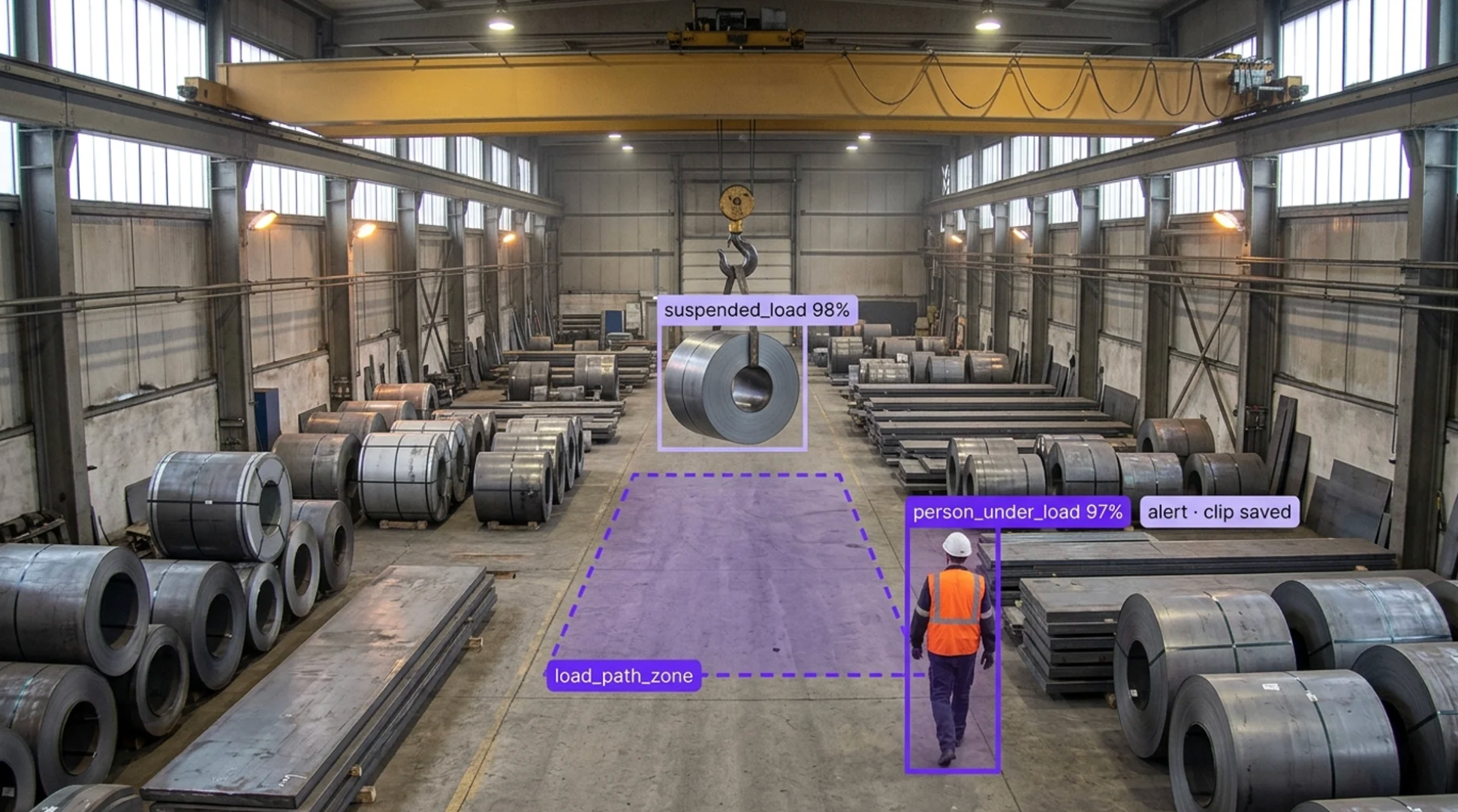
Bring real-time intelligence to every bridge crane, gantry crane, and ASRS stacker crane in the building with Roboflow vision AI for overhead crane monitoring.
Keep people out from under the load and out of the crane path:
- Detect a person under a suspended load or inside the travel path of a bridge, gantry, or stacker crane on runway and aisle cameras, with a model trained on your own footage including frost, fog, sodium lighting, high-visibility freezer gear, and partial views behind racking.
- Tell a worker apart from a forklift, pallet jack, or the crane itself so alerts fire on a person and not on every vehicle that crosses the bay.
- Apply dwell and debounce rules so a technician who lingers in an ASRS aisle triggers an event and a worker who walks through a clear bay does not.
Catch impacts, swing, and rigging problems before they become damage:
- Detect crane impacts with racking, building columns, end stops, and adjacent cranes, and count them per crane, per shift, and per aisle so maintenance can quantify what the anti-collision system did not report.
- Flag load swing, off-center picks, misaligned forks on a stacker crane, and coils or dies that shift on the hook so the operator can stop before a drop.
- Check that the hook latch is closed, the sling or spreader is seated, and the load is attached as expected before the lift proceeds.
Run in the freezer and sit alongside rated safety systems:
- Deploy on cold-rated IP66 cameras with heated housings and NVIDIA Jetson or industrial PC hardware in an enclosure rated for -20°F aisles, with a deployment manager that pushes models to every device across freezer, cooler, and dry zones.
- Run alongside laser anti-collision sensors, load-moment indicators, and runway limit switches as a supplementary detection layer that covers the angles those devices do not, without replacing your ISO 13849 rated safety functions.
- Give EHS and maintenance the record: every intrusion, impact, and rigging exception with a clip, for incident review and OSHA 29 CFR 1910.179 and ASME B30.2 inspection documentation.
Bring intelligence to every crane runway and ASRS aisle today. Stop crane impacts and near-misses from becoming injuries, rack collapses, and lost product.
Frequently asked questions
What is overhead crane safety monitoring with Vision AI?
Overhead crane safety monitoring with Vision AI uses existing runway, bay, and aisle cameras and a trained computer vision model (opens in a new tab) to watch bridge cranes, gantry cranes, and ASRS stacker cranes for the events that matter: a person under a suspended load or in the crane path, an impact with racking or building structure, load swing or misalignment, an open hook latch or unseated sling, an approach to an end stop, and dwell or blockage in an aisle. The model is trained on your own footage so it handles frost, fog, and the lighting in a freezer warehouse, and each event is logged with a clip. It runs as a supplementary layer alongside anti-collision and load-monitoring systems, with records that support OSHA 29 CFR 1910.179, ASME B30.2 and B30.17, CMAA 70 and 74, and ISO 45001 programs.
Can Vision AI detect crane impacts in a -20°F freezer warehouse, and how many streams fit on one Jetson?
Yes. A detection model trained on your own aisle footage learns what a stacker crane, a rack upright, an end stop, and a person look like at that angle in that light, and impact events are inferred from crane position, sudden stop, and contact with a rack or column, then counted per crane and per shift.
Does overhead crane monitoring support OSHA 29 CFR 1910.179 and ASME B30.2?
Overhead crane monitoring supports the inspection and documentation expectations of OSHA 29 CFR 1910.179 (the general industry standard for overhead and gantry cranes, including frequent and periodic inspection and the requirement that loads are not carried over people), ASME B30.2 (the safety standard for top-running bridge and gantry cranes) and ASME B30.17 (the standard for underhung and monorail cranes), CMAA Specifications 70 and 74 (the design and service classification specifications for top-running and underhung cranes), and ISO 45001 (the occupational health and safety management system standard), by giving EHS and maintenance a continuous record of intrusions, impacts, and rigging exceptions with video. ISO 13849 (the functional safety standard that defines performance levels for safety-related control systems) applies to certified safety-rated devices such as anti-collision sensors and hoist limit switches.
Vision AI on Roboflow is a supplementary layer that extends coverage and feeds the control system, not as a replacement for a rated safety function. Roboflow serves as the detection engine, and your EHS, maintenance, and functional safety teams own the risk assessment, the zone definitions, and the decision on how the crane control responds.
Can it integrate with our crane controls, WMS, and EHS platform?
Yes. Roboflow writes zone state, impact events, and rigging exceptions to a PLC variable over OPC UA, Modbus TCP, or MQTT, so Allen-Bradley, Siemens, and Schneider crane controllers, and the Dematic, Swisslog, or Daifuku control layer on an ASRS, can use the signal in slow-down, hold, or alarm logic alongside inputs from laser anti-collision sensors and load-moment indicators. Events and clips can be sent over REST (opens in a new tab) or written to a database for SCADA, a warehouse management system such as Manhattan or Blue Yonder, and EHS and maintenance platforms such as Ignition, AVEVA, Intelex, Cority, and SAP PM, and the same cameras can also run PPE detection, safety zone monitoring, and lifting fixture inspection across the cold chain facility.