Lifting Fixture Inspection AI

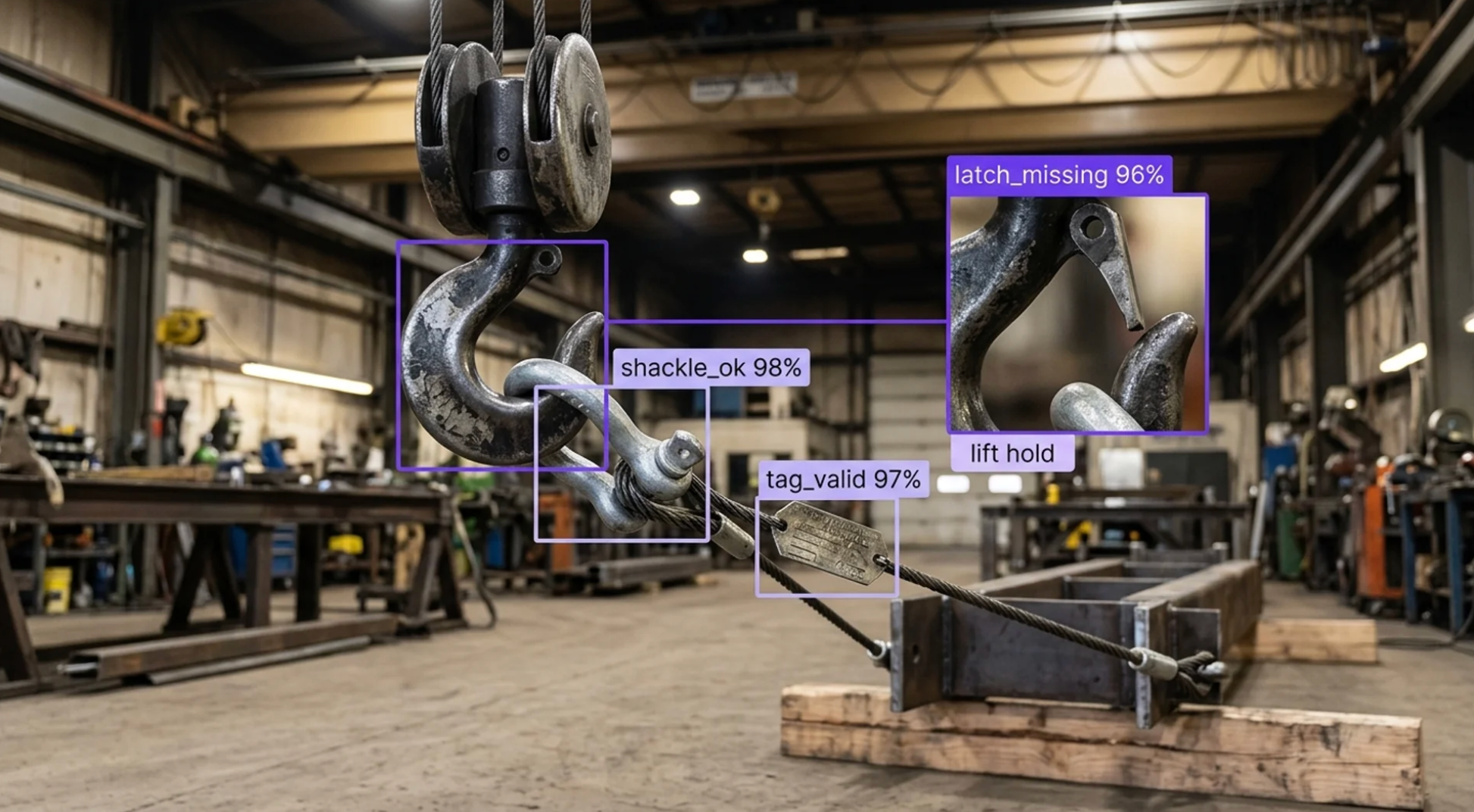
Catch a cracked spreader beam, a stretched shackle, a hook with no latch, or a sling with an expired inspection tag before the lift, confirm the right fixture is rigged for the load, and log every pre-lift check with an image.
Shipping container with OCR output

Lifting Fixture Inspection AI for the Toughest Gas Turbine, Wind, Shipyard, and Heavy Fabrication Lifts

Deploy Anywhere, Run Everywhere

Run lifting fixture inspection on handheld, fixed bay, and crane-mounted cameras on the edge, on-prem, in your VPC, or via API.

One Platform, Full Adoption

Tools every EHS and rigging team can adopt, from rigging supervisors and crane operators to maintenance and manufacturing engineers, no separate ML team required.

Secure, Compliant, and Audit-Ready

Data stays safe with SOC 2 Type II compliance, encrypted data, HIPAA compliance, and an uptime SLA, with validation documentation that supports ASME B30.20, OSHA 1910.179, and ISO 45001 programs.
Crack, Deformation & Wear on Fixtures, Spreader Beams & Eyebolts
Missing Hook Latches & Bent or Stretched Shackles
Sling Cuts, Broken Wires & Chain Link Elongation
Inspection Tag, Color Code & Rated Capacity Verification
Correct Fixture for the Load & Rigging Geometry Confirmation
Pre-Lift Check Logged With an Image
Crack, Deformation & Wear on Fixtures, Spreader Beams & Eyebolts
Missing Hook Latches & Bent or Stretched Shackles
Sling Cuts, Broken Wires & Chain Link Elongation
Inspection Tag, Color Code & Rated Capacity Verification
Correct Fixture for the Load & Rigging Geometry Confirmation
Pre-Lift Check Logged With an Image
Crack, Deformation & Wear on Fixtures, Spreader Beams & Eyebolts
Missing Hook Latches & Bent or Stretched Shackles
Sling Cuts, Broken Wires & Chain Link Elongation
Inspection Tag, Color Code & Rated Capacity Verification
Correct Fixture for the Load & Rigging Geometry Confirmation
Pre-Lift Check Logged With an Image
Crack, Deformation & Wear on Fixtures, Spreader Beams & Eyebolts
Missing Hook Latches & Bent or Stretched Shackles
Sling Cuts, Broken Wires & Chain Link Elongation
Inspection Tag, Color Code & Rated Capacity Verification
Correct Fixture for the Load & Rigging Geometry Confirmation
Pre-Lift Check Logged With an Image

Talk to a Vision AI engineer who's shipped in heavy equipment and energy manufacturing.

Bring us your toughest lifting fixture inspection problem and we'll map a working solution.
  • Solution architecture that fits ASME B30.20, ASME B30.9, ASME B30.26, ASME BTH-1, OSHA 29 CFR 1910.179 and 1910.184, and ISO 45001, and how a Vision AI pre-use check sits alongside the qualified-person inspection those standards require
  • A live demo on your own fixture, sling, and crane camera footage
  • Deployment options: edge, on-prem, air-gapped, VPC, handheld, fixed rigging bay, or crane-mounted on the site's existing camera network
  • ROI modeling against dropped-load and struck-by exposure, damaged turbine rotor and blade cost, crane downtime, citation and stop-work cost, and fixture replacement versus repair
  • We will connect you with an AI subject matter expert on our team based on your answers.
    What challenges would you like to solve with vision AI?
    Where will you run vision AI?
    Are you replacing a current solution with AI or will this be a new solution?
    How many detections do you anticipate per month?
    Describe the business problem you would like to solve.
    Oops! Something went wrong while submitting the form.

    Over 16,000 organizations build with Roboflow.

    “Roboflow has been instrumental in accelerating our learning and deployment of innovative AI solutions”
    Travis Turnbull Vice President & CIO, Pella Corporation
    See customer stories
    Trusted by top manufacturers

    Vision AI is transforming manufacturing

    Customers are deploying solutions across the entire business and driving meaningful impact
    $0 million
    Saved by automatically detecting defects
    0%
    Less time spent manually tracking inventory
    0%
    Reduction in customer return rate

    Bring Real-Time Intelligence to Every Lift, from the Rigging Bay to the Crane Hook

    Add a real-time pre-use inspection layer to every lift on the floor with Roboflow Vision AI for lifting fixture inspection.

    Inspect the hardware before it takes the load:

    • Detect cracks, deformation, corrosion, wear, and gouges on lifting fixtures, spreader beams, lifting beams, eyebolts, and swivel hoist rings with a model trained on your own fixtures, welds, and paint schemes, including partial views, grease, and shop lighting.
    • Flag a hook with a missing or sprung latch, a shackle with a bent bow or a pin that is not fully seated, and a sling with cuts, broken wires, knots, heat damage, or elongated chain links.
    • Read the inspection tag, color code of the period, and rated capacity on each sling, shackle, and fixture, and hold the lift when a tag is missing, unreadable, or expired.

    Confirm the right rigging for the load:

    • Verify the fixture attached matches the fixture called out for that part number, whether it is a rotor lifting fixture, a blade root fixture, a nacelle spreader, or a hull block beam, so a 20-ton fixture never goes on a 40-ton lift.
    • Check rigging geometry before the pick: sling angle, symmetrical attachment, hooks seated in the throat and not on the tip, and no side loading on eyebolts.
    • Confirm the load path is attached at every designated pick point and that no one is rigging from an unapproved point on the part.

    Log every pre-lift check and scale across sites:

    • Record each pre-use check with an image, timestamp, fixture ID, operator, and pass or hold result, so rigging supervisors and EHS have the record ASME B30.20 and OSHA 1910.184 documentation expects.
    • Run the same model on a handheld tablet in the rigging bay, a fixed camera at the fixture rack, and a crane-mounted camera at the hook, and deploy it across gas turbine, wind, and heavy fabrication shops in the same group.
    • Send holds and check results over REST or MQTT to your EHS platform, CMMS, or lift planning system, and feed periodic inspection scheduling with the wear the pre-use checks are seeing.

    Bring intelligence to every lift today. Stop a cracked fixture or an expired sling from becoming a dropped load.

    Frequently asked questions

    What is lifting fixture inspection with Vision AI?

    Lifting fixture inspection with Vision AI uses handheld, fixed bay, and crane-mounted cameras and a trained computer vision model to run a pre-use check on below-the-hook lifting devices and rigging: lifting fixtures, spreader beams, slings, shackles, hooks, and eyebolts. The model looks for cracks, deformation, wear, missing hook latches, and missing or expired inspection tags and color codes, confirms the correct fixture is attached for the load and that the rigging geometry is right, and logs each check with an image. It supplements, and does not replace, the pre-use and periodic inspections by a qualified person that ASME B30.20, ASME B30.9, ASME B30.26, OSHA 29 CFR 1910.179 and 1910.184, and ISO 45001 programs require.

    Can Vision AI reliably spot a hairline crack or a stretched shackle on a greasy, painted fixture?

    Yes. A detection model trained on images of your own fixtures learns what a sound weld, a sound shackle bow, and a seated hook latch look like under your paint and lighting, so it flags a crack at a weld toe, corrosion on a lifting lug, or a shackle bow that has opened up beyond its original geometry.

    Does lifting fixture inspection support ASME B30.20 and OSHA 29 CFR 1910.184?

    Lifting fixture inspection supports the inspection and documentation expectations of ASME B30.20 (the safety standard for below-the-hook lifting devices, including structural and mechanical lifting devices, vacuum lifters, and lifting magnets), ASME B30.9 (slings), ASME B30.26 (rigging hardware such as shackles, eyebolts, hoist rings, and turnbuckles), ASME BTH-1 (the design standard for below-the-hook lifting devices), OSHA 29 CFR 1910.179 (overhead and gantry cranes) and 1910.184 (slings), and ISO 45001 (the occupational health and safety management system standard), by giving every pre-use check an image and a record. Those standards require inspection by a designated or qualified person, and a Vision AI check does not change that. Roboflow serves as the inspection engine, and your EHS, rigging, and engineering teams own the acceptance criteria, the removal-from-service decision, and the periodic inspection program.

    Can it integrate with our EHS platform, CMMS, and crane controls?

    Yes. Roboflow sends each pre-lift check result, fixture ID, image, and hold reason over REST or MQTT to EHS and asset platforms such as Intelex, Cority, SAP PM, and IBM Maximo, so an expired sling opens a work order and a held fixture goes into the periodic inspection queue. Where a hold should stop the pick, a pass or hold signal can be written to a crane PLC over OPC UA or Modbus TCP on Allen-Bradley and Siemens controllers, alongside the same safety zone monitoring and worker presence detection cameras that watch the lift path, and surfaced in Ignition or AVEVA for the crane bay.

    Stay Connected

    Get the Latest in Computer Vision First

    Thank you for subscribing!
    Oops! Something went wrong!.
    Unsubscribe at any time. Review our Privacy Policy.

    Additional resources

    Vision AI is transforming every industry. Let’s transform yours.