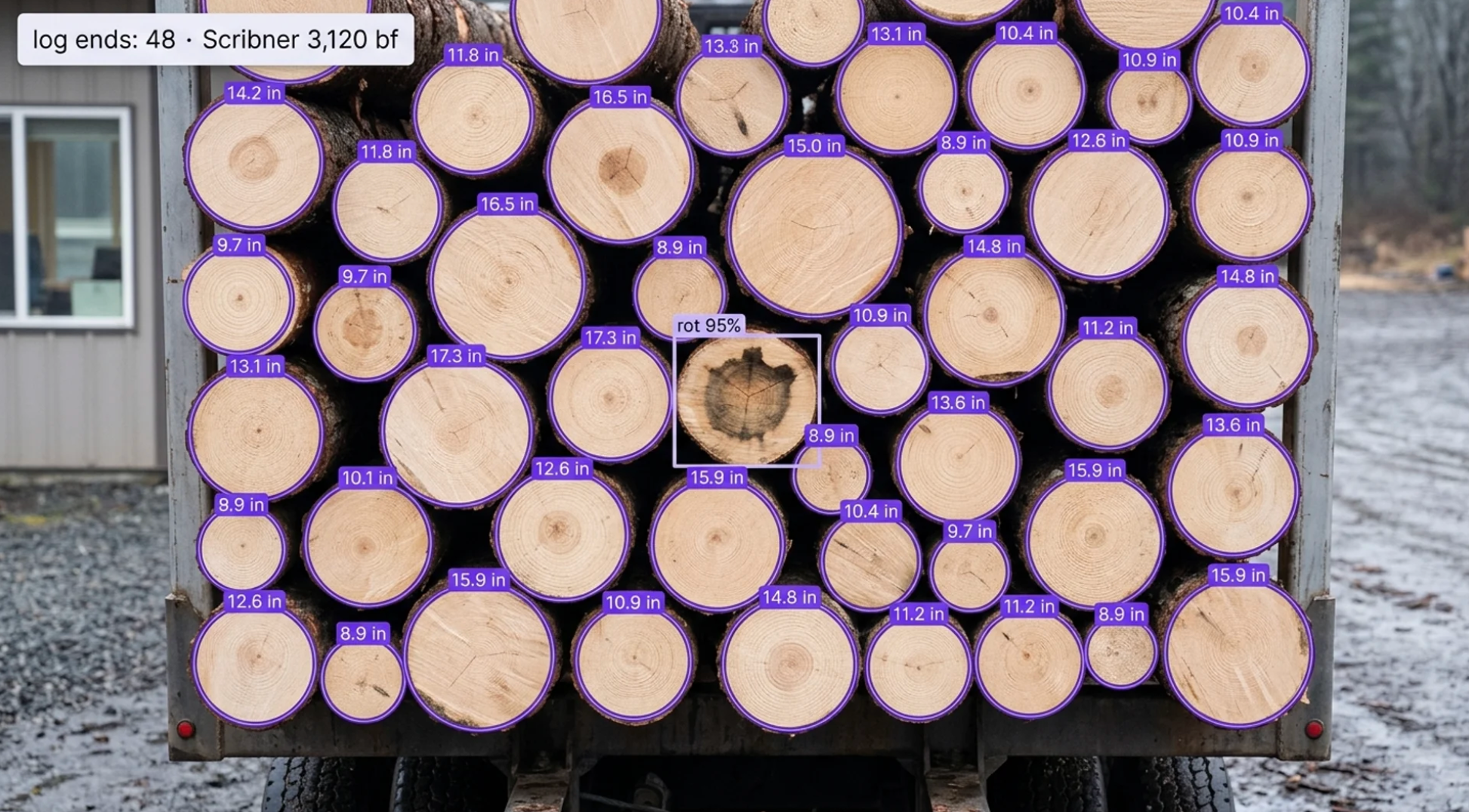
Bring real-time intelligence to every log entering the yard with Roboflow vision AI for log scaling and measurement.
Scale every log, not a sample:
- Measure small-end and large-end diameter inside bark and outside bark, length, taper, and sweep from a single camera or a stereo pair at the scale house, truck dump, or debarker infeed, with a model trained on your own species mix, bark condition, and lighting.
- Compute gross and net volume per log in Scribner, Doyle, International 1/4, or cubic (metric or board-foot) and apply your defect deductions the way your scaling bureau and procurement contracts define them.
- Flag rot, ring shake, end cracks, catface, oversize knots, and bark damage on the log end so the scaler sees the deduction candidates and the sorter gets a grade cue before the log hits the deck.
Count and sort on trucks, bunks, and the log deck:
- Count log ends on an arriving truck or bunk from a fixed camera or a phone photo and produce a diameter distribution per load in seconds, tied to the ticket number and supplier.
- Sort logs by diameter class and length at the merchandiser or log deck infeed and write the sort decision to the PLC that drives the kicker or bin.
- Reconcile piece count and volume per load against the supplier ticket and the scale weight so procurement sees weight-to-volume ratios by supplier, species, and season.
Track yard inventory and feed the mill:
- Estimate volume by pile and species from loader-mounted, pole-mounted, or drone cameras and keep a running yard inventory without walking the piles.
- Run alongside 3D scanners from USNR, Microtec, or Autolog on the merchandiser and primary breakdown line, adding camera coverage where a scanner is not installed and a second measurement where one is.
- Post every log record, image, and volume to SAP, Trimble LIMS, or your log accounting system with the ticket, species, and supplier, for PEFC and FSC chain-of-custody records and ISO 9001 traceability.
Bring intelligence to every log today.
Frequently asked questions
What is log scaling and measurement with Vision AI?
Log scaling and measurement with Vision AI uses cameras at the scale house, truck dump, log deck, or debarker infeed and a trained computer vision model (opens in a new tab) to measure small-end and large-end diameter, length, taper, and sweep on each log, to count log ends and produce a diameter distribution on a truck or bunk, and to compute volume per log under the Scribner, Doyle, International 1/4, or cubic rule your mill buys on. The same model can flag rot, cracks, knots, and bark damage on the log end as grade and deduction cues, and estimate yard inventory by pile. It works with the cameras already on site and can complement 3D scanners from USNR, Microtec, or Autolog, and it records every measurement with an image for USDA Forest Service and state scaling bureau check-scale reviews, PEFC and FSC chain-of-custody records, and ISO 9001 audits.
Can Vision AI measure small-end diameter inside bark accurately enough to pay on?
Yes. A segmentation model trained on your own log ends learns the bark line for your species mix and bark condition, and a calibrated camera (or a stereo pair, or a known reference in frame) converts the pixel measurement to inches or centimeters, as described in measurement and dimensioning. Accuracy depends on camera placement, resolution, and how much of the log end is visible, and a single fixed camera at a truck dump will not match a laser scanner on a merchandiser. We calibrate against your scaler's check-scale sample, report agreement with the human scale and the scanner, and your scaling manager decides which loads and which decisions the camera measurement is allowed to drive. You might also be interested in count and quantity verification and stockpile volume measurement.
Does log scaling with Vision AI support Scribner, Doyle, and International 1/4 rules and scaling bureau conventions?
Yes. Scribner (the diagram-based board-foot rule used across the western United States and by the USDA Forest Service in its Scribner Decimal C form), Doyle (the formula rule common in the eastern and southern United States that undercounts small logs), and International 1/4 (the taper-based rule used by many state agencies and the most accurate of the three for small diameters) are all applied as formulas on the measured diameter and length, and the Vision AI layer produces the diameter and length inputs and applies the rounding, trim allowance, and defect deduction conventions your USDA Forest Service or state scaling bureau (for example, the Northwest Log Rules Advisory Group or the Pacific Rim Log Scaling Bureau) prescribes. Roboflow serves as the measurement engine, and your scaling manager, procurement team, and third-party scaling bureau own the rule selection, the deduction policy, and the check-scale acceptance criteria. Each log record carries the image, the measured values, and the computed volume so it can be reviewed for PEFC and FSC chain-of-custody and ISO 9001 records.
Can it integrate with our log inventory system, scale house software, and optimizer PLCs?
Yes. Roboflow posts per-log and per-load records over REST (opens in a new tab) or direct database writes to SAP, Trimble LIMS, Microsoft Dynamics, and scale house ticketing systems, with the ticket number, supplier, species, and volume attached. Sort decisions and diameter class can be written to Allen-Bradley or Siemens PLCs over OPC UA or Modbus TCP to drive kickers and bins at the merchandiser or log deck, and log-level events can be published over MQTT to Ignition or AVEVA for yard and mill dashboards alongside data from your USNR, Microtec, or Autolog optimizers. Loader and truck movement in the yard can be tracked with heavy equipment detection on the same cameras.