Count and Quantity Verification AI

Count every part, kit, and batch by camera, with imagery behind every number.
Shipping container with OCR output

Count Verification AI Across Manufacturing, Kitting, and Logistics

Deploy Anywhere, Run Everywhere

Run count and quantity verification on the edge, on-prem, in your VPC, or via API, wherever your lines, kitting cells, and docks need it.

One Platform, Full Adoption

Tools every operations team can adopt, from line operators and kitting leads to warehouse supervisors, planners, and quality engineers, no separate ML team required to ship and own counting models.

Secure, Compliant, and Audit-Ready

Data stays safe with SOC 2 Type II compliance, encrypted data, and an uptime SLA, with count records and imagery that support ISO 9001 documentation, customer audits, and inventory reconciliation.
Piece & Part Counting
Kit & Batch Count Verification
Tray, Rack & Fixture Counts
Throughput & Cycle Counting
Over & Under-Count Alerts
Count Records & Reconciliation
Piece & Part Counting
Kit & Batch Count Verification
Tray, Rack & Fixture Counts
Throughput & Cycle Counting
Over & Under-Count Alerts
Count Records & Reconciliation
Piece & Part Counting
Kit & Batch Count Verification
Tray, Rack & Fixture Counts
Throughput & Cycle Counting
Over & Under-Count Alerts
Count Records & Reconciliation
Piece & Part Counting
Kit & Batch Count Verification
Tray, Rack & Fixture Counts
Throughput & Cycle Counting
Over & Under-Count Alerts
Count Records & Reconciliation

Talk to a vision AI engineer who's shipped counting on a production floor.

A kit that reaches the line one bolt short, shipment that leaves the dock two cartons light, or end-of-shift tally that disagrees with the MES by four hundred units can mean an assembly station idled over a fastener, a customer short-ship claim, and a variance meeting where nobody can prove what actually ran. Bring us your toughest counting problem and we'll map a working solution.
  • Solution architecture for ISO 9001 documentation, customer audit, and inventory reconciliation environments
  • Live demo on your tray imagery, kitting photos, conveyor footage, or dock captures
  • Deployment options: edge, on-prem, air-gapped, or VPC, with integration into PLCs, MES, WMS, and ERP
  • ROI modeling against short-ships, line stoppages, manual count labor, and cycle count variance
  • We will connect you with an AI subject matter expert on our team based on your answers.
    What challenges would you like to solve with vision AI?
    Where will you run vision AI?
    Are you replacing a current solution with AI or will this be a new solution?
    How many detections do you anticipate per month?
    Describe the business problem you would like to solve.
    Oops! Something went wrong while submitting the form.

    Over 16,000 organizations build with Roboflow.

    “Roboflow has been instrumental in accelerating our learning and deployment of innovative AI solutions”
    Travis Turnbull Vice President & CIO, Pella Corporation
    See customer stories
    Trusted by top manufacturers

    Vision AI is transforming manufacturing

    Customers are deploying solutions across the entire business and driving meaningful impact
    $0 million
    Saved by automatically detecting defects
    0%
    Less time spent manually tracking inventory
    0%
    Reduction in customer return rate

    Put a Number and a Picture on Everything That Moves, with Vision AI

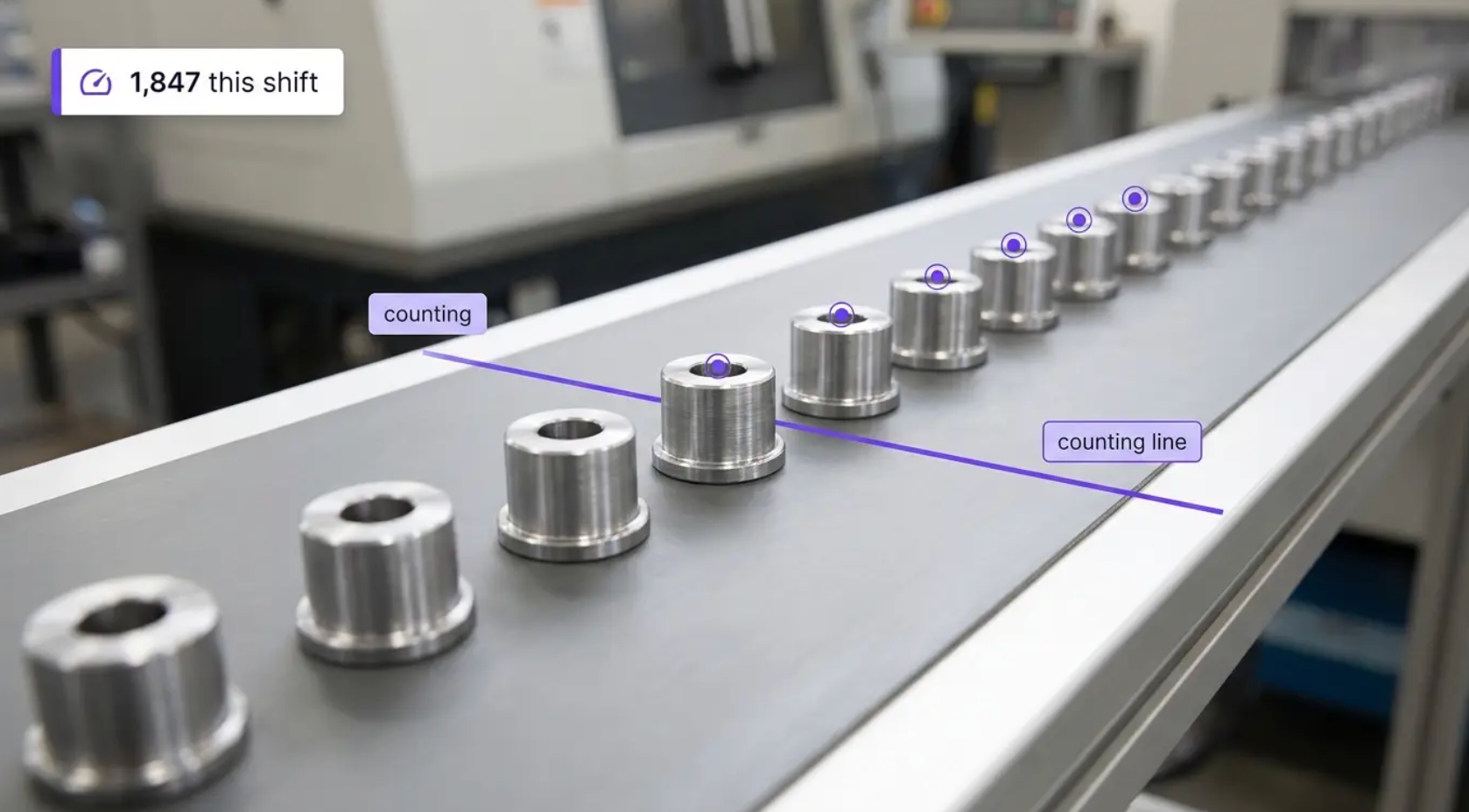
    Add a real-time counting layer to every line, kit, and batch with vision AI for count and quantity verification. Built for the operations where a missing bolt is discovered by the assembly station that needed it, the shift tally is whatever the last tired count said it was, or the customer's claim of a short shipment can't be answered because nobody can prove what left. Whether you're counting parts on conveyors, kits before they reach the line, trays and racks between processes, or cartons at the dock, Roboflow counts by camera at line rate, with imagery behind every number.

    Line and Batch Counting:

    • Count parts on moving conveyors at line rate, with running totals by shift, lot, and SKU
    • Verify batch quantities on trays, racks, and fixtures between processes, before the next step builds on a wrong count
    • Alert on over-counts and under-counts against the order, recipe, or standard pack the moment they happen

    Kitting and Order Verification:

    • Verify kits and totes carry the right count of the right parts before they reach the line or the truck
    • Count mixed contents with identity, so twelve fasteners of the wrong size never pass as twelve of the right one
    • Check cartons, bundles, and pallet layers at the dock, with a photographic record of what shipped

    Records, Reconciliation, and Systems Integration:

    • Feed verified counts into MES, WMS, and ERP through a standard API, replacing end-of-shift estimates with measured numbers
    • Keep imagery behind every count, so a variance investigation starts with a picture instead of an argument
    • Drive diverts and holds through PLC integration when a count fails, with records tied to line, lot, and time

    Bring intelligence to every count today. Stop counting errors from becoming idled stations, short-ship claims, or variance meetings without answers.

    More About Count and Quantity Verification

    What is count and quantity verification with Vision AI?

    Count and quantity verification with vision AI uses computer vision models to count objects in imagery and video: parts on conveyors, kit and tote contents, batches on trays and racks, and cartons and pallet layers at the dock. Models trained on your actual parts and containers count at line rate, verify quantities against orders and recipes, and feed measured numbers with imagery into MES, WMS, and ERP, so every count is a record rather than an estimate.

    Can Vision AI count small parts that overlap or pile up?

    Piled and overlapping parts are the hard case: identical fasteners touching and stacking, parts partially hidden behind each other, and counts where being off by one matters. Deep-learning models trained on your actual parts and presentations learn to separate touching items and count through partial occlusion, and where material genuinely piles too deep for any camera to see, the workflow presents it in countable layers or flags it for a check instead of guessing. For bulk quantities counted by weight, counting scales remain the right tool; vision counts what scales can't tell apart, and confirms identity along with quantity.

    How accurate is camera counting compared to manual counts?

    A trained model applies the same judgment to the ten-thousandth tray as the first, at line rate, without the drift that end-of-shift tallies accumulate. Every count carries its imagery, so any disputed number can be re-verified against the picture rather than re-counted from memory, and borderline frames are flagged for human review instead of silently guessed. Accuracy on your parts gets measured during evaluation on your imagery, not asserted in the abstract; that measured baseline becomes the acceptance criterion your team signs off on.

    Can it integrate with our MES, WMS, and ERP?

    Yes. Roboflow Inference exposes a standard API and supports common industrial protocols, so verified counts flow into your existing systems: MES and ERP platforms like SAP and Oracle, WMS and inventory systems, line PLCs from Allen-Bradley and Siemens, and SCADA and HMI platforms like Ignition and AVEVA, through REST, MQTT, OPC UA, and direct database writes. PLC-level integration drives diverts and holds when a count fails, and every count carries line, lot, timestamp, and imagery, with a full audit trail behind every number.

    Stay Connected

    Get the Latest in Computer Vision First

    Thank you for subscribing!
    Oops! Something went wrong!.
    Unsubscribe at any time. Review our Privacy Policy.

    Additional resources

    Vision AI is transforming every industry. Let’s transform yours.