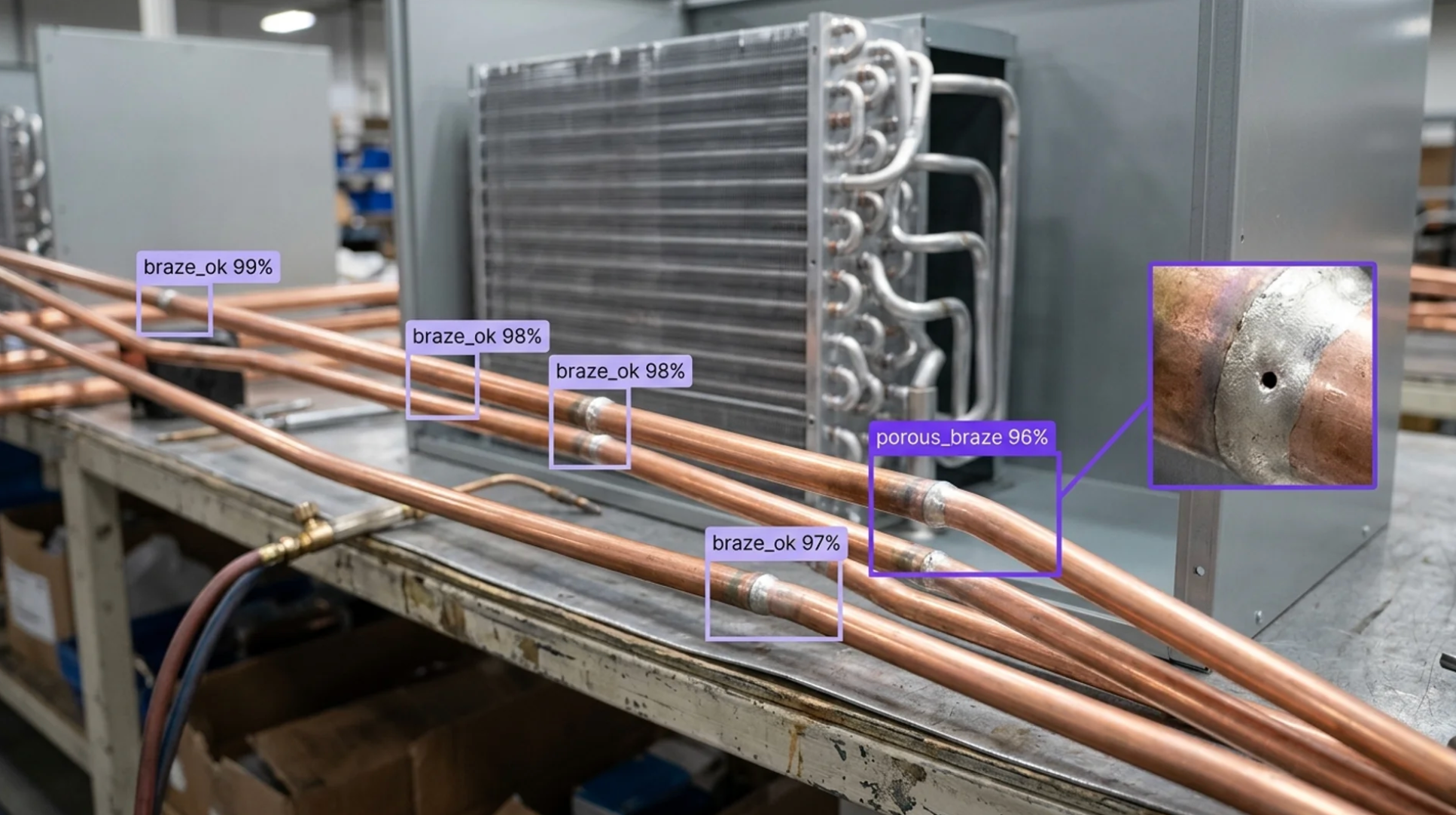
Add a real-time inspection layer to every unit on the line with Roboflow Vision AI for HVAC manufacturing quality inspection.
Refrigerant circuit: brazed joints, flares, and coils:
- Inspect brazed joints on copper suction and liquid lines for pinholes, voids, incomplete fillet, overheated or oxidized copper, and flux residue, on the braze cell camera before the joint is buried in insulation.
- Check flare fittings for cracked, off-center, or under-formed flares and confirm the nut is present and torque-marked before the line set is connected.
- Detect crushed, bent, or missing fins and tube damage on evaporator and condenser coils, and flag fin density loss that lowers rated capacity.
Mechanical and electrical assembly:
- Verify compressor, fan motor, and blower mounting bolts and grommets are present and seated, and confirm the correct fastener count per model variant with fastener verification.
- Confirm wiring harness routing follows the standard path, connectors are fully seated on the control board, capacitor, and contactor, and no lead crosses a sharp edge or a hot discharge line.
- Check insulation sleeve coverage on suction lines, sealant coverage at cabinet penetrations, and grommet presence where refrigerant lines pass through sheet metal.
Cabinet, labeling, and final release:
- Detect dents, scratches, and paint chips on sheet metal cabinets and panels, and confirm missed or misplaced holes with sheet metal inspection before panels reach final assembly.
- Read and verify the rating plate, serial number, refrigerant charge label, and UL mark against the work order with label verification, so a 3-ton R-454B heat pump does not ship with a 2.5-ton R-410A plate.
- Confirm final assembly completeness by model variant (panels, filter, drain pan, thermostat, accessory kit) and capture the pass/fail result, pressure, and decay reading from the leak-test station display into the unit's record.
Stop braze leaks, missing fasteners, and mislabeled units from becoming warranty claims and field callbacks.
Frequently asked questions
What is HVAC manufacturing quality inspection with Vision AI?
HVAC manufacturing quality inspection with Vision AI uses cameras at the braze cell, coil line, final assembly, and leak-test station, paired with a trained computer vision model (opens in a new tab), to inspect every air conditioner, heat pump, furnace, or refrigeration unit as it moves down the line. The model is trained on your own plant footage to catch porous or incomplete brazed joints on copper refrigerant lines, crushed fins, missing compressor and fan mounting fasteners, misrouted harnesses and unseated connectors, insulation and sealant gaps, cabinet dents, and wrong or missing rating plates, and to confirm assembly completeness by model variant. Every result is logged against the unit serial number, which gives quality teams the traceability that ISO 9001, AHRI certification programs, UL 60335-2-40 and UL 1995 listings, and EPA Section 608 refrigerant handling records expect.
Can Vision AI catch a porous brazed joint on a copper refrigerant line before the leak test?
Yes. A detection model such as RF-DETR (opens in a new tab)trained on your braze cell images learns the appearance of pinholes, voids, incomplete fillet flow, overheated or blackened copper, and flux residue at the specific joint geometries on your lines, and it flags joints for rework before they are wrapped in insulation and hidden inside the cabinet.
Does HVAC manufacturing inspection support ISO 9001 and AHRI certification records?
Yes. ISO 9001 (the quality management system standard that requires documented inspection, nonconformance control, and traceability) is supported by per-unit inspection records, images, and pass/fail history tied to serial number. AHRI certification programs (the third-party performance rating programs that verify a unit's published capacity and efficiency) depend on the shipped unit matching the rated configuration, so coil fin condition, correct compressor, and correct rating plate checks help protect the certified rating. UL 60335-2-40 and UL 1995 (the safety standards covering heat pumps, air conditioners, and heating and cooling equipment) and EPA Section 608 (the refrigerant handling and recordkeeping rule) are supported by evidence that guarding, wiring, and refrigerant labeling match the listed design. Roboflow serves as the inspection engine, and your quality, certification, and manufacturing engineering teams own the acceptance criteria, sampling plan, and disposition rules.
Can it integrate with our MES, leak-test stations, and line PLCs?
Yes. Inspection results, images, and defect classes can be written to an MES such as SAP ME, Siemens Opcenter, or Rockwell Plex over REST (opens in a new tab) or direct database writes, so the unit record carries braze, fastener, harness, and label results alongside the leak-test decay value. Pass/fail can be written to Allen-Bradley or Siemens PLCs over OPC UA, Modbus TCP, or MQTT to hold a unit at the station or divert it to rework, and the same events can feed Ignition or AVEVA SCADA dashboards for first-pass yield by station. The leak-test station itself can be captured by reading its display or result screen with OCR, so the pressure and decay reading lands in the unit record without a manual keyboard entry.