Sheet Metal Missed Hole Detection AI

Catch missed holes, missing features, and absent hardware on every part before powder coat makes them expensive.
Shipping container with OCR output

Fabrication Verification AI Across Punching, Laser Cutting, and Forming

Deploy Anywhere, Run Everywhere

Run sheet metal verification on the edge, on-prem, in your VPC, or via API, wherever your punches, lasers, and brakes need it.

One Platform, Full Adoption

Tools every fab shop can adopt, from punch and laser operators to brake operators, hardware crews, and quality leads, no separate ML team required to ship and own verification models.

Secure, Compliant, and Audit-Ready

Data stays safe with SOC 2 Type II compliance, encrypted data, and an uptime SLA, with per-part records that support ISO 9001, customer drawing requirements, and IATF 16949 where fabrication feeds automotive.
Missed & Missing Hole Detection
Wrong Size & Position Flags
Cutout, Notch & Louver Checks
Bend & Forming Verification
Hardware Insertion Checks
Per-Part & Revision Records
Missed & Missing Hole Detection
Wrong Size & Position Flags
Cutout, Notch & Louver Checks
Bend & Forming Verification
Hardware Insertion Checks
Per-Part & Revision Records
Missed & Missing Hole Detection
Wrong Size & Position Flags
Cutout, Notch & Louver Checks
Bend & Forming Verification
Hardware Insertion Checks
Per-Part & Revision Records
Missed & Missing Hole Detection
Wrong Size & Position Flags
Cutout, Notch & Louver Checks
Bend & Forming Verification
Hardware Insertion Checks
Per-Part & Revision Records

Talk to a vision AI engineer who's shipped verification in a fab shop.

A missed hole discovered after powder coat, run of five hundred parts cut to last month's revision, or missing PEM nut found by the installer's screw can mean stripping and re-running finished parts, a batch that ships back on your dime, and an assembly line somewhere waiting on a bracket. Bring us your toughest fabrication verification problem and we'll map a working solution.
  • Solution architecture for ISO 9001, customer drawing, and IATF 16949 environments
  • Live demo on your part imagery, nest photos, or shop floor footage
  • Deployment options: edge, on-prem, air-gapped, or VPC, with integration into punches, lasers, brakes, PLCs, and shop MES
  • ROI modeling against strip-and-recoat rework, wrong-revision runs, returned batches, and manual drawing checks
  • We will connect you with an AI subject matter expert on our team based on your answers.
    What challenges would you like to solve with vision AI?
    Where will you run vision AI?
    Are you replacing a current solution with AI or will this be a new solution?
    How many detections do you anticipate per month?
    Describe the business problem you would like to solve.
    Oops! Something went wrong while submitting the form.

    Over 16,000 organizations build with Roboflow.

    “Roboflow has been instrumental in accelerating our learning and deployment of innovative AI solutions”
    Travis Turnbull Vice President & CIO, Pella Corporation
    See customer stories
    Trusted by top manufacturers

    Vision AI is transforming manufacturing

    Customers are deploying solutions across the entire business and driving meaningful impact
    $0 million
    Saved by automatically detecting defects
    0%
    Less time spent manually tracking inventory
    0%
    Reduction in customer return rate

    Check Every Part Against What the Drawing Says, with Vision AI

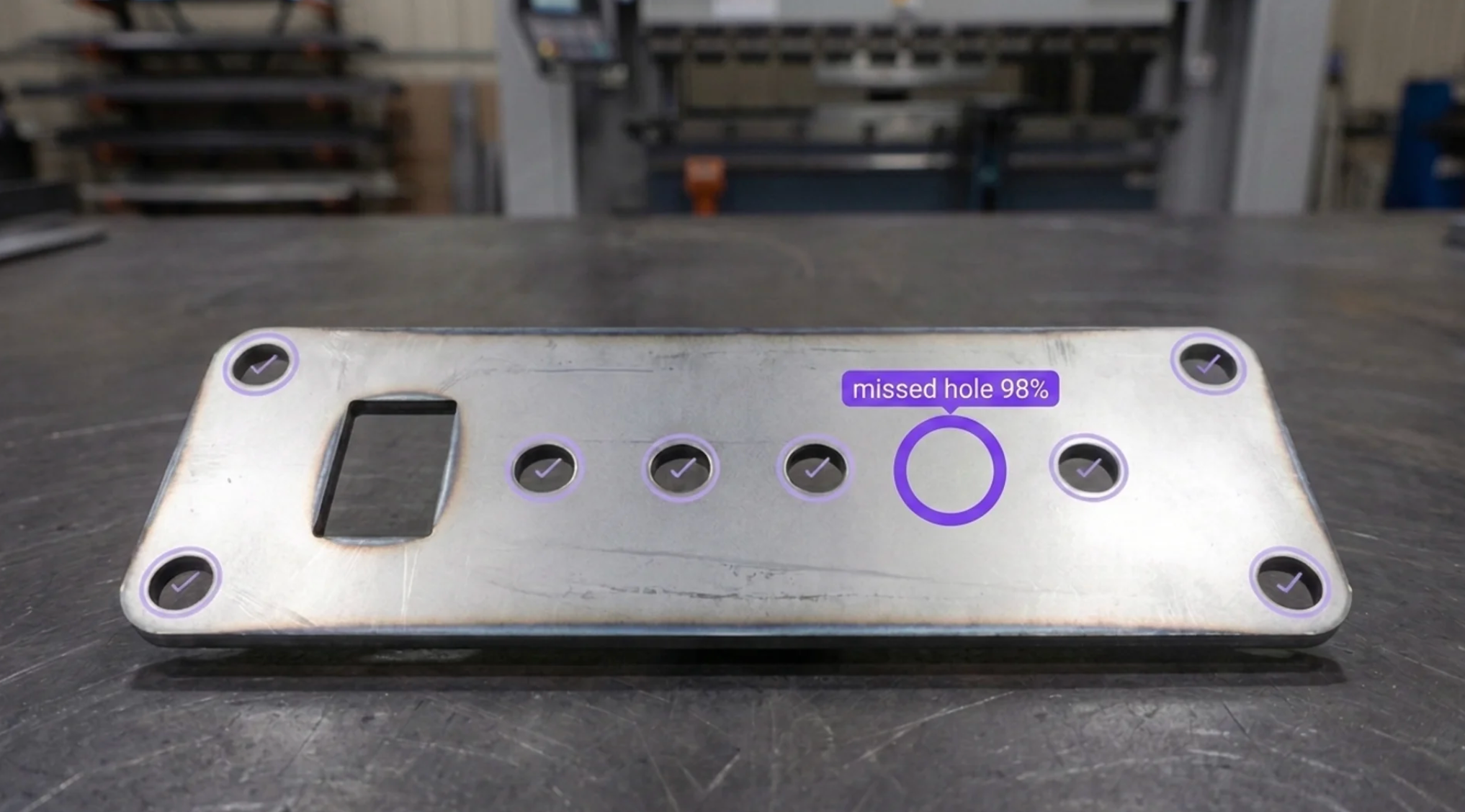
    Add a real-time verification layer to every fabricated part with vision AI for sheet metal missed hole detection. Built for the shops where a turret punch skips one hit and nobody knows until the part is coated, a laser runs yesterday's program on today's revision, or the missing standoff surfaces as a phone call from the customer's assembly line. Whether you're punching, laser cutting, forming, or inserting hardware in a high-mix job shop or a dedicated fabrication line, Roboflow checks every part against its expected feature map, with per-part records behind every job.

    Holes, Cutouts, and Features:

    • Catch missed and missing holes at punch and laser exit, while the fix is a re-run instead of a strip-and-recoat
    • Flag wrong hole sizes and out-of-position features against the part's expected map
    • Verify cutouts, notches, louvers, and embosses are present, plus stuck slugs and slug marks that mean trouble downstream

    Bends, Hardware, and Revisions:

    • Verify bend presence and direction after the brake, catching the flange that went the wrong way
    • Check inserted hardware: PEM nuts, standoffs, and studs present, seated, and the right type
    • Catch wrong-revision parts by their features, so last month's program never ships as this month's part

    Shops, Batches, and Systems Integration:

    • Verify before powder coat and shipping, the two gates where a missed feature turns from minutes into money
    • Onboard new parts from a golden sample or drawing-derived map, built for high-mix shops where every week brings new part numbers
    • Keep per-part and per-job records with imagery, feeding shop MES and ERP through a standard API

    Bring intelligence to every part today. Stop missed features from becoming stripped coatings, returned batches, or a customer's line down over a bracket.

    More About Sheet Metal Missed Hole Detection

    What is sheet metal missed hole detection with Vision AI?

    Sheet metal missed hole detection with vision AI uses computer vision models to verify fabricated parts against their expected features: holes present at the right sizes and positions, cutouts, notches, and formed features in place, bends made in the right direction, and inserted hardware present and correct. Models verify every part at punch, laser, brake, and hardware stations, with per-part records tied to job and revision that support ISO 9001 and customer drawing requirements.

    How does this work in a high-mix shop where every job is different?

    High mix is the hard case: a shop where this week's parts didn't exist last month, and per-part vision programming would cost more than the inspection saves. Expected feature maps get built from a golden first article or derived from the drawing, so a new part number onboards in minutes rather than an integration project, and the model's judgment about what a hole, slug mark, or seated PEM looks like transfers across parts. Uncertain features get flagged for a check instead of guessed, so the first article stays the standard and every part after it gets compared.

    Does verification support ISO 9001 and customer drawing requirements?

    Yes. Roboflow models can run as documented verification controls inside your ISO 9001 quality system and against customer drawing and first-article requirements, with per-part records, imagery, model version history, and training data lineage that support audits, source inspection, and IATF 16949 programs where your fabrication feeds automotive customers. Roboflow is the verification engine; your quality team owns the drawings and acceptance rules.

    Can it integrate with our punches, lasers, brakes, and shop MES?

    Yes. Roboflow Inference exposes a standard API and supports common industrial protocols, so verification events flow into your existing systems: machine and cell PLCs from Allen-Bradley and Siemens, shop MES and job tracking, and ERP platforms like SAP and Oracle, through REST, MQTT, OPC UA, and direct database writes. Machine-level integration flags a failed part before it leaves the station, and every event carries part, job, revision, station, and imagery, with a full audit trail behind every batch.

    Stay Connected

    Get the Latest in Computer Vision First

    Thank you for subscribing!
    Oops! Something went wrong!.
    Unsubscribe at any time. Review our Privacy Policy.

    Additional resources

    Vision AI is transforming every industry. Let’s transform yours.