Computer Vision in Oil and Gas
Watch every flare, gauge, tank, and right-of-way, from the wellsite to the refinery, without driving out to look.
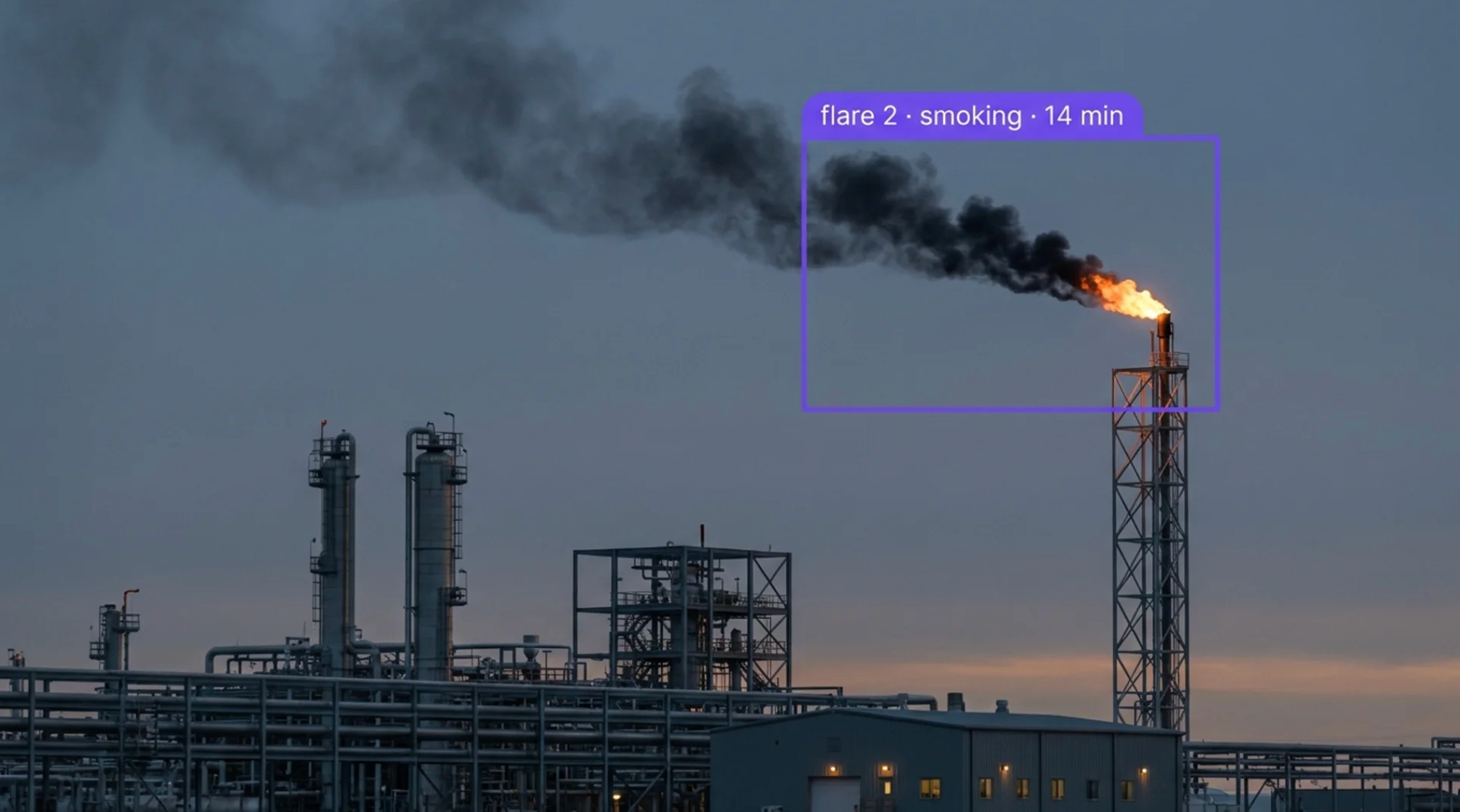
Computer Vision in Oil and Gas Across Upstream, Midstream, Downstream, and Offshore
Deploy Anywhere, Run Everywhere
Run oil and gas vision on the cameras your sites already have and edge devices at the pad, the station, and the plant, on-prem, air-gapped, in your VPC, or via API, on the power and connectivity remote sites actually have.
One Platform, Full Adoption
Tools every operations team can adopt, from pumpers and control room operators to integrity engineers, HSE, and measurement teams, no separate ML team required to ship and own field models.
Secure, Compliant, and Audit-Ready
Data stays safe with SOC 2 Type II compliance, encrypted data, and an uptime SLA, with image-backed event records that support EPA OOOOb monitoring, PHMSA and API integrity programs, and incident investigations.
- Flare Smoke & Pilot Monitoring
- Analog Gauge & Valve Position Reading
- Spill, Sheen & Leak Indicator Detection
- Right-of-Way Encroachment Detection
- Tank, Roof & Containment Monitoring
- PPE, Exclusion Zone & Permit Verification
“Roboflow has been instrumental in accelerating our deployment of innovative AI solutions.”
Travis Turnbull
Vice President & CIO, Pella Corporation
Talk to a Vision AI engineer who's shipped vision on producing assets.
Bring us your toughest oil and gas vision problem and we'll map a working solution.
Ask us about:
- Solution architecture for upstream wellsites and rigs, midstream pipelines, compressor stations, and terminals, refineries and gas plants, and offshore platforms, alongside existing SCADA, OGI, and leak detection
- Live demo on your site camera, drone, or OGI footage, or the problem, flares, gauges, spills, or rights-of-way, that costs your operation the most
- Deployment options: existing cameras and edge devices at the site, Class I Division 2 rated hardware where required, on-prem, air-gapped, or VPC, with integration into SCADA, historians, and CMMS
- ROI modeling against emissions events and OOOOb monitoring costs, pumper routes and windshield time, line strikes and right-of-way patrols, spill response, and unplanned downtime
Over 16,000 organizations build with Roboflow.
- Rivian
- Pella
- Chobani
- USG Corporation
- BNSF Railway
- American Woodmark
Vision AI is transforming businesses
Customers across the board are solving complex challenges and driving meaningful impact.
- Automotive customer
$10 million
Saved by automatically detecting defects on the production line
- Logistics & freight company
90%
Less time spent manually tracking shipping inventory
- Building materials supplier
60%
Lower customer return rate with improved product quality
Watch the Flares, Read the Gauges, and Guard the Rights-of-Way, with Vision AI
Roboflow reads the fixed cameras, thermal and OGI cameras, drones, and aerial imagery you already have, watches the flares, the gauges, the tanks, the rights-of-way, and the people, and turns the field into data, in real time and at remote-site scale.
Wellsites, Flares, and Emissions:
- Monitor flare state, smoking, pilot-out, and abnormal combustion from existing cameras, so a smoking flare is an alert in minutes rather than a complaint from the neighbors
- Read analog gauges, level indicators, and valve positions on cameras at unmanned sites, so the pumper's route is driven by exceptions rather than by the calendar
- Detect liquid spills, sheens, and leaks at pads, containments, and load-out points, and pair with OGI and thermal cameras for methane and hydrocarbon plume detection under EPA OOOOb monitoring programs
Pipelines, Tanks, and Integrity:
- Detect excavators, drilling rigs, and unauthorized activity on pipeline rights-of-way from aerial, drone, and fixed imagery, so a third-party strike is prevented rather than reported
- Monitor tank farms for external floating roof condition, level anomalies, containment integrity, and overfill events, with imagery behind every alarm
- Detect corrosion, coating failure, and staining on piping, vessels, and structures from drone and walkdown imagery, feeding integrity programs under API 570, 653, and 510
Safety, People, and Systems Integration:
- Verify PPE and flame-resistant clothing at site access, detect people in exclusion zones around wellheads, cranes, and live flanges, and monitor lone workers at remote sites
- Verify permit-to-work conditions on camera, attendants at confined spaces, barriers at hot work, and vehicle positioning at load-out, supporting OSHA and process safety programs
- Push detections and events into SCADA, historians, and control rooms through standard protocols, so a vision alert lands in the same alarm list the operators already watch
Bring intelligence to every site today.
More About Computer Vision in Oil and Gas
What is computer vision in oil and gas?
Computer vision in oil and gas uses the cameras the industry already deploys, fixed site cameras, thermal and optical gas imaging cameras, drones, and aerial and satellite imagery, with deep-learning models trained for field conditions to monitor what operators care about: flare state and combustion quality, analog gauges and valve positions at unmanned sites, spills and leaks, right-of-way encroachment, tank and containment condition, corrosion and integrity indicators, and people and PPE around hazardous work. Detections flow into SCADA, historians, and control room alarm systems, so vision becomes another instrument on the site rather than another screen to watch. Learn more about corrosion detection for integrity findings, PPE detection and safety zone monitoring for people around hazards, and predictive maintenance for equipment condition.
Does this work at remote, unmanned sites with poor connectivity?
Yes. Inference runs at the edge on a small industrial computer at the site, on solar-and-battery power budgets where needed, so detection does not depend on a backhaul: the model watches locally, and only events, readings, and their images travel over the satellite, cellular, or radio link the site has. A gauge reading is a few bytes; a flare alert carries one frame. Cameras and enclosures are chosen for the environment, Class I Division 2 rated where classification requires it, heated housings for winter, and models are trained on your sites' actual footage, so heat shimmer over a pad in August and a snow-covered wellhead in January are training data rather than false alarms. When the link is down, events queue and sync when it returns.
Can it integrate with our SCADA, historians, and control room?
Yes. Roboflow Inference runs at the edge on site and exposes a standard API and the protocols operations already use, so vision events land in the systems operators already watch: SCADA platforms from Emerson, Honeywell, ABB, and AVEVA, historians like AVEVA PI, alarm management and control room displays, CMMS and integrity systems like SAP PM and IBM Maximo, pipeline control and leak detection systems, and field data capture tools, through REST, MQTT, OPC UA, Modbus, discrete I/O, and direct database writes. A smoking flare becomes an alarm with a frame attached, a gauge reading becomes a historian tag, an encroachment becomes a one-call ticket with coordinates, and every event carries site, asset, timestamp, class, reading or measurement, and imagery, with a full record behind every alarm and every report.