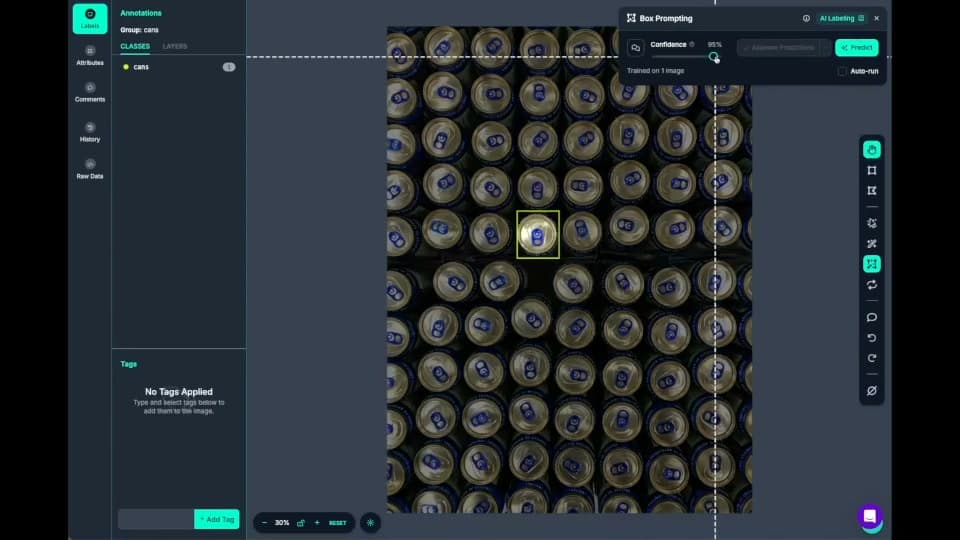
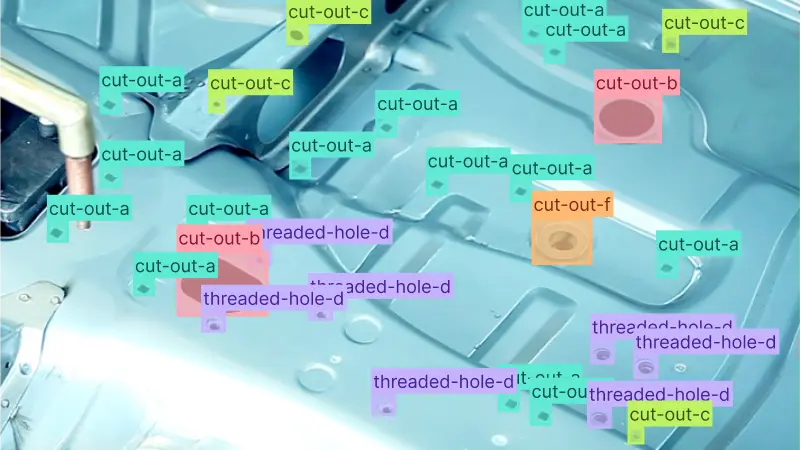
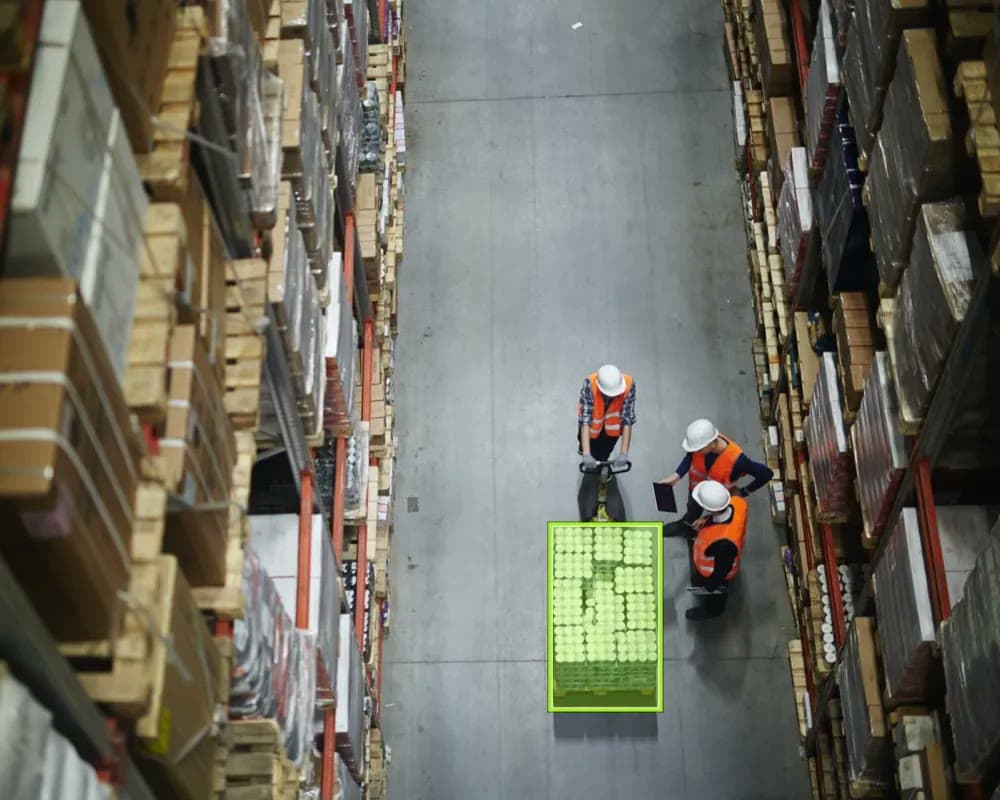
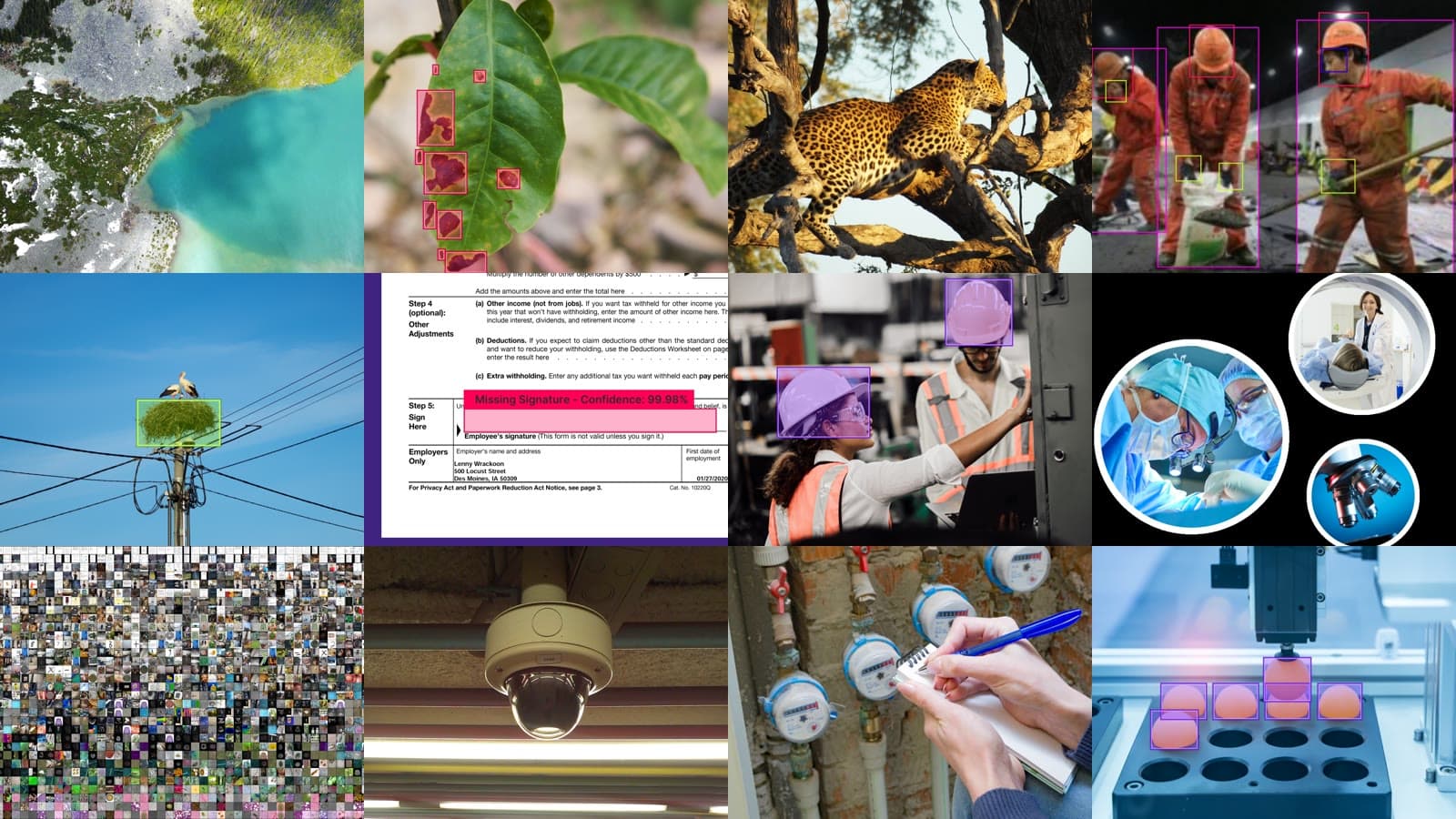
Label Studio is an open-source labeling tool from HumanSignal that covers images, text, audio, video, and time series, with an Enterprise edition that adds automation, quality metrics, and compliance. Label Studio does not train or host models: you run your own model server as an ML backend and wire it in. Teams that want to go from raw images to a deployed model in one place often choose Roboflow. Roboflow includes labeling, dataset management, model training, hosted inference, and edge deployment, so engineers can sign up, label with foundation models, train, and ship without stitching together separate systems. Teams pick Roboflow because the whole loop, from the first annotation to the production model, lives in one platform they can iterate on every day.
Label Studio vs Roboflow Annotate: feature by feature
Both tools cover the core vision tasks: object detection, instance segmentation, keypoints, and classification. They differ in automation, dataset tooling, and what happens after the labels are done.
The key differences
Label Studio is a flexible, open-source tool that reaches well beyond vision into audio, text, and time series, with SSO and role-based access in its paid editions. Roboflow Annotate covers the same vision tasks and adds dataset analytics, annotation history, semantic search, image augmentation, and AI label assistants built in, then carries the labeled data into model training, deployment, and an interactive app builder on the same platform.
- Ease of use: Roboflow Annotate is ready to go in the browser with instant AI labeling. Label Studio is more configurable, and the advanced features take technical setup or a paid plan.
- Automation: Roboflow's Auto Label and Label Assist speed up annotation and model iteration out of the box. Label Studio relies on an ML backend you host yourself, and automated pre-labeling is reserved for Starter Cloud and Enterprise.
- End-to-end integration: Roboflow runs from annotation to training to deployment. Label Studio focuses on annotation and hands off to other tools for training and deployment.
- Collaboration and QA: Both support team review. Roboflow's real-time collaboration and integrated approval flow keep QA inside the same tool as labeling and training.
Label Studio fits teams that want a customizable open-source annotation tool across many data types. Roboflow Annotate fits teams that want fast, automated labeling that feeds directly into integrated vision workflows, so even people without an ML background can go from data to deployed model.
Roboflow
End-to-end computer vision platform (annotate, train, deploy)
Label Studio
Open-source data labeling and AI evaluation platform with an enterprise edition (HumanSignal)
Scale & Ecosystem
Roboflow
- 2,000,000+ developers on the platform
- 1,000,000+ public datasets on Roboflow Universe
- 100,000+ pre-trained models hosted publicly
- 25,000+ organizations building with the platform, including more than half of the Fortune 100 (publicly cited: Rivian, Chobani, USG, Pella)
- Self-serve sign-up; teams can begin annotating, training, and deploying without a services contract
Label Studio
- Total disclosed funding of approximately $30M; latest priced round is a $25M Series A led by Redpoint Ventures in May 2022, with no later round announced
- Roughly 28,000 GitHub stars on the Apache-2.0 label-studio repository; company cites 250,000 to 500,000+ open-source users and a 20,000-member Slack community
- Logos shown on labelstud.io include Cloudflare, NVIDIA, Meta, IBM, and Intel, presented as users of the open-source tool rather than named Enterprise customers
- Acquired Erud AI in November 2025 to launch managed multimodal data services alongside the software
- No public catalog of community-contributed datasets or pre-trained models comparable to Roboflow Universe
Product Capabilities (Computer Vision)
Roboflow
- End-to-end platform: dataset management, annotation, model training, hosted inference, and deployment
- Auto Label uses foundation models (GPT-6 Astra, Gemini) to label images for classes you define in a text prompt; label 1,000 images in under ten minutes
- Label Assist pre-annotates new images with your own trained models, and Smart Polygon creates one-click polygon annotations powered by Meta AI's Segment Anything
- Native support for object detection, instance and semantic segmentation, image classification, keypoint detection, OCR, depth estimation, and multimodal tasks
- Roboflow Workflows for chaining detection, classification, OCR, and business logic into a single pipeline
- Active model registry covering RF-DETR, YOLO (v8 / v11 / v26), Detectron2, and other current architectures
Label Studio
- Multi-type labeling across images, audio, text, HTML, time series, video, PDFs, and LLM/agent traces; CV templates cover bounding boxes, ellipses, polygons, brush masks, keypoints, OCR, and video object tracking
- No 3D or point-cloud annotation; an open feature request for LiDAR support (April 2026) has no maintainer commitment
- AI-assisted labeling runs through an external ML backend that you host yourself (example backends include SAM, SAM 2, YOLO, and Grounding DINO); automated pre-labeling and active-learning loops are Enterprise-only
- Documentation states that Label Studio itself does not train or host models; there is no native training, hosted inference, deployment layer, or model registry
- 2025 to 2026 roadmap centers on LLM evaluation, LLM-as-judge, and agent observability rather than CV training or deployment
Developer Experience
Roboflow
- Open-source supervision library - model-agnostic utilities for detections, tracking, annotation, and evaluation
- Open-source inference server - self-hostable HTTP inference for custom and foundation models
- Native integrations with Hugging Face Transformers, MMDetection, and the broader open-source CV stack
- Python SDK plus REST/HTTP APIs; standardized I/O lets teams swap model weights without changing application code
Label Studio
- Open-source Python SDK (label-studio-sdk) and REST API for projects, tasks, and annotations
- Open-source label-studio-ml-backend SDK for wrapping your own model as a prediction server, plus a converter for exports
- Exports to JSON, CSV, COCO, YOLO, Pascal VOC, and brush masks as NumPy or PNG
- Community edition self-hosts via Docker or pip; Enterprise installs on Kubernetes with Helm and requires PostgreSQL and Redis
- Labeling interfaces are defined in XML configs; no comparable open-source CV utility library or self-hostable inference server
Enterprise & Security
Roboflow
- SOC 2 Type II compliant
- HIPAA-compliant infrastructure with BAAs available
- PCI DSS (SAQ A and AOC) compliance
- Deployment options: managed cloud, customer VPC, on-premises, and fully air-gapped / offline (Docker-based) for firewalled environments
- Training and inference can run on customer-owned bare metal or in the customer's own cloud account
Label Studio
- SOC 2 Type 2 and HIPAA compliance apply to Label Studio Enterprise
- ISO 27001, GDPR, and PCI DSS are not documented on the HumanSignal security page
- Deployment options: hosted SaaS (Starter Cloud and Enterprise cloud), on-premises via Kubernetes or Docker, and air-gapped installs for Enterprise; raw data loads from customer cloud storage via pre-signed URLs
- SSO (SAML 2.0 / LDAP), SCIM, RBAC, audit logs, and annotator agreement metrics are Enterprise-only
- Pricing: Community edition free; Starter Cloud $99 per month for up to 12 users; Enterprise and managed Data Services priced by contract
Sources: roboflow.com, docs.roboflow.com, security.roboflow.com, universe.roboflow.com, github.com/roboflow, labelstud.io, humansignal.com, docs.humansignal.com, github.com/HumanSignal, cbinsights.com. Figures reflect publicly available information as of September 2026.